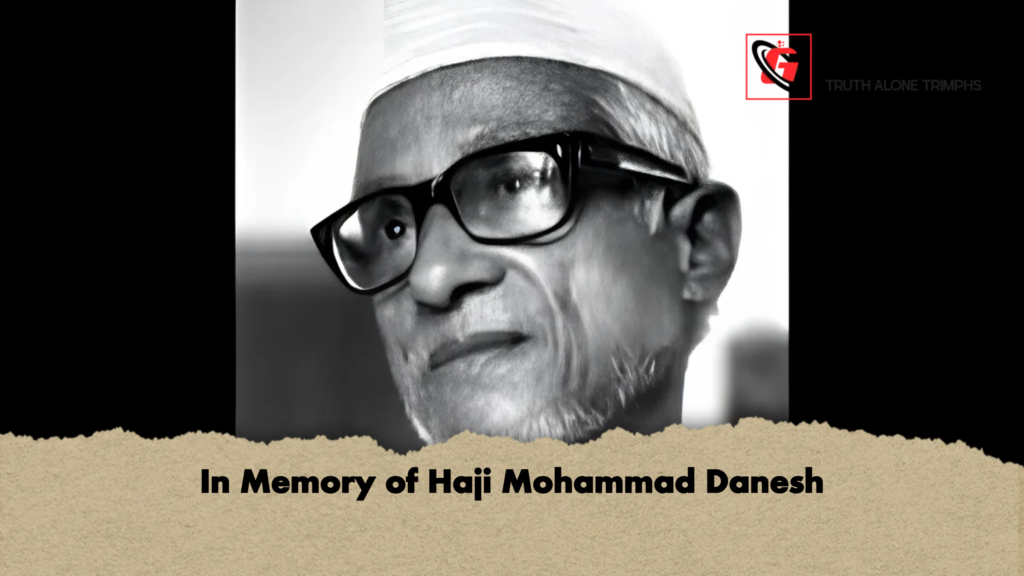
In the history of Bengal’s agrarian struggles, the name of Haji Mohammad Danesh will forever be uttered with profound respect. He was not merely a politician; he was a fearless crusader for the rights of exploited and marginalised peasants, a pioneer of the historic Tebhaga movement, and a true leader of the masses.
Born on 27 June 1900 in Sultanpur village of the Dinajpur district, he exhibited a deep passion for education and social welfare from his childhood. He obtained his MA in History in 1931 and a BL degree in 1932 from the Aligarh Muslim University, subsequently joining the legal profession in Dinajpur. However, the struggles and hardships of the working-class peasantry moved him far more than personal professional success.
Leadership in Agrarian Reform and the Tebhaga Movement
In 1938, he associated himself with the peasant committee of the Bengal Provincial Communist Party and spearheaded the peasant movement in North Bengal. He organised consecutive agitations demanding the abolition of the Zamindari system, an end to illegal toll collections, and the establishment of fair rights for farmers. His defiant activism resulted in frequent arrests and prolonged periods of imprisonment.
He was one of the key organisers of the Bengal Peasant Conference held in Domar, Nilphamari, in 1942. Following the conference, he was detained once again. Undeterred by his release from prison, he mobilised sharecroppers across North Bengal to launch the historic Tebhaga movement, demanding a rightful two-thirds share of the harvest. It was his steadfast leadership during this movement that earned him widespread recognition.
Political Transitions and Constitutional Roles
Although he joined the Muslim League in 1945, his uncompromising stance on peasant rights led to his expulsion from the party in 1946, followed by another spell of incarceration. After his release in 1947, he joined Surendranath College in Dinajpur as a Professor of History. Throughout his career, he maintained absolute integrity across both academia and state politics.
In 1952, he founded the Ganatantri Dal (Democratic Party) and was elected its president. He later aligned with the Jukta Front (United Front) coalition, winning a seat in the East Bengal Legislative Assembly from Dinajpur in the landmark 1954 elections. However, following the arbitrary dissolution of the United Front government, he was jailed once again by the ruling regime.
By 1957, he aligned with Maulana Abdul Hamid Khan Bhashani, joining the National Awami Party (NAP) and securing the position of vice-president. He subsequently served the party in various crucial capacities, including that of general secretary. Despite structural political differences that led him to oppose Sheikh Mujibur Rahman’s Six-Point Programme, he firmly backed the 1921 Liberation War, contributing significantly to the independence struggle from Mujibnagar.
Later Years, Legacy, and Death
Following independence, he founded the Jatiya Ganamukti Union. He later associated with BAKSAL, experimented with new political alignments, and eventually served as the chief advisor to the Jatiya Krishak Party. He remained actively involved in grassroots politics, advocating for the rights of farmers, labourers, and ordinary citizens until his final days.
He breathed his last in Dhaka on 28 June 1986. His ideals, struggles, and personal sacrifices endure as a guiding light in the history of Bengali agrarian movements.
A Triumphant Tribute
Haji Mohammad Danesh demonstrated that politics is not a pursuit of state power, but an instrument for establishing human rights. In the struggle for the emancipation of the oppressed, he remained an uncompromising, fearless, and principled leader. His life and work will continue to inspire future generations to fight for justice, equality, and the rights of the masses.
On his 40th death anniversary, we offer our deepest tribute. We pray for the salvation of his departed soul and reaffirm our commitment to draw inspiration from his exemplary, revolutionary life.