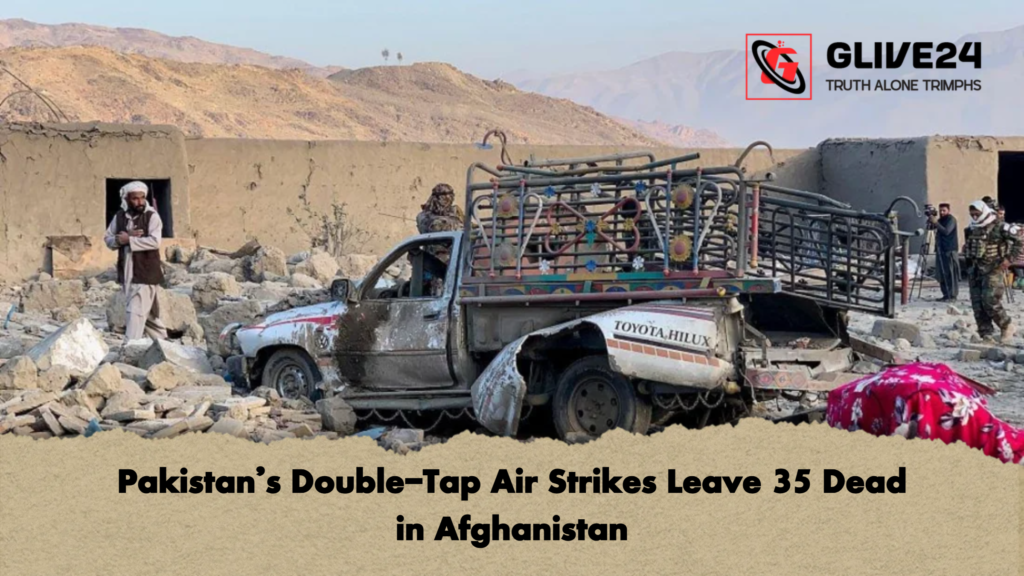
At least 35 civilians, including children and elderly people, have reportedly been killed after Pakistani military aircraft carried out what Afghan authorities described as a “double-tap” bombing campaign in eastern Afghanistan. While Islamabad maintains that the operation targeted militant groups, Afghanistan’s Taliban-led government has condemned the strikes as a grave act of aggression and alleged war crime, insisting that innocent civilians bore the brunt of the attacks.
According to Afghan officials, the air raids began shortly after midnight on Sunday in several districts close to the Pakistan-Afghanistan border. Pakistani warplanes reportedly struck residential areas and mosques in Gayan district of Paktika Province, Chamkani district in Paktia Province, and Marawara district in Kunar Province.
Military analysts use the term “double-tap” to describe a tactic in which a target is struck and then attacked again shortly afterwards, often when rescuers or emergency responders have arrived at the scene. Afghan authorities allege that this was precisely the pattern followed during the latest operation.
Officials said that around 25 minutes after the initial bombardment, local villagers rushed to rescue people trapped beneath collapsed buildings, including women and children whose cries could be heard from the rubble. At that point, Pakistani aircraft allegedly returned and launched a second wave of strikes, hitting the rescue effort. Afghan authorities claim that this second attack significantly increased the death toll, which has risen to at least 35, while more than one hundred injured people, many in critical condition, were admitted to nearby hospitals.
The Taliban government’s chief spokesman, Zabihullah Mujahid, issued a strong condemnation of the air strikes, describing them as a “cowardly act of aggression”. He said the Afghan authorities regarded the attacks as criminal and barbaric, accusing Pakistan of deliberately targeting civilians rather than legitimate military objectives.
Official figures released by the Taliban administration indicate that several of those killed were children aged between four and nine, alongside elderly residents. Videos circulating from hospitals reportedly showed bloodied children receiving emergency treatment, while residents from Chamkani insisted that no militant presence existed in the affected villages and that ordinary civilians had been caught in the bombardment.
Pakistan, however, has presented a markedly different account of the operation. Information Minister Attaullah Tarar said in a post on X that the military action was launched in response to a series of recent terrorist attacks inside Pakistan, including incidents in Khyber Pakhtunkhwa, Balochistan and an attack on a Rangers camp in Karachi.
According to the Pakistani government, intelligence-led ground and precision air operations targeted hideouts belonging to the banned Jamaat-ul-Ahrar organisation and a group it referred to as “Fitna al Khawarij”. Islamabad claimed that 29 militants were killed during the operation.
Pakistan has repeatedly accused the Tehreek-e-Taliban Pakistan (TTP) of using Afghan territory as a base from which to organise and launch attacks inside Pakistan. Kabul has consistently rejected those allegations, insisting that it does not permit its territory to be used against neighbouring countries. The issue has remained one of the most contentious points in relations between the two countries since the Taliban returned to power in Afghanistan.
The latest cross-border strikes come at a time when Pakistan is also facing several significant domestic and political challenges. Following last week’s attack on a Rangers facility in Karachi, Interior Minister Mohsin Naqvi alleged that “Indian proxies” were involved, an accusation that New Delhi dismissed as entirely baseless.
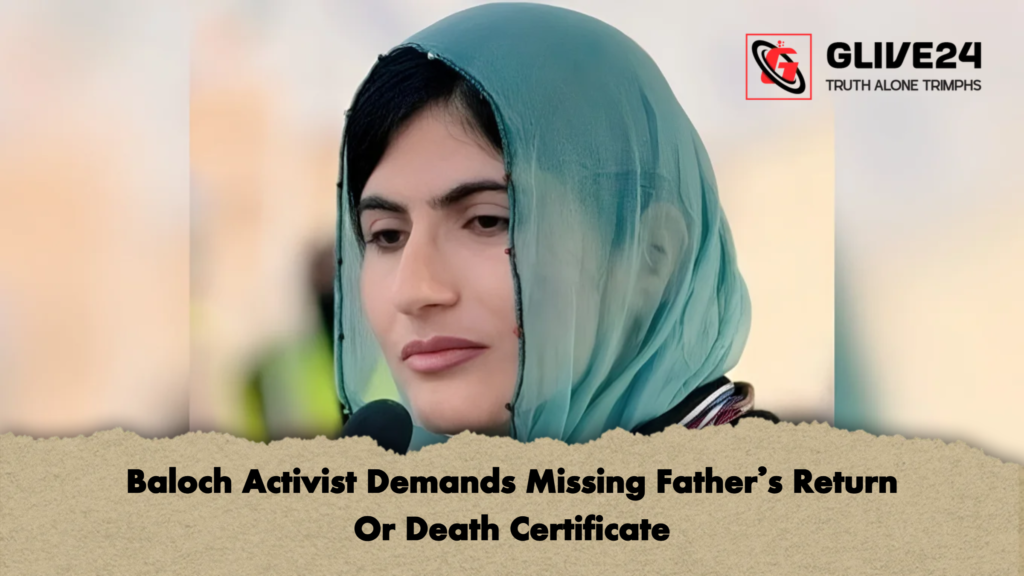
In another development, an anti-terrorism court in Balochistan sentenced prominent human rights campaigner Mahrang Baloch to life imprisonment over the killing of a paramilitary soldier during a protest held in 2024. International human rights organisations have criticised the verdict, arguing that it represents political retaliation and an attempt to silence dissent.
Pakistan has also faced criticism after one of the country’s largest television broadcasters, Geo News, was temporarily taken off air over allegations that its programming had offended religious sentiments, adding to concerns about press freedom and the country’s increasingly tense political environment.
The conflicting narratives surrounding the latest air strikes are likely to deepen already strained relations between Pakistan and Afghanistan, with civilian casualties expected to remain at the centre of international scrutiny as calls grow for an independe