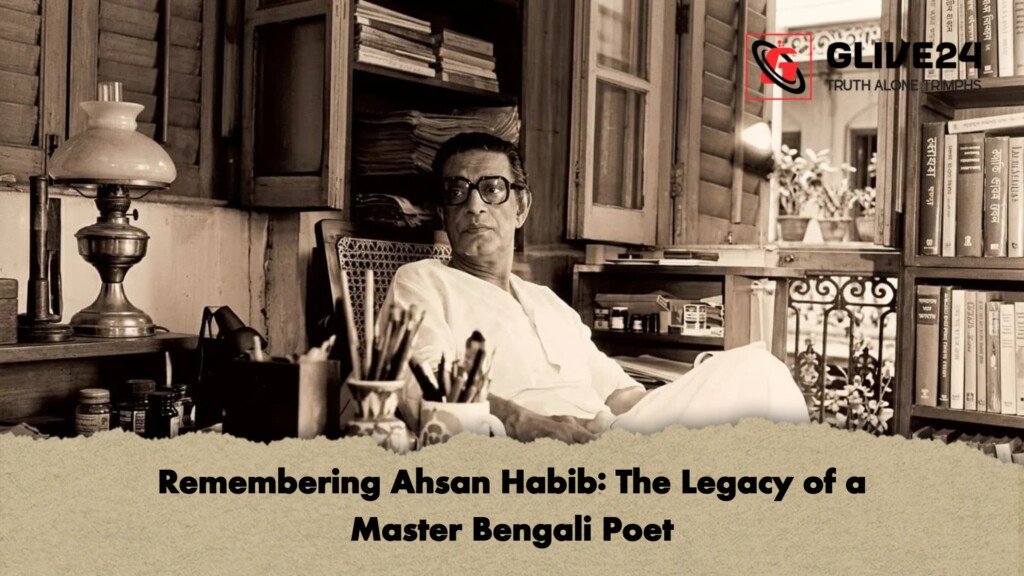
Ahsan Habib remains a towering figure in modern Bengali literature, celebrated for his profound humanism and distinct poetic voice. Born on 2 January 1917 in the village of Shankarpasha under Pirojpur district, Habib grew up surrounded by a vibrant cultural atmosphere. This early exposure to literature deeply influenced his young mind, sparking a lifelong passion for writing. He began composing verses at an early age, displaying a natural gift for language that would eventually shape the course of twentieth-century Bengali poetry.
His academic journey faced severe interruptions. After successfully passing his entrance examinations from Pirojpur Government School in 1935, Habib enrolled at the prestigious Brojomohun (BM) College in Barisal. However, crippling poverty cut his higher education short. Forced to abandon his studies after just a year and a half, he moved to Kolkata in late 1936 in search of a livelihood.
The Kolkata years were defined by absolute hardship. Habib faced extreme destitution, often spending nights on public pavements without food. In one poignant instance, unable to pay his bill at a local eatery, he had to offer his scarf as collateral. Despite these bleak circumstances, he refused to let adversity break his spirit, channeling his personal struggles into creative energy.
His professional breakthrough came in 1937 when he joined the Daily Takbeer as an assistant editor on a modest monthly salary of 17 rupees. This marked the beginning of an illustrious career in journalism and broadcasting. He went on to work for influential literary journals like Bulbul and Saugat. Later, he secured a position as a staff artist for the Kolkata centre of All India Radio (Akashvani).
Following the partition of the subcontinent and the eventual independence of Bangladesh in 1971, Habib became the long-standing literary editor of the prominent newspaper Dainik Bangla. In this role, he was much more than a journalist; he served as a benevolent guardian to a whole generation of post-independence writers. His mentorship, constructive criticism, and enduring warmth guided countless young talents into the literary mainstream.
Habib’s creative footprint spans poetry, novels, essays, and children’s literature. Over his lifetime, he published around twenty-five books, including seminal poetry collections like R रात्रिshesh (The End of Night), Chhaya Harin (The Shadow Deer), and Ashay Basati (Living in Hope). His verses captured the rustic beauty of Bengal alongside the urban anxieties of ordinary people. For his monumental contributions to Bengali letters, he was honoured with the Ekushey Padak in 1978 and Bangladesh’s highest civilian award, the Independence Award, posthumously in 1988.
His creative legacy continues through his children. His son, Moinul Ahsan Saber, is a highly regarded contemporary novelist and publisher, whilst his daughter, Keya Chowdhury, is a well-known actress and presenter. Ahsan Habib passed away on 10 July 1985, but his elegant language, social consciousness, and poetic vision continue to inspire the cultural landscape of Bengal.