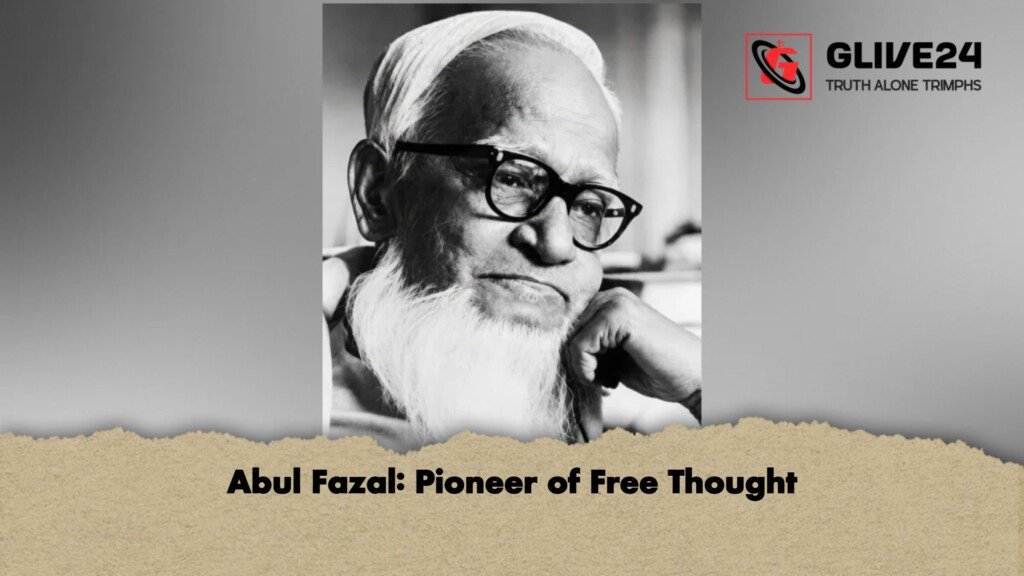
“Where knowledge is limited, intellect is constrained; where intellect is constrained, freedom is impossible.” These timeless words continue to define the intellectual legacy of Abul Fazal, one of the foremost champions of free thought, secular humanism and modern Bengali literature. A distinguished educationist, essayist, novelist, social thinker and progressive intellectual, Fazal devoted his life to the pursuit of knowledge and the advancement of a rational, enlightened society.
Born on 17 July 1903 in Keochia village of Satkania, Chattogram, Abul Fazal emerged as one of the most influential literary and intellectual figures of twentieth-century Bengal. His father, Maulvi Fazlur Rahman, served as the Imam of Chattogram Juma Mosque. Although Fazal began his education in a madrasa, he later pursued higher studies with remarkable success. He earned his Bachelor of Arts degree from the University of Dhaka in 1928, completed a Bachelor of Teaching qualification at the Dhaka Teachers’ Training College in 1931, and obtained a Master’s degree in Bengali Language and Literature from the University of Calcutta in 1940.
His professional life began in religious service as an imam before he transitioned into academia. In 1941, he joined Krishnanagar College as a lecturer in the Department of Bengali. Two years later, he was transferred to Chattogram College, where he spent much of his academic career and eventually retired as a professor in 1956.
Abul Fazal later assumed one of the country’s most significant academic leadership roles when he became Vice-Chancellor of the University of Chittagong in 1973. In 1975, he also served as a member of the Bangladesh Government’s Advisory Council on Education and Culture, contributing to national policy during a formative period in the country’s history.
During his years at the University of Dhaka, Fazal became actively involved in the Muslim Sahitya Samaj (Muslim Literary Society), a pioneering organisation established to promote intellectual freedom and challenge superstition, dogmatism and blind conformity. He was elected its secretary in 1930. Through the society’s literary journal, Shikha, emerged the celebrated Movement for Intellectual Freedom, whose enduring motto declared:
“Where knowledge is limited, intellect is constrained; where intellect is constrained, freedom is impossible.”
This philosophy became the foundation of Abul Fazal’s literary and intellectual pursuits. Throughout his career, his writings consistently championed reason, humanism, truth, patriotism, secular values and social justice. His work reflected a firm belief that education and critical thinking were indispensable to both individual and national progress.
Fazal was also recognised for his moral courage. At moments of national importance, he spoke openly in defence of truth and cultural identity. In 1967, when the Pakistani authorities imposed restrictions on the broadcasting of Rabindra Sangeet, he publicly opposed the decision, demonstrating his unwavering commitment to the Bengali language, literature and cultural heritage. His principled stance earned him lasting respect as one of the leading voices of progressive thought in Bengal.
His literary achievements extended across multiple genres, including novels, short stories, essays, drama, autobiography, religious writings and travel literature. Among his most notable works are Chauchir, Prodip O Patanga, Matir Prithibi, Bichitra Katha, Ranga Probhat, Rekhachitra and Durdiner Dinlipi. Collectively, these works established him as one of the most versatile contributors to modern Bengali literature.
His outstanding contributions received widespread recognition. Abul Fazal was awarded the Bangla Academy Literary Award in 1962, the President’s National Literary Award in 1963, the Adamjee Literary Award in 1966, the Nasiruddin Gold Medal in 1980, the Muktadhara Literary Award in 1981, and the Abdul Hai Literary Medal in 1982. In 1974, the University of Dhaka conferred upon him an honorary doctorate in recognition of his exceptional service to literature, education and intellectual life.
Abul Fazal passed away in Chattogram on 4 May 1983, bringing to an end an extraordinary life dedicated to scholarship, literature and public service. Yet his influence has endured well beyond his lifetime. His writings, ideas and unwavering commitment to intellectual freedom continue to inspire readers, scholars and advocates of progressive thought across Bangladesh and the wider Bengali-speaking world.
On the anniversary of his birth, Abul Fazal is remembered not only as a distinguished literary figure but also as a fearless advocate of enlightenment and rational inquiry. His enduring message—that genuine freedom can only flourish where knowledge is encouraged and critical thinking is nurtured—remains as relevant today as it was during his lifetime, ensuring that his legacy continues to illuminate generations to come.