
Khabor Wala Desk
Published: 20th July 2026, 8:32 PM
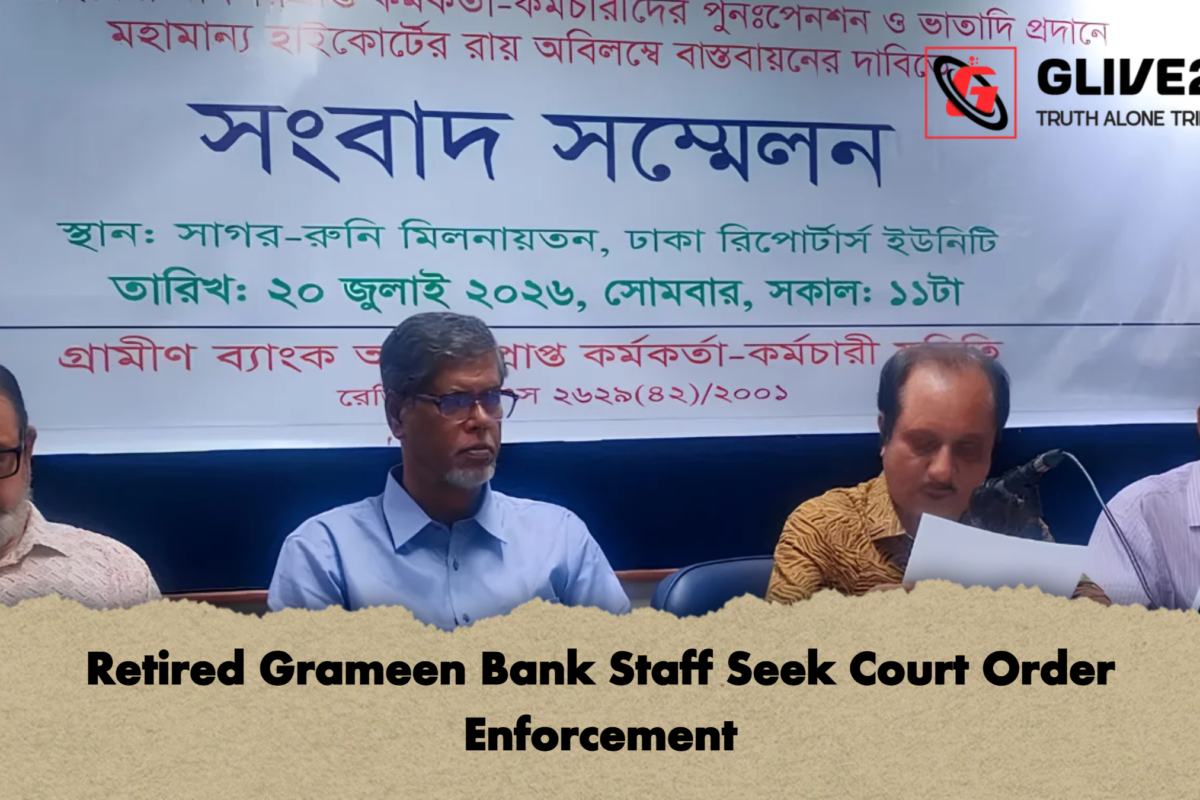
Thousands of retired employees of Grameen Bank have accused the bank’s management of failing to implement a landmark High Court judgement, leaving around 14,000 retired officers, employees and their families facing prolonged financial hardship and growing uncertainty.
The allegations were made on Monday (20 July) during a press conference organised by the Grameen Bank Retired Officers and Employees Association at the Sagar-Runi Auditorium of the Dhaka Reporters Unity (DRU). Speakers at the event urged the government and relevant authorities to intervene without delay to ensure the immediate enforcement of the court’s ruling.
Presenting the association’s written statement, its central president, K M Shahidul Haque, said Grameen Bank was established under the Grameen Bank Ordinance of 1983 as a statutory state institution. As such, he argued, the benefits and allowances announced by the government for employees of state-owned and statutory organisations should legally apply to Grameen Bank staff as well. He claimed, however, that employees of the institution had been deprived of those benefits for many years.
According to the statement, retired employees filed two separate writ petitions (Nos. 9526/2021 and 6765/2021) before the High Court in pursuit of what they described as their lawful entitlements. After lengthy hearings, the court delivered its judgement in their favour on 19 March 2024, while the full written verdict was published on 22 June 2026.
The detailed judgement directed Grameen Bank authorities to immediately reinstate post-retirement pension benefits and pay all outstanding festival allowances, medical allowances and Bengali New Year allowances owed to retired officers and employees.
In its observations, the High Court stated that, as a recognised statutory institution, Grameen Bank must extend any financial incentives or employment-related benefits announced by the government to its officers and employees without discrimination.
Expressing frustration over the delay, Shahidul Haque said that all other state-owned banks and statutory organisations had already implemented the Ministry of Finance directives regarding festival and medical allowances introduced in 2004, as well as the re-pension policy announced in 2018. He questioned why Grameen Bank had yet to follow the same directives, despite the legal framework and subsequent court ruling.
He also alleged that a controversial voluntary retirement programme introduced in 1994 had forced many employees into early retirement against their wishes, contributing to years of financial disadvantage for those affected.
Association leaders claimed that nearly a month had passed since publication of the full High Court judgement, yet the bank administration had taken no meaningful steps towards implementation. They alleged that administrative complications and financial constraints were being cited as reasons for the continued delay, while many retired employees were struggling to meet essential living expenses and afford necessary medical treatment.
The association warned that if the court’s directives were not implemented promptly, retired employees would consider pursuing stronger legal and organisational measures to secure their rights.
Among those attending the press conference were the association’s Vice-President Habibul Islam, Adviser Golam Mawla, Secretary-General Advocate Siddiqur Rahman, Finance Secretary Abu Mohammad Matiur Rahman, along with retired officers and employees from different parts of the country. They collectively called for the immediate execution of the High Court’s verdict, arguing that doing so would restore the lawful benefits of thousands of retired Grameen Bank employees and provide much-needed financial relief to their families.




Comments