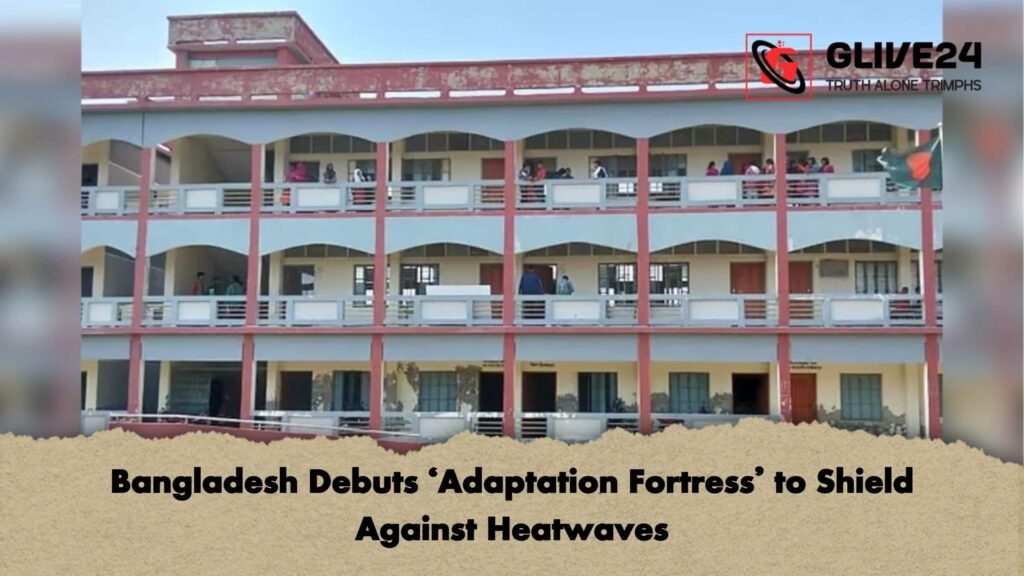
In a significant evolution of disaster management, Bangladesh has commenced the construction of its inaugural ‘Adaptation Fortress’. Located at the Bardal Aftab Uddin Collegiate School in Ashashuni, Satkhira, this facility represents a paradigm shift: a shelter designed to protect the populace not only from the fury of cyclones and tidal surges but also from the silent, increasingly lethal threat of extreme heatwaves.
Transforming Infrastructure for a Warming World
The project is a collaborative masterpiece involving the Jameel Observatory Climate Resilience Early Warning System Network (Jameel Observatory CreWNSnet)—a joint initiative between the Massachusetts Institute of Technology (MIT) and Community Jameel—alongside the renowned development organisation BRAC.
The concept revolves around the sophisticated retrofitting of existing schools and cyclone centres. By integrating advanced thermal engineering, these buildings are converted into “cool havens.” Even in the event of a total power grid collapse, the fortress remains operational through an independent solar-powered cooling system and high-capacity battery storage.
Core Capabilities of the Adaptation Fortress
| Capability | Technical Implementation |
| Thermal Regulation | Passive cooling design to mitigate ‘Urban Heat Island’ effects. |
| Renewable Power | Solar arrays provide off-grid electricity for fans and cooling. |
| Resource Sharing | Excess solar energy is distributed to the local community. |
| Water Resilience | Rainwater harvesting to combat coastal salinity and drought. |
| Community Hub | Serves as a school and climate-education centre year-round. |
A Blueprint for South Asian Resilience
The Satkhira pilot is the first step in an ambitious regional strategy. With a second site already confirmed at Satbaria High School in Jessore, the ultimate goal is the deployment of 1,250 fortresses. Such a network would provide a thermal safety net for an estimated 500,000 residents across the country’s most vulnerable zones.
Mohammed Abdul Latif Jameel KBE, Chairman of Community Jameel, remarked that the fortress is a vital milestone in proactive disaster response. As global temperatures rise, heat-related fatalities are projected to soar; this infrastructure seeks to decouple extreme weather from human tragedy.
Professor Elfatih Eltahir, Lead Investigator at MIT, highlighted that while cyclone shelters have long been a staple of Bangladeshi resilience, the inclusion of heatwave protection is a world-first for the region. Deborah Campbell, Executive Director of the Jameel Observatory, added that this project establishes a scalable model for climate-resilient infrastructure that could eventually be adopted across the entire South Asian subcontinent.
By turning existing buildings into high-tech sanctuaries, the Adaptation Fortress ensures that the most at-risk communities have the tools to survive an increasingly volatile climate.