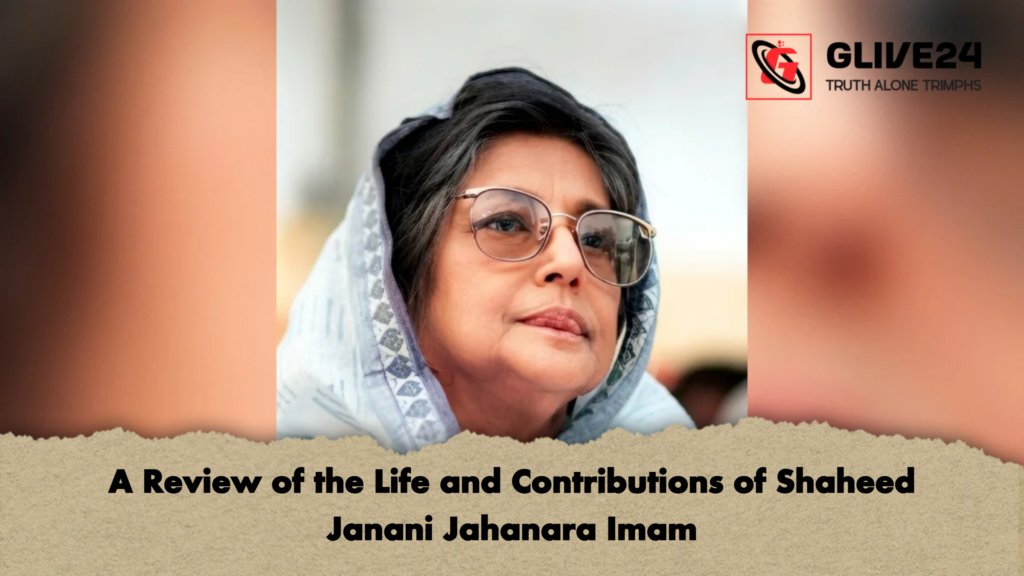
Jahanara Imam was a prominent Bangladeshi writer, educator, and activist whose life and work are closely associated with the country’s Liberation War of 1971 and its aftermath. She is widely recognised for her literary contribution, particularly her memoir documenting wartime experiences, as well as her role in advocating for justice related to war crimes committed during the conflict.
Born on 3 May 1929 in Murshidabad into a conservative Muslim family, Jahanara Imam pursued her education with distinction and developed progressive intellectual and humanistic values over time. She completed her undergraduate studies at Lady Brabourne College in Kolkata. She later undertook higher studies at the University of Dhaka and also pursued further education in the United States.
Her professional career began in teaching, which remained a central part of her early life. She worked in various educational institutions in Mymensingh and Dhaka, where she was involved in teaching and academic development. Through her teaching career, she contributed to the education of multiple generations of students.
Her literary work gained significant recognition, particularly her memoir Ekattorer Dinguli (“The Days of Seventy-One”), which provides a first-hand account of the events and experiences of the 1971 Liberation War. The book is regarded as an important historical document, recording personal and societal experiences during the conflict.
The 1971 Liberation War had a profound impact on her life. Her eldest son, Shafi Imam Rumi, participated in the liberation struggle as a guerrilla fighter. He was involved in several successful operations before being detained by the Pakistani armed forces. He later died in custody following torture. This event became a defining moment in her personal history and influenced her subsequent public engagement.
Following the war, Jahanara Imam became actively involved in movements demanding justice for war crimes committed during the conflict. She played a leading role in the formation and activities of the Ghatak-Dalal Nirmul Committee, an organisation established to demand the trial of individuals accused of collaborating with the Pakistani military in 1971.
She passed away on 26 June 1994 in Detroit, United States, while undergoing medical treatment.
Key Biographical Timeline
| Year | Event |
|---|---|
| 1929 | Born in Murshidabad, British India |
| 1940s | Studied at Lady Brabourne College, Kolkata |
| 1950s | Undertook higher studies at the University of Dhaka and in the United States |
| 1960s–1970 | Worked as an the teacher and academic in Mymensingh and Dhaka |
| 1971 | Son Shafi Imam Rumi participated in Liberation War and later died in custody |
| 1972 | Published Ekattorer Dinguli |
| 1990s | Led activities related to the Ghatak-Dalal Nirmul Committee |
| 1994 | Died in Detroit, United States |
Jahanara Imam’s contributions encompass literature, education, and civic activism. Her memoir remains a significant source for understanding the lived experiences of the 1971 Liberation War, while her later public role placed her at the centre of discussions on historical accountability in Bangladesh.