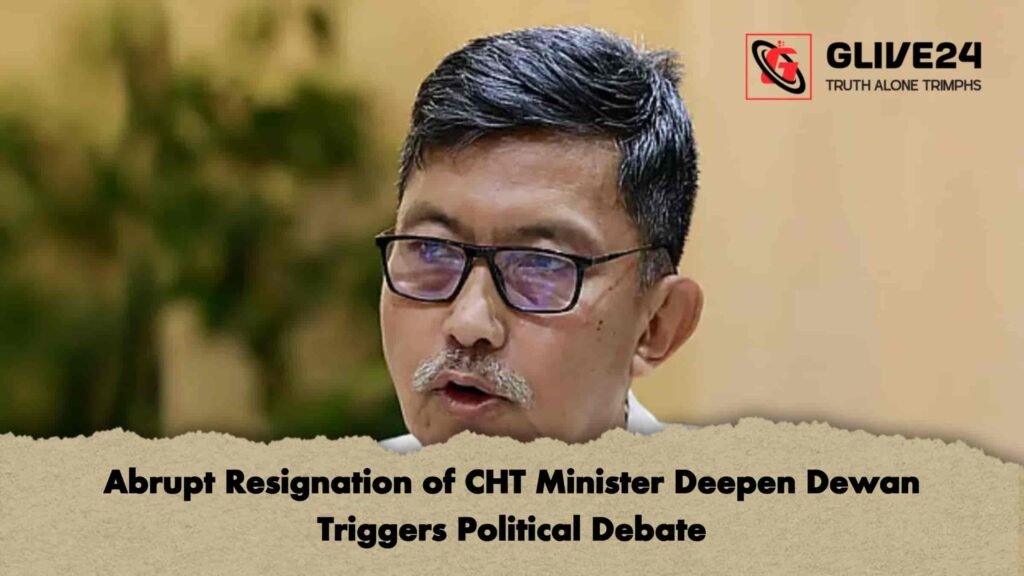
The Minister for Chittagong Hill Tracts (CHT) Affairs, Deepen Dewan, tendered his resignation on Monday, 1 June 2026, marking the first official working day following the Eid-ul-Azha holidays. The resignation letter, submitted to the Prime Minister’s Office in the morning, was promptly accepted. Coming just three and a half months after the formation of the new administration, the sudden departure of the first-time lawmaker and minister has generated significant political discussion.
In his official resignation letter, Dewan cited health concerns as the primary reason for stepping down:
“Since assuming office, I have been suffering from various physical complications. Due to my physical illness, various problems are arising in discharging the regular duties of the ministry. To enhance the dynamism of the current government’s developmental and administrative activities, I deem it necessary to be relieved from my current position (Minister).”
Protests and Alternative Theories in Rangamati
Following the announcement, a faction of Dewan’s followers and activists from the Bangladesh Nationalist Party (BNP) and its affiliate organisations staged a road blockade and protest rally in Rangamati town, demanding the withdrawal of his resignation and his immediate reinstatement. The demonstration took place in front of the party office in the Kathaltoli area.
Protesters claimed that the minister was forced to resign under external pressure. Sajamong Marma, Senior Vice-President of the Kaukhali Upazila BNP and an executive member of the district BNP, asserted that the reasons stated in the resignation letter were inaccurate, declaring Dewan physically and mentally fit to lead the ministry. Saiful Islam, Vice-President of the Rangamati District BNP, echoed these sentiments, stating that Dewan was not physically ill and adding that his departure would be detrimental to regional politics and communal harmony among the hill and plains communities.
While government sources have not confirmed any underlying motives, wider political discussions have centred on three main issues:
-
Administrative Control: Discomfort regarding the internal structure of the CHT Affairs Ministry.
-
Council Restructuring: Disagreements surrounding the reorganization of the Hill District Councils.
-
Internal Factionalism: Power dynamics within the Rangamati District BNP.
Ministerial Relations and Tribal Representation
A primary point of contention discussed within political circles was the historic appointment of Mir Mohammad Helal Uddin, the Member of Parliament for the Chittagong-5 (Hathazari) constituency, as the Minister of State for CHT Affairs. This marks the first time an official from outside the hill tracts region has been appointed to the ministry. Local indigenous communities have historically maintained that both the Minister and Minister of State portfolios should be reserved exclusively for representatives of the hill tracts’ ethnic minorities.
Speculation on social media suggested a growing rift between Dewan and his deputy. However, Minister of State Mir Mohammad Helal Uddin strongly denied these claims on Monday night, describing their relationship as excellent. He noted that his father, former Minister of State Mir Mohammad Nasir Uddin, had been a professional colleague of Dewan during their time in the judiciary. Helal Uddin stated he had attempted to call Dewan upon hearing the news but was unable to reach him, adding that he understood Dewan had been unwell but could not comprehend the reason behind the sudden resignation.
Hill District Council Delays and Policy Stances
Another factor linked to the resignation involves differences over the reconstitution of the three Hill District Councils of Rangamati, Khagrachhari, and Bandarban. Sources indicate that the Prime Minister’s Office had instructed Dewan to expedite the restructuring of these councils, but the minister had delayed the process. Conversely, counter-claims suggest that Dewan sought to independently appoint administrators of his choosing to the district councils—with some reports alleging attempts to appoint relatives—but was unable to secure authorization.
Regarding broader regional policy, sources close to Dewan stated he remained deeply committed to the implementation of the CHT Peace Accord. He reportedly advocated for direct dialogue between the government and the Parbatya Chattagram Jana Samhati Samiti (PCJSS). In recent discussions with a senior journalist, Dewan expressed his desire for formal talks to take place between PCJSS chief Jyotirindra Bodhipriya Santu Larma and Prime Minister Tarique Rahman.
Background and Cabinet Overview
Deepen Dewan holds a Master of Laws degree from the University of Dhaka and initially built a career within the judicial service. In 2005, he resigned from his post as a Joint District Judge to enter politics with the BNP, subsequently becoming the President of the Rangamati District BNP in 2010. His leadership coincided with complex internal debates regarding tribal and non-tribal representation within the district party structure.
In 2016, Dewan was appointed as the central Assistant Secretary for Religious Affairs for the BNP, which shifted his focus away from localized district politics. However, during the Thirteenth National Parliamentary Election, he secured the BNP nomination for the Rangamati constituency and won the seat by a substantial margin of 170,322 votes over his closest rival. His father, the late Subimal Dewan, previously served as the tribal affairs adviser to the late President Ziaur Rahman.
Following the general election, the BNP administration was formed on 17 February 2026 under the leadership of Prime Minister Tarique Rahman. Dewan’s resignation comes amidst widespread anticipation of a broader cabinet reshuffle. The resignation of a cabinet minister within such a short period of governance is considered highly unusual in the country’s political history.
Current Structure of the Bangladesh Cabinet
| Category of Official | Current Strength / Count | Notes |
| Prime Minister | 1 | Tarique Rahman (Head of Government) |
| Full Ministers | 24 | Excludes the vacant CHT Affairs portfolio |
| Ministers of State | 23 | Includes CHT Affairs State Minister Mir Mohammad Helal Uddin |
| Total Cabinet Members | 48 | Total active ministers and ministers of state |
| Prime Minister’s Advisers | 10 | Holding the status of Minister or Minister of State |