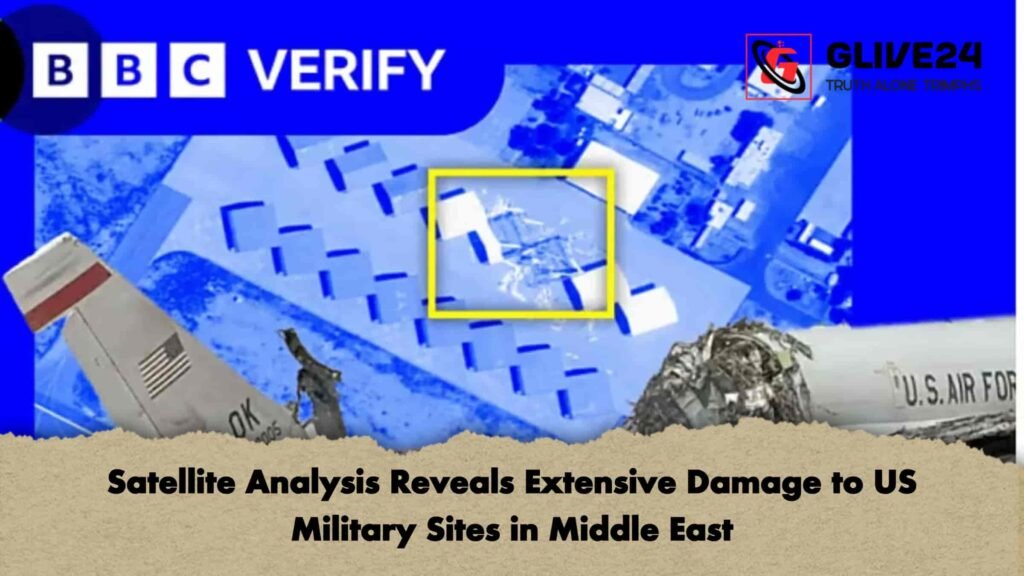
An investigation of satellite imagery and video footage by BBC Verify has confirmed that at least 20 United States military installations in the Middle East have been damaged by Iranian strikes since the outbreak of hostilities. The analysis indicates that the scale and precision of the counter-attacks executed by Tehran were significantly more extensive than the figures publicly acknowledged by US officials.
The conflict escalated on 28 February 2026, when the United States and Israel launched a coordinated offensive against Iran, codenamed “Operation Epic Fury”. According to Pentagon estimates, US forces targeted more than 13,000 objectives inside Iran during the operation.
In response, Iran executed a series of retaliatory strikes across eight Middle Eastern countries. These counter-attacks specifically targeted critical US infrastructure, disabling advanced air defence batteries, logistics facilities, and radar networks designed to protect American assets in the region.
Technical Assessment of Material Losses
Independent geospatial analysts confirmed that the strikes successfully compromised high-value defensive assets. Among the verified losses are three advanced anti-ballistic missile battery systems located at Al Ruwais and Al Sadad in the United Arab Emirates (UAE), and Muwaffaq Salti Air Base in Jordan.
The US military operates only eight Terminal High Altitude Area Defense (THAAD) batteries globally. Each system costs approximately $1 billion to manufacture, requires a specialised crew of roughly 100 personnel, and utilises interceptor missiles valued at $12.7 million per unit.
“These batteries form the backbone of a highly complex regional defence architecture. They cannot be easily or rapidly replaced,” stated Mark Mellett, former Vice Admiral and Chief of Staff of the Irish Defence Forces.
Satellite data also revealed extensive devastation at Prince Sultan Air Base in Saudi Arabia, where craters and severely damaged airframes are clearly visible. Analysts from the UK-based geospatial intelligence firm MAIAR identified an E-3 Sentry airborne early warning and control aircraft among the assets struck. According to US media assessments, replacing a single E-3 Sentry can cost up to $700 million.
Further damage was tracked at Ali Al Salem Air Base and Camp Arifjan in Kuwait. At the Ali Al Salem facility, analysts identified destroyed fuel storage bunkers, aircraft hangars, and personnel accommodation blocks. Concurrently, the defence intelligence firm Janes documented catastrophic destruction to satellite communication infrastructure located at Camp Arifjan.
Documented US Hardware Losses and Financial Estimates
| Asset / Category | Documented Damage / Units Impacted | Estimated Unit / Operational Cost |
| Total Damaged Bases | 20 confirmed installations (up to 28 suspected) | Under Evaluation |
| THAAD Anti-Ballistic Batteries | 3 Systems (UAE & Jordan) | $1,000,000,000 per battery |
| E-3 Sentry Surveillance Aircraft | 1 Unit (Saudi Arabia) | $700,000,000 per unit |
| Total Destroyed/Damaged Aircraft | Minimum 42 airframes (including F-15, F-35, A-10) | Varies by airframe |
| MQ-9 Reaper Drones | 24 Units | Varies by configuration |
| Operation Epic Fury Total Cost | May 2026 Pentagon estimate | $29,000,000,000 |
Tactical Evolution and Intelligence Restrictions
Experts tracking the conflict noted a distinct shift in Iranian military tactics during the campaign. Initially, Iran deployed low-cost, easily replaceable unmanned aerial vehicles (UAVs) alongside mass missile salvos designed to overwhelm American and allied integrated air defence systems.
Kelly Grieco, a senior analyst at the US-based Stimson Centre, noted:
“Initially, Iranian strikes were largely quantitative, structured to saturate defensive perimeters. However, within days, Tehran adjusted to precise, smaller-scale targeted operations. By conserving high-value munitions for high-value targets, they focused attacks on critical nodes where even near-misses guaranteed severe operational disruption.”
An analyst from MAIAR suggested that the US military demonstrated a degree of complacency during the opening phases of the war by failing to disperse expensive aircraft away from bases within range of Iranian ordnance. The analyst noted that Prince Sultan Air Base had been targeted prior to the successful destruction of the stationary US aircraft.
Amid these developments, the White House maintained that Iranian military capability had been almost entirely neutralised. However, the visible infrastructure damage contradicts these assertions. In an effort to control the flow of information, the US government requested Planet, a primary commercial satellite imagery provider, to impose an indefinite restriction on publishing new imagery covering Iran and the wider Middle East.
Planet defended the decision, stating it aimed to prevent its data from falling into the hands of hostile actors who could use it to target allied forces, NATO partners, or civilian populations. Consequently, BBC Verify cross-referenced historical Planet imagery with data from alternative international geospatial providers to verify the 20 sites across Saudi Arabia, the UAE, Qatar, Kuwait, Iraq, Jordan, Bahrain, and Oman.
Strategic Implications and Future Risks
The financial toll of the campaign remains substantial. A Pentagon report released in May 2026 estimated the total expenditure for Operation Epic Fury at $29 billion, with a significant portion allocated to repairing or replacing destroyed hardware. Lawmakers from the Democratic Party have stated that the actual cost is likely higher. The report confirmed the loss or severe damage of at least 42 US aircraft since February 2026, including F-15 and F-35 fighter jets, 24 MQ-9 Reaper drones, and an A-10 strike aircraft.
The Supreme Leader of Iran, Mojtaba Khamenei, utilised the findings to underscore the vulnerability of foreign forces. In a public statement, he declared:
“No nation or territory in this region will serve as a shield for American bases anymore. There will be no safe place left for the United States to establish military outposts in this region. Day by day, they will be pushed further from their previous positions.”
These remarks come at a time when the fragile ceasefire between the two nations faces severe strain. The Islamic Revolutionary Guard Corps (IRGC) stated that it conducted a retaliatory strike against a US installation following a renewed American airstrike in southern Iran.
Grieco warned that if the current truce collapses, US forward bases in the Persian Gulf will face extreme vulnerability due to depleted air defence interceptor stockpiles. “These interceptor inventories cannot be quickly replenished,” Grieco concluded. “Should Iran launch a fresh offensive, the US will have to confront it with only a fraction of the defensive capability it possessed at the start of the conflict.”