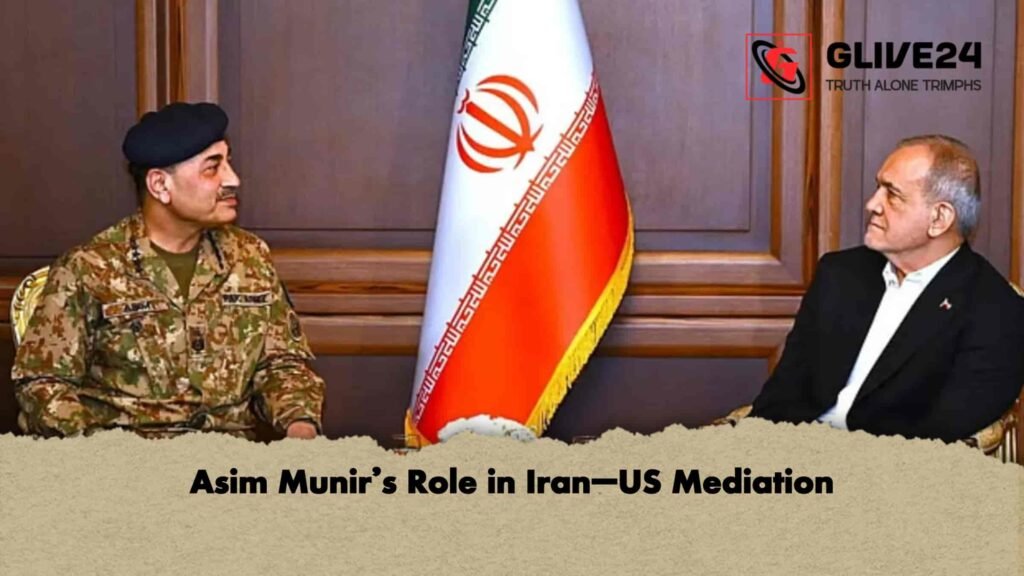
Pakistan’s Chief of Army Staff, Field Marshal Asim Munir, reportedly emerged as a central intermediary in efforts to halt hostilities between Iran and the United States, according to accounts of recent diplomatic developments.
On Wednesday evening, upon landing in Tehran, Munir was received with a warm embrace by Iran’s Foreign Minister and chief negotiator Abbas Araghchi. Dressed in military uniform, his presence was widely interpreted within diplomatic circles as part of an active mediation mission rather than a ceremonial visit.
His trip followed a period of heightened diplomatic activity. Four days earlier, U.S. Vice President JD Vance had departed Islamabad after 21 hours of talks between Iranian and American representatives ended without agreement. Subsequent discussions remained uncertain amid continuing tensions, including reported restrictions affecting Iranian ports.
Following the breakdown of initial talks, U.S. President Donald Trump reacted by announcing naval restrictions in the Strait of Hormuz, further escalating tensions. He nonetheless publicly acknowledged Munir’s involvement, describing his efforts as “excellent” in maintaining dialogue channels.
According to reports, Munir travelled to Tehran carrying a new U.S. proposal outlining a framework for renewed talks in Islamabad the following week. Former Pakistani ambassador Maliha Lodi stated that Munir was the “driving force” behind the process, adding that without him the initiative would not have progressed.
Key Diplomatic Developments
| Date/Period | Event |
|---|---|
| 13 April | Iran–US delegations meet in Islamabad with Munir present |
| Following week | Proposed framework for renewed talks in Islamabad |
| Previous week | 21-hour Iran–US talks end without agreement |
| Shortly after | U.S. imposes naval restrictions in Strait of Hormuz |
| Wednesday | Munir arrives in Tehran with new proposal |
Munir is reported to be among a limited number of figures capable of direct communication with senior leadership in both Tehran and Washington, facilitating message exchange between the parties. Observers note that key diplomatic activity has increasingly centred on Pakistan’s military headquarters in Rawalpindi rather than civilian institutions in Islamabad.
Lodi further remarked that Pakistan’s foreign ministry has largely played a supporting role, while trust from both Iran and the United States has been placed primarily in Munir’s personal engagement.
During earlier tensions involving direct threats from President Trump, Munir’s intervention was credited by officials with helping maintain communication channels. Reports also indicate that Trump has engaged with Munir directly in previous discussions involving regional security issues.
Academics and analysts suggest Pakistan’s military establishment plays a dominant role in shaping foreign policy. Professor Avinash Paliwal of SOAS University of London noted that Pakistan’s leadership structure has enabled it to act as a credible intermediary in selected international disputes.
Munir has also expanded diplomatic engagement beyond the Iran–US track. He has undertaken visits to Washington, Riyadh, and Tehran, and reportedly played a role in defence and economic agreements, including cooperation involving cryptocurrency, mineral extraction, and defence arrangements with Saudi Arabia.
He has previously been received multiple times at the White House by President Trump, who has publicly praised him in strong terms. Reports also state that Pakistan’s cooperation on counterterrorism measures, including the handover of high-profile suspects, contributed to strengthening ties with Washington.
Tensions between Iran and Pakistan in 2024, as well as Pakistan’s positions during regional conflicts, have also formed part of the broader diplomatic background to current engagements.
Political analyst Muhammad Mehdi emphasised that while Munir plays a leading role, the process involves coordinated efforts across Pakistan’s civilian government and military institutions.
Overall, the mediation effort is viewed as both a test of Pakistan’s diplomatic influence and a reflection of its military-led foreign policy structure, with potential implications for regional security architecture should negotiations succeed.