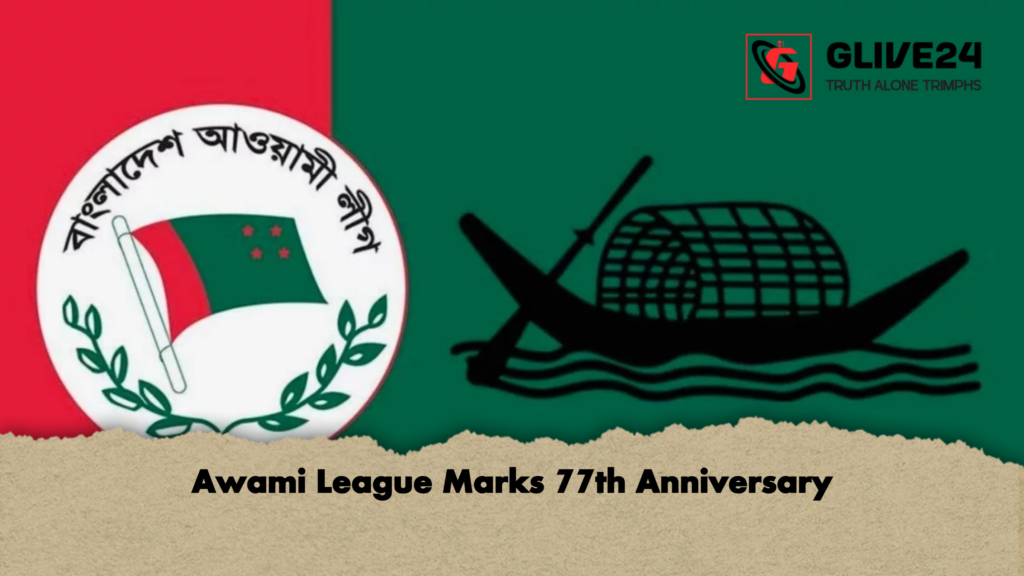
The 77th founding anniversary of the Awami League is being observed today, recalling a political journey that began on 23 June 1949 at the historic Rose Garden Palace on K M Das Lane. Emerging in the then East Pakistan, the party was originally established as the Awami Muslim League, positioning itself as the first major opposition force in the region’s post-colonial political landscape. Its foundation was deeply rooted in demands for democratic rights, popular representation, and greater provincial autonomy, shaping the trajectory of political mobilisation in the decades that followed.
At its inaugural council, the party elected Mawlana Abdul Hamid Khan Bhashani as president and Shamsul Huq as general secretary. Although incarcerated at the time, young leader Sheikh Mujibur Rahman was unanimously appointed as joint secretary, marking the beginning of his central role in the organisation’s leadership structure.
In 1953, during the second council held in Mymensingh, leadership arrangements were reshaped, with Bhashani continuing as president and Sheikh Mujibur Rahman elected as general secretary. This period saw the party strengthening its organisational capacity and increasingly aligning itself with the growing autonomy movement in East Bengal.
A significant ideological and structural transformation took place during the third council, held from 21 to 23 October 1955 at Rupmahal Cinema Hall in Dhaka’s Sadarghat area. The term “Muslim” was removed from the party’s name, reflecting a shift towards a more inclusive, secular political identity. The organisation was subsequently renamed the Awami League, marking a decisive step in broadening its political appeal beyond religious affiliation.
In 1966, Sheikh Mujibur Rahman formally assumed the presidency of the party in the lead-up to the historic Six-Point Programme, which became the cornerstone of the autonomy movement in East Pakistan. This programme is widely regarded as a turning point in the region’s struggle for self-determination, ultimately contributing to the political momentum that led to the independence of Bangladesh in 1971.
Following independence, the party adopted its present name, the Awami League of Bangladesh. In 1981, Sheikh Hasina was elected party president, ushering in a new era of leadership that has continued for decades.
Today, the anniversary carries heightened political significance, as the party’s activities are currently subject to restrictions, making the occasion both symbolic and reflective in nature.
Key Historical Milestones
| Year | Event | Significance |
|---|---|---|
| 1949 | Founding of Awami Muslim League | Emergence of first major opposition in East Pakistan |
| 1953 | Second Council in Mymensingh | Leadership restructuring and organisational consolidation |
| 1955 | Name change to Awami League | Shift towards secular and inclusive political identity |
| 1966 | Six-Point Programme | Foundation of autonomy movement |
| 1971 | Independence of Bangladesh | Emergence of sovereign state shaped by mass political struggle |
| 1981 | New leadership under Sheikh Hasina | Beginning of long-term contemporary leadership era |
The historical evolution of the Awami League reflects more than institutional continuity; it represents a sustained political movement that played a decisive role in shaping democratic aspirations, mass mobilisation, and the eventual emergence of Bangladesh as an independent nation.