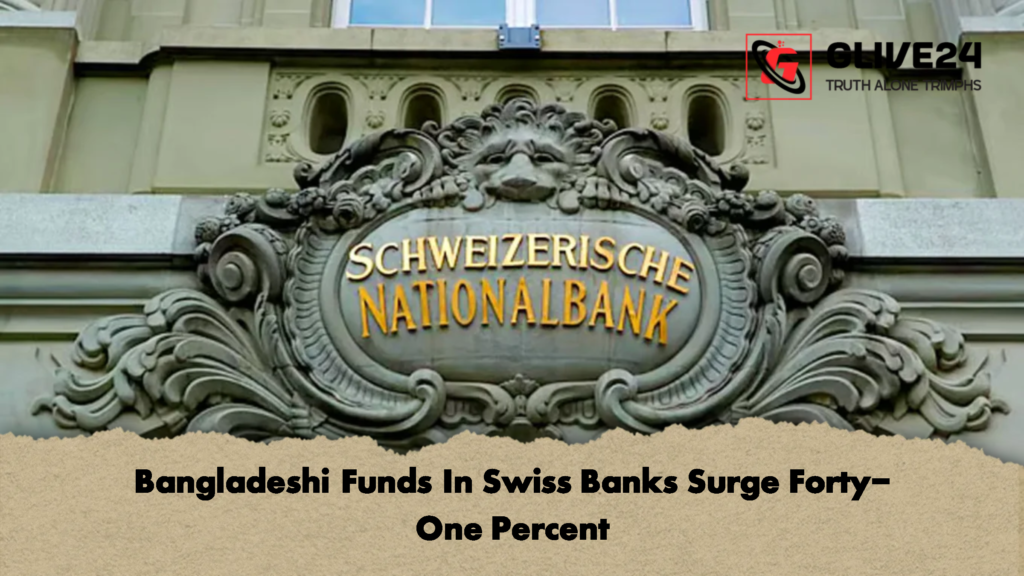
The volume of funds deposited by Bangladeshi nationals and institutions within Swiss banking establishments has experienced a substantial escalation over a one-year period. According to the 2025 financial disclosures, total deposits attributable to Bangladeshis advanced to 834.1 million Swiss Francs (CHF), representing an approximate 41 per cent increment relative to the preceding fiscal year’s figures.
Statistical Breakdown and Fiscal Evaluation
The newly released data indicates a sharp reversal from prior fiscal trajectories. In the year 2024, the aggregate financial capital held by Bangladeshi clients within the Swiss banking apparatus stood at approximately 590 million CHF. The updated metrics were officially promulgated on Thursday, 18 June 2026, within the comprehensive annual financial report published by the Swiss National Bank (SNB), the central banking authority of Switzerland.
Whilst the Swiss Franc does not possess an extensive structural circulation within the domestic retail markets of Bangladesh, its conversion metric remains highly consequential for macroeconomic assessments. Based on current market evaluation frameworks, the exchange valuation of a single Swiss Franc fluctuates between 152 and 153 Bangladeshi Taka (BDT).
Utilising a baseline conversion matrix of 152 BDT per Swiss Franc, the aggregate financial reserves maintained by Bangladeshis in Switzerland at the termination of 2025 equate to an estimated 126.78 billion Taka. The 2025 statistical figures constitute the highest volume of Bangladeshi financial assets recorded in Swiss accounts since the peak observed in 2021, and simultaneously mark the second-highest aggregate accumulation documented across the preceding ten-year fiscal timeline.
Composition and Classification of Swiss Deposits
The institutional framework governing asset allocation in Switzerland stipulates that capital originating from Bangladesh is catalogued under several distinct operational parameters. The funds comprise deposits logged by private individual citizens, corporate entities, and sovereign commercial banking institutions operating through legitimate financial channels.
Furthermore, the data encompasses capital deposited by non-resident Bangladeshis residing globally who utilise Swiss banking networks, alongside assets placed within international branches of Swiss banks operating in various global jurisdictions outside Switzerland itself.
The Swiss National Bank designates these inbound transnational deposits as external liabilities within its official balance sheets. Consequently, the fiscal data clarifies that the entirety of the recorded financial volume cannot be automatically categorised as illicit capital flight or laundered wealth, as a portion represents validated cross-border commercial transactions and institutional liquidity management.
Historical Trajectories and Expert Analysis
The upsurge in 2025 follows a temporary period of contraction observed during preceding fiscal cycles. According to historical SNB annual reports, Bangladeshi deposits had experienced sharp declines in both 2022 and 2023, during which the cumulative numbers dropped to 55 million CHF and 17.5 million CHF respectively.
Commenting on the latest financial disclosures, Moinul Islam, a former professor of the Department of Economics at the University of Chittagong, stated that there was a widespread systemic expectation that capital flight would diminish following the collapse of the Awami League administration on 5 August 2024.
He noted, however, that the updated Swiss data demonstrates that illicit financial transfers have persisted unabated, yielding adverse macroeconomic consequences for Bangladesh. The academic further emphasised that Swiss institutions represent only a singular destination within a broader global network utilised for international capital flight. According to his assessment, the trajectory of future asset preservation depends heavily upon the institutional measures implemented by the current government to curb outbound flows and repatriate extracted assets.
Political Transitions and Structural Shifts
The broader contextual background of this financial surge is linked to monumental political shifts within Bangladesh. Following the massive student-led public uprising in August 2024, numerous government ministers, members of parliament, and corporate executives closely aligned with the deposed Awami League administration fled the country.
Subsequent state actions resulted in the widespread freezing and confiscation of their domestic assets. These enforcement measures are widely understood to have driven the rapid transnational relocation of liquid wealth across multiple global jurisdictions.
Furthermore, an official white paper on the economy commissioned by the subsequent interim government verified that vast sums of capital were systemically siphoned out of the country during the tenure of the previous administration. These diverted funds are believed to have gradually found their way into Swiss accounts via various complex financial intermediaries.
Historically, the Swiss banking system functioned as a premier sanctuary for undeclared global wealth due to strict statutory secrecy laws that prohibited the transmission of client data to foreign sovereign states. However, the international regulatory environment has evolved significantly.
Under pressure from global financial transparency agreements, the Swiss Confederation now routinely shares transactional data with foreign governments upon official formal request. Consequently, contemporary methods of capital flight have increasingly migrated towards trade misinvoicing and commercial fronts, allowing perpetrators to disguise illicit wealth transfers under the pretext of legitimate international trade and business operations.