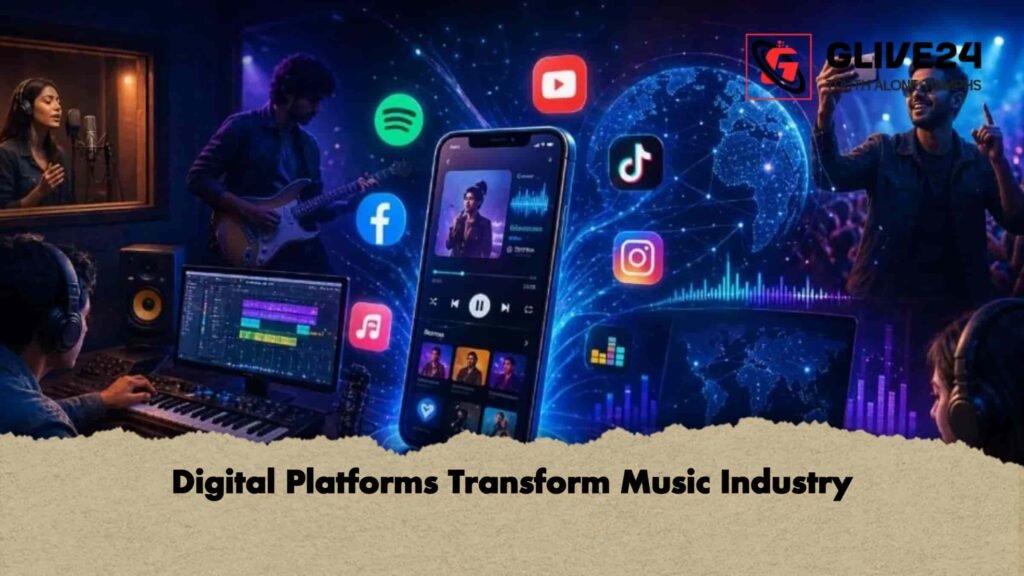
Bangladesh’s music industry is undergoing a structural shift driven by digital platforms, widespread internet access, and changing audience behaviour. Music consumption is no longer limited to audio listening alone; for over a decade, music videos have become an established component of song releases, with audiences increasingly engaging with both visual and audio formats simultaneously.
Data from the Bangladesh Telecommunication Regulatory Commission indicates that the country now has over 130 million internet users. A significant proportion of these users regularly access YouTube and various social media platforms for music consumption. This expansion in connectivity has contributed to the decline of physical music formats such as cassettes and compact discs, which have largely disappeared from the market.
Previously, television and radio airplay were essential for a song’s commercial success. Today, however, a single video uploaded to YouTube or a short clip shared on TikTok can achieve widespread popularity within a short period, particularly among younger audiences who form the largest segment of digital consumers.
YouTube has emerged as the primary platform for the country’s music industry. Most music labels now depend heavily on advertising revenue, monetisation systems, and view counts generated through the platform. Research indicates that for several major music labels, around 70 to 80 per cent of total revenue is derived from YouTube-based earnings. As a result, YouTube channels have evolved into fully functioning commercial distribution and marketing platforms rather than simple publishing tools.
Comparison of Traditional and Digital Music Models
| Category | Earlier System | Current Digital System |
|---|---|---|
| Main distribution channel | Television, radio, physical media | YouTube, streaming platforms, social media |
| Revenue source | Album sales and physical distribution | Advertising, streaming revenue, monetisation |
| Music discovery | Scheduled broadcasts | Algorithms, viral content |
| Artist dependency | Record labels | Independent publishing possible |
| Market reach | Mainly domestic | Domestic and international |
Music analysts note that this transition has created a new economic structure in which viewership and digital engagement have replaced physical sales as the primary income drivers.
Alongside YouTube, international streaming services such as Spotify, Apple Music, and Amazon Music are gradually gaining visibility in Bangladesh. While their usage remains lower compared with YouTube, an increasing number of emerging artists are distributing their music through these platforms in order to reach global audiences. Market assessments suggest that the country’s digital music sector is expanding and may evolve into a multi-million-dollar industry in the coming years.
Social media platforms have also become central to music promotion strategies. Facebook, TikTok, and Instagram now play a significant role in determining a song’s popularity. In many cases, songs gain initial traction through short-form videos on TikTok before becoming widely circulated on YouTube and other streaming services. Genres such as folk fusion, remix, and contemporary adaptations often benefit most from this format-driven exposure.
Music researchers highlight that audience interaction with music has become increasingly participatory. Listeners now not only consume music but also share, remix, and promote it across platforms, making the process more interactive than in earlier distribution models. This shift has enabled many independent artists to achieve recognition without relying on large production houses.
The digital transition has also reduced dependence on traditional record labels. Artists can now record, publish, and distribute their work independently using basic production setups and online platforms. However, this accessibility has introduced new challenges, particularly low revenue per stream and heightened competition, as thousands of tracks are released daily across platforms.
Dhruv Ghosh, head of Dhruv Music Station, stated: “In the digital era, releasing music has become easier, but sustaining a career has become more difficult. A good song alone is no longer sufficient; effective marketing is equally important.”
Despite these challenges, several Bangladeshi artists have achieved significant digital success, with songs reaching millions of views and gaining international audiences. Genres such as folk fusion, modern pop, and remix music have performed strongly on both YouTube and streaming platforms.
The broader digital ecosystem surrounding music has also generated new employment opportunities, including roles in video production, audio engineering, digital marketing, and content management. This growth has supported the rise of freelancing and digital content creation as viable career paths among young professionals.
Industry observers describe the sector as being in a continued phase of digital transition. With the growing influence of emerging technologies, including artificial intelligence and blockchain-based systems, further structural changes are anticipated in how music is produced, distributed, and monetised.
Overall, the digital transformation has reshaped Bangladesh’s music industry into a more open yet competitive environment, where accessibility and visibility are increasingly determined by technology-driven platforms.