
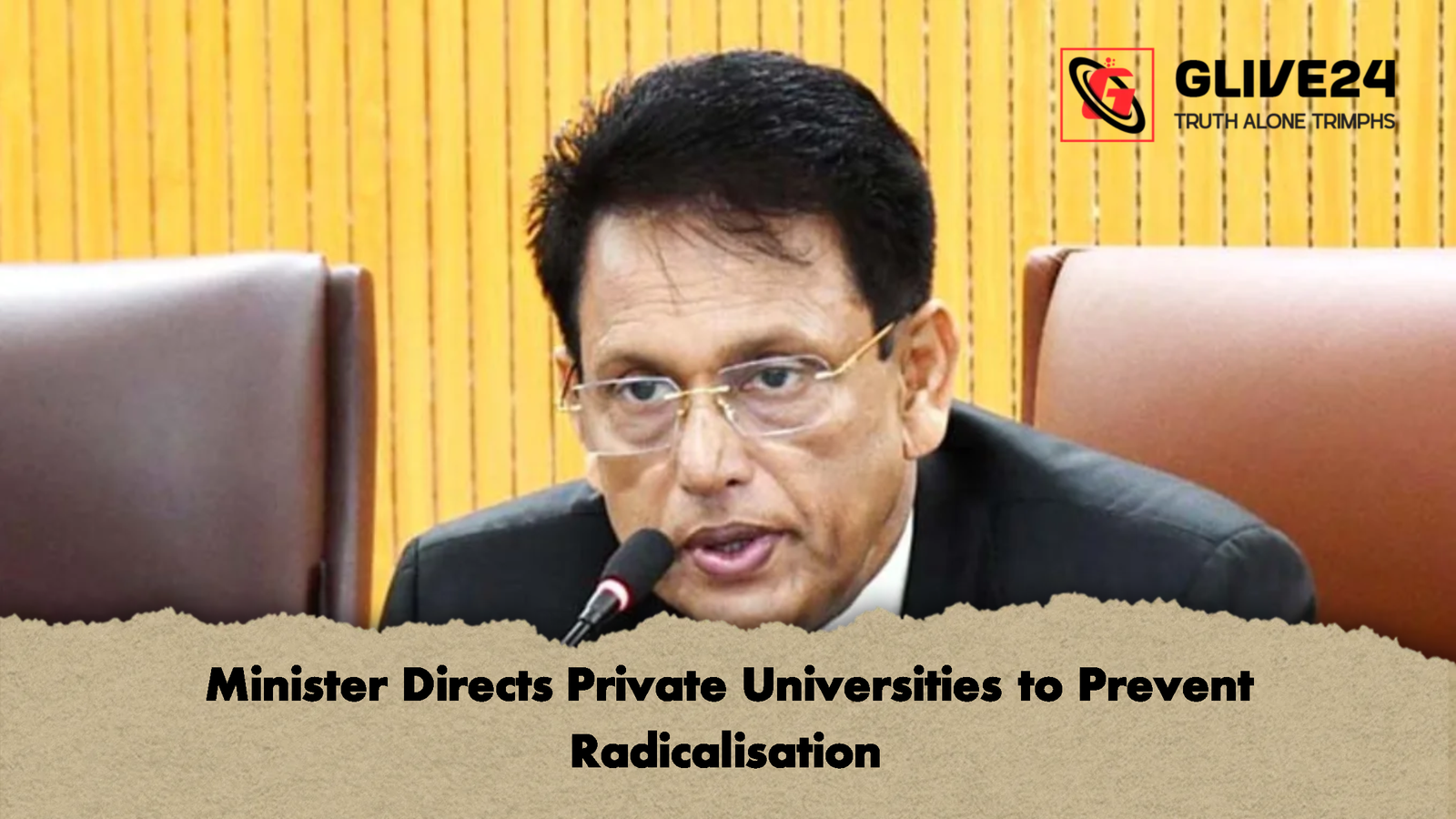
The Education Minister, A.N.M. Ehsanul Hoque Milan, has articulated a firm government stance on the operational parameters of private universities, emphasizing a transition towards heightened regulatory oversight. Speaking at a formal engagement in Banani, Dhaka, on Tuesday, 5 May 2026, the Minister detailed a strategy to balance institutional autonomy with the imperative of national security, specifically aimed at preventing these campuses from becoming susceptible to extremist infiltration.
Minister Milan asserted that while the administration supports the independence of private higher education, this “freedom” is not unconditional. He explicitly referenced the 2016 Holey Artisan Bakery tragedy as a cautionary benchmark, noting that historical evidence showed certain private institutions had been compromised by radical elements. “We must maintain this perspective. Private universities had, in the past, transformed into factories for militants. Consequently, the government will regulate these institutions,” he stated, signalling a more interventionist approach by the Ministry of Education in campus monitoring.
Enhanced Regulatory Oversight and Fiscal Accountability
A primary focus of the Minister’s address was the financial integrity and transparency of private university administrations. He highlighted a significant discrepancy regarding the fiscal reporting of these entities. Under current legislation, private universities in Bangladesh are mandated to function as non-profit organisations; however, the Minister challenged the transparency of their revenue management.
“While owners maintain that these are non-profit ventures, the ultimate destination of their substantial earnings remains opaque,” the Minister observed. This indicates an impending move toward stricter financial audits. The government aims to ensure that tuition fees and institutional income are transparently reinvested into academic infrastructure, faculty development, and research, rather than being diverted for private gain.
Despite the stringent tone, the Minister conveyed a collaborative message from the Prime Minister, assuring trustees that the government remains a developmental partner. The administration has reportedly pledged to expedite the resolution of structural and administrative bottlenecks, provided they are formally communicated through established ministerial channels.
Emulating Global Benchmarks: The Malaysian Template
In a moment of strategic reflection, Minister Milan invoked the administrative legacy of former President Ziaur Rahman, whose brief tenure in the education portfolio serves as a high benchmark for rapid reform. The Minister acknowledged that the decisiveness demonstrated during that period remains a goal for current sectoral improvements.
Broadening the scope to international excellence, the Minister cited the Malaysian education system as a primary model for Bangladesh to emulate. He questioned the inability to replicate Malaysia’s rapid academic transformation, which has successfully positioned higher education as a major contributor to national revenue.
“If Malaysia achieved an overnight transformation of its educational landscape, Bangladesh possesses the same potential. We intend to emulate the strategies of nations that have achieved global excellence to establish Bangladesh as a reputable regional academic hub,” he added.
Statutory Framework: The Private University Act 2010
The Minister’s directives are firmly rooted in the Private University Act 2010, the primary legal instrument governing the sector. This Act empowers the University Grants Commission (UGC) and the Ministry of Education to supervise institutional conduct. Key statutory requirements include:
Board of Trustees: Mandatory governance through a registered board.
Permanent Campuses: Strict timelines for moving operations to self-owned land.
Reserve Funds: Maintenance of specific financial reserves to ensure institutional stability.
By advocating for stricter compliance with these laws, the Minister is signalling a shift to ensure that the private education sector contributes to national prosperity without compromising financial integrity or social stability. The ultimate objective is to evolve the sector into a high-standard, reputable industry that mirrors the successes of global leaders in higher education.