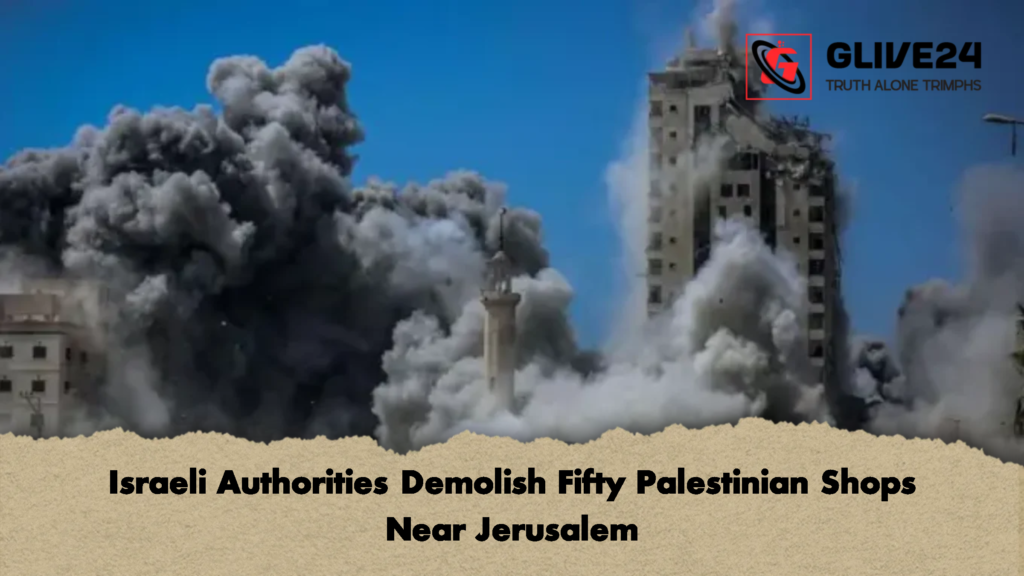
Israeli municipal authorities, supported by security forces and heavy machinery, have demolished approximately fifty Palestinian-owned commercial establishments on the outskirts of a town southeast of Jerusalem. The demolition, which took place this week, is reportedly a preparatory measure for a settlement-linked infrastructure project in the occupied West Bank. According to reports from Al Jazeera, the operation has resulted in significant economic displacement for local business owners and has drawn sharp criticism from humanitarian organisations and legal observers monitoring the region’s territorial developments.
The demolition activity was concentrated in the town of al-Eizariya on Tuesday. This specific location is geographically sensitive, situated along a corridor that connects Jerusalem to various parts of the West Bank. The structures destroyed included various retail units and workshops that served as the primary source of income for numerous Palestinian families.
Infrastructure Development and Strategic Implications
Hagit Ofran, a director at Peace Now—an organisation dedicated to monitoring and opposing settlement expansion—provided a detailed assessment of the strategic intent behind the demolitions. Ofran stated that the commercial units were located on land designated for a new Israeli road construction project. According to Peace Now, this project is designed to redirect Palestinian vehicular traffic away from primary routes, effectively bifurcating the transport network.
The ultimate objective of this infrastructural change, as noted by observers, is to facilitate the isolation of the E1 area. The E1 zone is a strategically vital tract of land between East Jerusalem and the Israeli settlement of Ma’ale Adumim. Humanitarian groups argue that by creating separate road systems, Israel is moving towards a segregated transport model that would restrict Palestinian access to key corridors and further consolidate control over the West Bank hinterland.
Legal Challenges and Regulatory Pretexts
The demolition followed an accelerated administrative process. Less than a week prior to the arrival of the bulldozers, several shop owners had been served with eviction and demolition notices. The justification provided by Israeli authorities was “construction without the required permits.” Obtaining such permits in Israeli-controlled areas of the West Bank is widely documented by international bodies, including the United Nations, as being exceptionally difficult for Palestinian residents.
Despite the short timeframe, legal representatives for the affected shop owners filed an urgent appeal with the Israeli Supreme Court in an attempt to secure a stay of execution. However, the demolition proceeded on Tuesday before a final judicial resolution could be reached or a temporary injunction granted. The Palestinian Authority and various human rights organisations have characterised these regulatory pretexts as part of a broader policy of displacement and urban restructuring intended to alter the demographic and physical landscape of the peripheries of Jerusalem.
Economic Impact and Local Testimonies
For the local Palestinian community, the loss of fifty shops represents a severe economic blow. Mohammad Abu Ghalia, one of the affected business owners, expressed profound shock and dismay as he observed the destruction of his family’s livelihood. Ghalia remarked that the business had been established by his father, who had laboured for 48 years to build a secure future for his children. The sudden removal of these establishments leaves dozens of entrepreneurs and employees without a place of business.
International observers and human rights groups maintain that such actions are consistent with a long-term strategy to establish separate road infrastructures for Israeli and Palestinian ID holders. This dual-road system is frequently cited in international reports as a primary example of discriminatory urban planning. The Palestinian Authority has formally condemned the demolitions, describing them as a violation of international law and a direct impediment to the geographical continuity of a future Palestinian state.
The Israeli government, however, maintains that the demolitions are a matter of enforcing zoning laws and proceeding with necessary public infrastructure improvements. As the rubble is cleared, the focus remains on the E1 corridor and the potential for further settlement-linked development that could permanently reshape the regional transport and security environment.