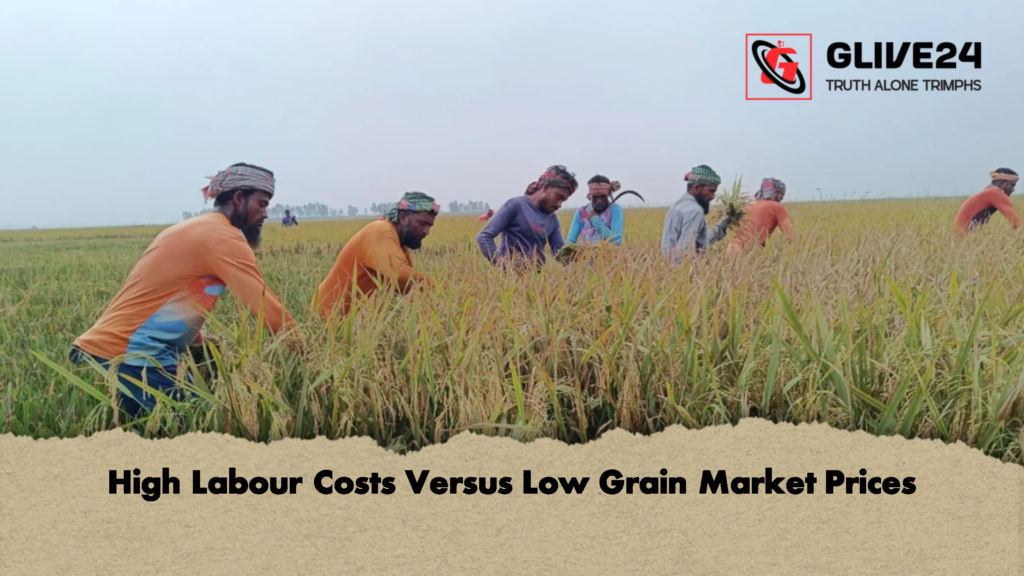
Agricultural workers and landowners in the Melandah Upazila of Jamalpur district have reported a severe financial imbalance during the current Boro harvesting season. Despite achieving a prolific yield, the local farming community is facing substantial fiscal deficits due to a combination of surging manual labour wages and depressed market rates for paddy. On Tuesday, 12 May 2026, farmers operating in the fields of Mahmudpur village expressed significant distress over the viability of their profession as production costs begin to exceed projected revenues.
Nazarul Islam, a resident farmer from Mahmudpur, highlighted the primary economic disparity currently destabilising the local agricultural sector. He noted that while the market price for one maund (approximately 37.32 kilograms) of paddy is currently situated at 800 Taka, the daily wage for a single agricultural labourer has escalated to 1,200 Taka. This inverted cost-to-income ratio has left many cultivators questioning their ability to sustain their households or reinvest in future crop cycles.
Analysis of Production Costs and Market Deficits
Data gathered from various agricultural zones within the upazila indicates that the total cost of cultivating one bigha (approximately 33 decimals) of land during this Boro season ranges between 23,000 and 25,000 Taka. These figures encompass the entirety of the cultivation process, including land preparation, the purchase of high-yield seeds, chemical fertilisers, irrigation expenses, and general crop maintenance.
However, the most significant financial burden identified by the farmers is the acute shortage of manual labour, which has driven wages to record highs. The technical requirements for harvesting one bigha of land typically necessitate at least eight labourers. At the current daily rate of 1,200 Taka, the cost for harvesting alone amounts to 9,600 Taka per bigha.
When calculated against the average yield of 24 to 25 maunds per bigha, and sold at the prevailing market rate of 800 Taka per maund, the gross return is estimated at roughly 20,000 Taka. Consequently, farmers are incurring a net loss of 3,000 to 5,000 Taka per bigha. Rabiul Islam, another local cultivator, corroborated these figures, stating that the returns are insufficient to cover the principal investment, thereby eliminating any possibility of profit.
Historical Context and Regional Cultivation Data
The current economic climate has forced experienced farmers into unprecedented hardship. Suruj Mia, a farmer from Melandah who transitioned from assisting his father to managing his own nine-bigha farm, remarked that he had never encountered such a severe disparity in his career. He noted that while the prices of all essential commodities and services have risen, the value of the primary agricultural product has remained stagnant or decreased, threatening the livelihood of families solely dependent on land produce.
According to the Department of Agricultural Extension (DAE) in Jamalpur, Boro paddy was cultivated across 126,385 hectares of land in the district this season. While the department confirmed that production targets have been exceeded, the financial grievances of the primary producers remain a significant concern for regional food security and rural stability.
Official Recommendations and Government Intervention
Mohammad Alam Sharif Khan, the Deputy Director of the Jamalpur District Agricultural Extension Department, addressed the situation by offering strategic advice to the affected farmers. He urged cultivators to avoid immediate “panic selling” to private wholesalers and middlemen, who often exploit the harvest glut to keep prices low.
The Deputy Director proposed two primary alternatives for the farming community:
-
Delayed Sales: Advising farmers to store their grain for one to two months, anticipating a market correction once the initial harvest surge subsides.
-
Government Procurement: Encouraging farmers to sell their produce directly to government silos and procurement centres, where the state-guaranteed price is significantly higher than that offered by private wholesalers.
However, officials acknowledged that for many marginal farmers with immediate debt obligations or lack of storage facilities, selling to private wholesalers at a loss remains an unavoidable, albeit detrimental, necessity. The DAE continues to monitor the situation, though they have limited direct authority over private market fluctuations.