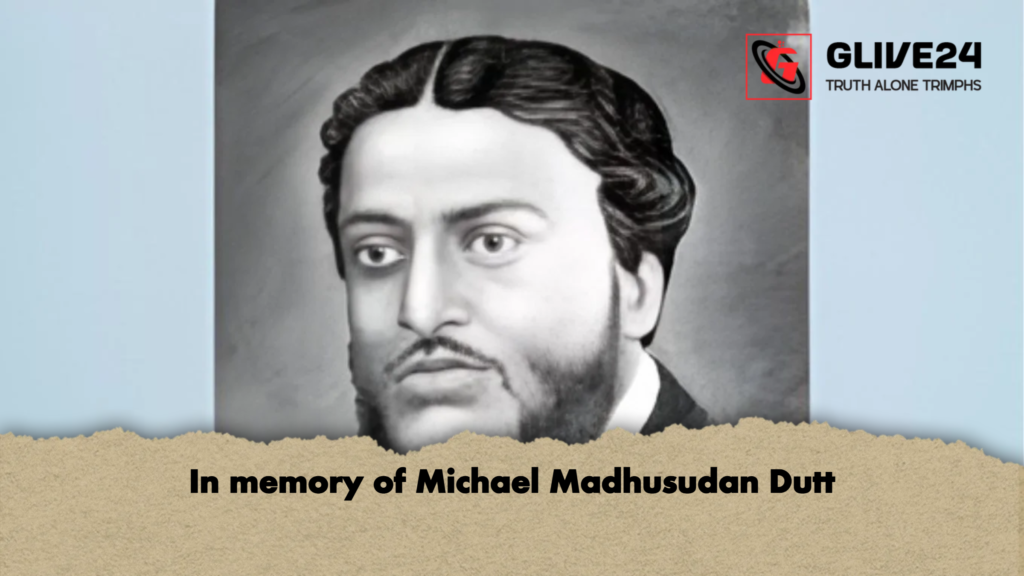
Today, the literary world remembers Michael Madhusudan Dutt, one of the most extraordinary figures of 19th-century Bengali literature. A poet, dramatist, satirist, and revolutionary writer, Dutt was not merely a creator of verse—he was a pioneering spirit who broke with tradition and redefined Bengali literary expression.
Born on 25 January 1824 in Sagar Dighi, a village in the Keshabpur region of Jessore district, he belonged to a respectable Kayastha zamindar family. His father, Rajanarayan Dutt, was a renowned lawyer in the Dewani courts of Kolkata, while his mother, Jahnabi Devi, nurtured his early intellectual curiosity. Even as a child, Dutt displayed remarkable literary talent, yet his path through life was never straightforward.
In his youth, Dutt’s conversion to Christianity estranged him from his family and social circle, setting the stage for a life marked by profound personal conflict. His existence oscillated between luxury and poverty, ambition and frustration, triumph and tragedy—rendering his final years deeply poignant. Despite these struggles, his contributions to the Bengali Renaissance remain unparalleled.
Rejecting conventional poetic forms, Dutt initiated a modern literary movement in Bengali literature, earning him the title of the first rebel poet of modern Bengali letters. His early experiments in English literature, while influenced by Western models, did not bring him the recognition he sought. However, upon returning to his mother tongue, Dutt produced a remarkable body of work in Bengali—dramas, comedies, and epic poems—that transformed both the language and its stylistic possibilities.
Notably, he introduced the sonnet form and Amitrakshar (quantitative) metre to Bengali poetry. His magnum opus, “Meghnad Badh Kavya”, an epic based on the Ramayana, remains a masterwork of literary rebellion, human insight, and modern sensibility.
Tragically, Dutt passed away on 29 June 1873 at the age of 49, leaving behind a legacy that continues to illuminate Bengali literature. His audacity, innovation, and vision endure, inspiring generations of writers and readers alike.
Key Life Events of Michael Madhusudan Dutt
| Year | Event | Significance |
|---|---|---|
| 1824 | Birth in Sagar Dighi, Jessore | Beginnings in a Kayastha zamindar family |
| 1843 | Conversion to Christianity | Personal and social estrangement; formative turning point |
| 1846–1850 | Early English literary experiments | Influenced by Western literature; limited recognition |
| 1850s | Return to Bengali literature | Initiation of new poetic forms and dramas |
| 1861 | Composition of Meghnad Badh Kavya | Magnum opus; blending epic narrative with modern sensibility |
| 1873 | Death at age 49 | Premature end of a revolutionary literary career |
Today, Bengali literature honours Michael Madhusudan Dutt not only as a poet of extraordinary talent but as a trailblazer who challenged conventions, expanded literary horizons, and left an indelible mark on the cultural history of Bengal.
Tribute—Michael Madhusudan Dutt.