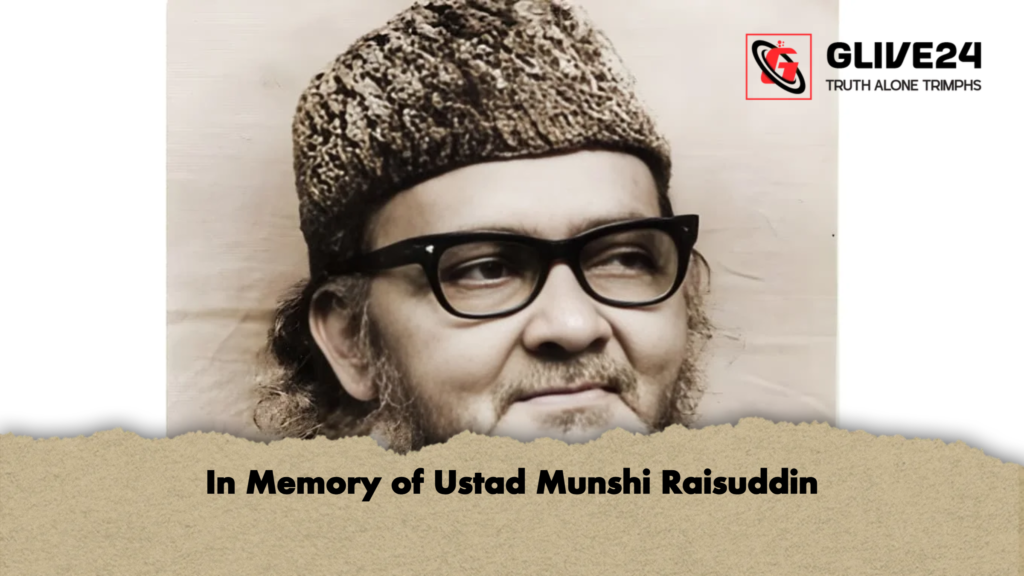
Ustad Munshi Raisuddin—an illustrious star of Bengali classical music—enriched the country’s musical heritage immensely through his devotion, creativity, and teaching.
In recognition of his outstanding contribution to music, he was posthumously awarded the Ekushey Padak in 1986, a distinguished honour reflecting his lifelong dedication to the art.
He was born on 10 January 1901 in the village of Nakol in the Magura district, into a respectable but financially struggling family. From early childhood, his voice carried the sweetness of melody, hinting at the emergence of a future musical master. His initial training in music began under the guidance of his maternal cousin, Shamsul Haque.
At the age of just 17, he moved to Kolkata in search of livelihood. Alongside his professional work, he immersed himself deeply in music. Under the renowned musician Rasbehari Mullick, he received twelve years of rigorous training in Dhrupad and Khayal, strengthening his classical foundation. Later, he pursued advanced formal training at Girija Shankar Chakraborty’s Sangeet Kala Bhavan and further refined his artistry under Sharjit Kanjilal of Lucknow, adding new dimensions to his musical journey.
In 1938, his voice was first broadcast on Kolkata Radio, marking a significant milestone in his career. After the Partition of India in 1947, he moved to Dhaka and joined the radio station as an artist, later settling permanently in Narayanganj. There, he established the “Praveshika Sangeet Vidyalaya,” which became an important institution for nurturing numerous talented musicians.
From its inception in 1955, he served as the co-principal of the Bulbul Lalitakala Academy and later became its principal in 1964. Under his leadership, the region experienced a renewed vitality in classical music practice and education.
His life’s mission was the promotion of classical music, fostering public interest in the art form, and training the next generation of musicians. To achieve this, he not only taught but also authored numerous instructional texts after the inclusion of music in formal education. His notable works include Saral Sangeet, Sar-Sangrah, Chotoder Saregama, Abhinav Shatarag, Sangeet Parichay, Rag Lahari, and Geet Lahari, which continue to serve as invaluable resources for students.
In addition to his literary contributions, he enriched the field of music by creating new ragas. For his research and artistic contributions, he received several honours including the Adamjee Literary Award and the President’s Award.
In his personal life, he was a loving father. His children also continued the musical legacy, reflecting his enduring influence. Many of his students went on to become renowned musicians, carrying forward his ideals and teachings.
This great maestro passed away on 11 April 1973. Yet his melodies, his dedication, and his creations continue to live on in our hearts and within the depths of our cultural heritage.
A tribute to a great master—an immortal composer of timeless music.