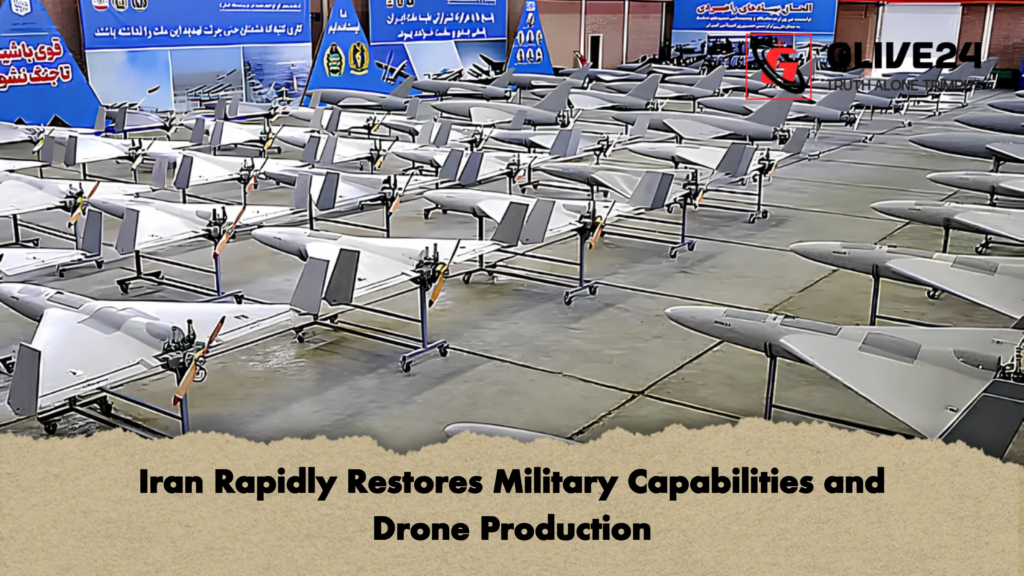
United States intelligence officials have reported that Iran is recovering its military capabilities at a pace far exceeding initial expectations. Following the ceasefire that commenced in April, Tehran has reportedly resumed the manufacturing of unmanned aerial vehicles (UAVs), commonly known as drones. This rapid reconstitution follows a period of intense conflict involving strikes by the United States and Israel.
Table of Contents
Intelligence Assessments and Reconstruction Speed
According to intelligence sources cited by CNN, Tehran has already initiated the reconstruction of various military assets damaged during recent hostilities. While initial American estimates suggested a prolonged recovery period, four separate sources have indicated that the speed of this restoration has bypassed early projections. Intelligence familiar with the matter suggests that missile bases, launch systems, and weapons factories—previously deemed destroyed or disabled—are being systematically returned to operational status.
A United States administration official noted that while different weapon systems require varying manufacturing timelines, Iran is projected to fully restore its drone strike capabilities within the next six months. This rapid progress challenges previous assertions that Iranian military infrastructure had been neutralised for the long term.
Current Status of Iranian Military Assets
The following table outlines the current state of Iranian military hardware based on recent intelligence evaluations and reports:
| Military Asset Category | Status Following Hostilities | Current Estimated Capacity |
| Missile Launchers | 50% remained intact in April | Increased to 66% (two-thirds) |
| Unmanned Aerial Vehicles (Drones) | Significant damage reported | ~50% (thousands of units) intact |
| Coastal Defence Cruise Missiles | Majority remained untouched | High operational readiness |
| Production Facilities | 90% claimed destroyed by CENTCOM | Actively being refurbished |
| Air Defence Systems | Partially degraded | Remains functional/operational |
Strategic Implications and Foreign Support
The recovery is significantly bolstered by external support. Sources indicate that Russia and China have played pivotal roles in this process. Despite a US naval blockade currently limiting some supplies, China has reportedly continued to provide essential components for missile production. Israeli Prime Minister Benjamin Netanyahu recently informed CBS News that China is supplying Tehran with missile parts, a claim that the Chinese Foreign Ministry, through spokesperson Guo Jiakun, has dismissed as baseless.
Furthermore, US intelligence suggests that Iran’s coastal defence cruise missiles remain largely intact. This is attributed to the fact that American strikes focused primarily on Iranian naval vessels rather than land-based coastal installations. These missiles are considered Iran’s primary tool for potentially obstructing the Strait of Hormuz.
Conflicting Reports Within the US Administration
There remains a notable discrepancy between intelligence assessments and public statements from military leadership. Admiral Brad Cooper, Commander of US Central Command (CENTCOM), testified before the House Armed Services Committee that “Operation Epic Fury” had devastated 90% of Iran’s arms production centres, suggesting a recovery would take years.
However, intelligence sources contest this, stating that the damage to the industrial base may only set Iran back by a few months. Some sectors of the Iranian defence industry remained entirely untouched, allowing for an accelerated restoration of specific military functions.
The Geopolitical Context
The conflict, which began on 28 February and saw a ceasefire on 8 April, remains unresolved despite a round of talks in Islamabad. US President Donald Trump has maintained a firm stance, stating as recently as last Tuesday that he was only “one hour away” from resuming aerial bombardments should a permanent peace treaty fail to materialise. As the diplomatic stalemate continues, the rapid refurbishment of Iran’s drone and missile arsenals remains a primary concern for US allies in the Middle East, particularly Israel and the Gulf states, which remain within range of these reconstituted systems.