Prolonged exchanges of hostilities over 39 consecutive days have left the Middle East in a state of heightened instability. During this period, Iran temporarily closed the Strait of Hormuz, one of the world’s most critical energy shipping routes, leading to significant disruption in global oil and gas markets. In response to escalating tensions, Iran and the United States eventually agreed to a two-week temporary ceasefire.
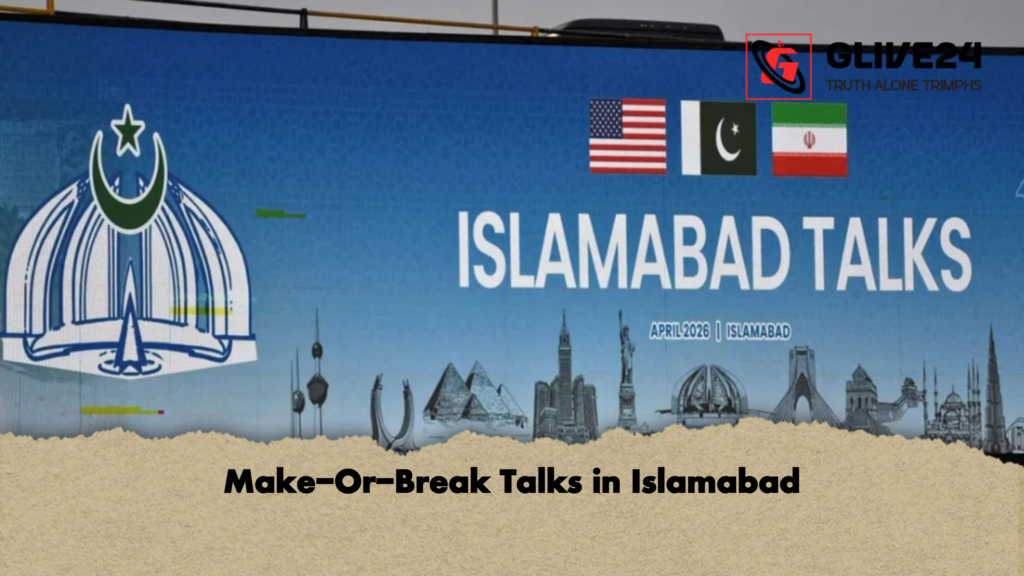
Following this interim arrangement, both sides are set to meet in Islamabad on Saturday for high-level discussions aimed at establishing a more durable peace framework. Despite last-minute complications linked to Israeli strikes in Lebanon, Iran’s conditional agreement to attend the talks has largely resolved the immediate diplomatic impasse. Reports suggest that a preliminary understanding on extending the ceasefire could be reached ahead of the meeting.
In a televised address, Pakistan’s Prime Minister Shehbaz Sharif confirmed that senior leadership from both the United States and Iran would participate in the Islamabad dialogue. He described the initiative as a significant opportunity to advance towards peace, while also acknowledging that the process has entered a decisive phase where it could either succeed or fail. According to him, transitioning from a temporary ceasefire to a permanent resolution remains the central challenge.
The Iranian delegation, led by Parliament Speaker Bagher Ghalibaf and Foreign Minister Abbas Araghchi, arrived in Islamabad early on Saturday. They were received by Pakistan’s Deputy Prime Minister and Foreign Minister Ishaq Dar, National Assembly Speaker Ayaz Sadiq, Chief of Defence Forces Field Marshal Asim Munir, and Interior Minister Mohsin Naqvi.
The United States delegation also arrived in Islamabad by air. According to The Guardian, the delegation is headed by Vice President JD Vance and includes President Donald Trump’s special envoy Steve Witkoff and his son-in-law Jared Kushner.
Ishaq Dar expressed hope that all parties would engage constructively, adding that Pakistan would continue to facilitate efforts aimed at achieving a stable and lasting settlement.
These talks mark the first direct high-level engagement between Washington and Tehran since 1979. However, the diplomatic process had earlier faced the risk of collapse after Iran linked its participation to conditions involving the situation in Lebanon.
Key Positions and Negotiation Issues
| Party | Core Position | Key Demands |
|---|---|---|
| United States | Nuclear programme restrictions | Reduced uranium enrichment and removal of nuclear material |
| Iran | Sanctions relief and recognition | Full lifting of sanctions, recognition of nuclear rights, return of frozen funds |
| Negotiation Scope | Regional and strategic security issues | Strait of Hormuz navigation framework, missile range discussions, sequencing of concessions |
Iranian Parliament Speaker Bagher Ghalibaf clarified that Tehran’s participation depends on two conditions: a ceasefire in Lebanon and the release of approximately USD 7 billion in frozen Iranian assets. Without these, Iran indicated that talks would not proceed.
Intense behind-the-scenes diplomacy continued throughout the day between Islamabad, Tehran, and Washington, with involvement from several regional and international stakeholders. Some developments were reported on the ground, including a reduction in Israeli strikes on Beirut and the Dahieh district, which was viewed as partial progress towards meeting Iranian conditions. However, attacks in other parts of southern Lebanon continued.
The situation had already become more complex following Israeli strikes in Lebanon within 24 hours of the initial Iran–US ceasefire agreement on 8 April. Iran maintains that any ceasefire should apply across all related fronts, including Hezbollah, whereas the United States and Israel consider the Lebanon strikes to be outside the scope of the ceasefire framework. This divergence has repeatedly complicated negotiations.
Before departing Washington, Vice President JD Vance stated that the United States was entering the talks in good faith and warned against any delay tactics. President Donald Trump, meanwhile, adopted a firmer stance, stating that Iran had limited options and warning that military measures could be reconsidered if negotiations failed. He also criticised Iran’s restrictions on maritime movement through the Strait of Hormuz.
The agenda for the Islamabad talks remains complex. While Iran’s 10-point proposal is being used as a reference framework, significant differences persist between the two sides. The United States is seeking constraints on Iran’s nuclear programme, particularly reductions in uranium enrichment and limits on nuclear material. Iran, on the other hand, is demanding comprehensive sanctions relief, recognition of its nuclear rights, a structured framework for navigation through the Strait of Hormuz, and the return of frozen financial assets. Additional disagreements remain over regional influence, missile capabilities, and the sequencing of concessions.