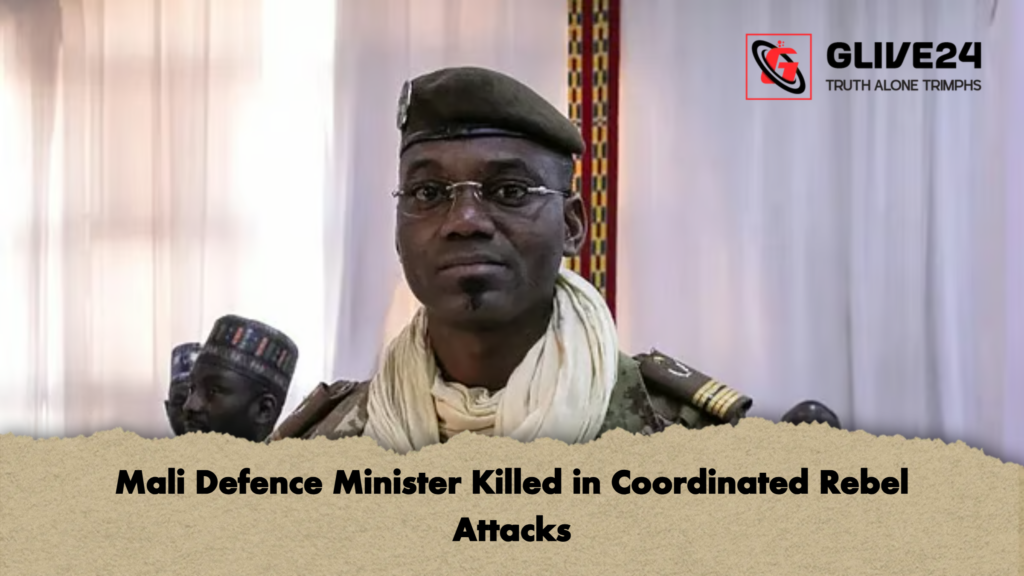
Mali’s Defence Minister, General Sadio Camara, has been killed following a series of sophisticated assaults on military installations and government residences across the country. The attacks, which occurred over the weekend, were carried out by a coalition involving Al-Qaeda-linked militants and Tuareg rebel groups.
Details of the Assassination
On Sunday, government spokesperson Issa Ousman Coulibaly confirmed the Minister’s death in an official statement. According to the report, insurgents targeted Camara’s private residence in the garrison town of Kati, located approximately 15 kilometres (9 miles) northwest of the capital, Bamako.
The assault on the highly fortified military enclave involved a suicide car bomb. Reports from news agency AFP indicate that the blast also claimed the lives of the Minister’s second wife and two of his grandchildren. While Kati is considered one of the most secure locations in the nation—serving as the residence for both Camara and the interim president—the attackers managed to breach its perimeter.
A Significant Blow to the Military Junta
General Camara was a pivotal figure in the military administration that seized power through coups in 2020 and 2021. Analysts and observers, including Al Jazeera correspondent Nicolas Haque, noted that Camara was one of the most influential members of the ruling leadership, with many viewing him as a potential future leader of Mali. His death is regarded as a severe strategic setback for the Malian Armed Forces.
The interim president, Assimi Goïta, was reported to be unharmed. Following the commencement of the attacks, security details successfully evacuated the President to an undisclosed, secure location.
Escalation and Rebel Coordination
The offensive was not limited to the capital region. Gunmen launched simultaneous strikes across various sectors, including:
-
Gao and Kidal in the north.
-
Sévaré in the central region.
-
Bamako and Kati in the south.
Residents in Kidal reported heavy gunfire and explosions continuing into Sunday. Security analyst Bulama Bukarti observed that two distinct insurgent groups—the Al-Qaeda-affiliated Jama’at Nusrat al-Islam wal-Muslimin (JNIM) and the Tuareg fighters of the Azawad Liberation Front (FLA)—have moved from internal rivalry to a unified front against the Malian state.
Summary of Targeted Locations and Casualties
| Location | Region | Nature of Incident | Key Outcomes |
| Kati | Southwest (near Bamako) | Suicide car bomb & ground assault | Death of Gen. Sadio Camara, his wife, and two grandchildren. |
| Bamako | Capital District | Multiple armed incursions | Increased security lockdown; President Goïta evacuated. |
| Kidal | North | Heavy shelling and gunfire | Ongoing instability and territorial contestation. |
| Gao | North | Coordinated raids | Strategic military installations targeted. |
| Sévaré | Central | Armed assault | Disruption of regional military operations. |
International Condemnation
The assassination and the broader wave of violence have drawn swift condemnation from the international community. The African Union, the United States Bureau of African Affairs, and the European Union have all issued statements denouncing the attacks. Additionally, the Secretary-General of the Organisation of Islamic Cooperation (OIC) expressed formal condemnation of the insurgent activity.
Experts warn that the alliance between JNIM and the FLA signals a period of intensified conflict as these groups seek to seize control of strategically vital territories from the interim government.