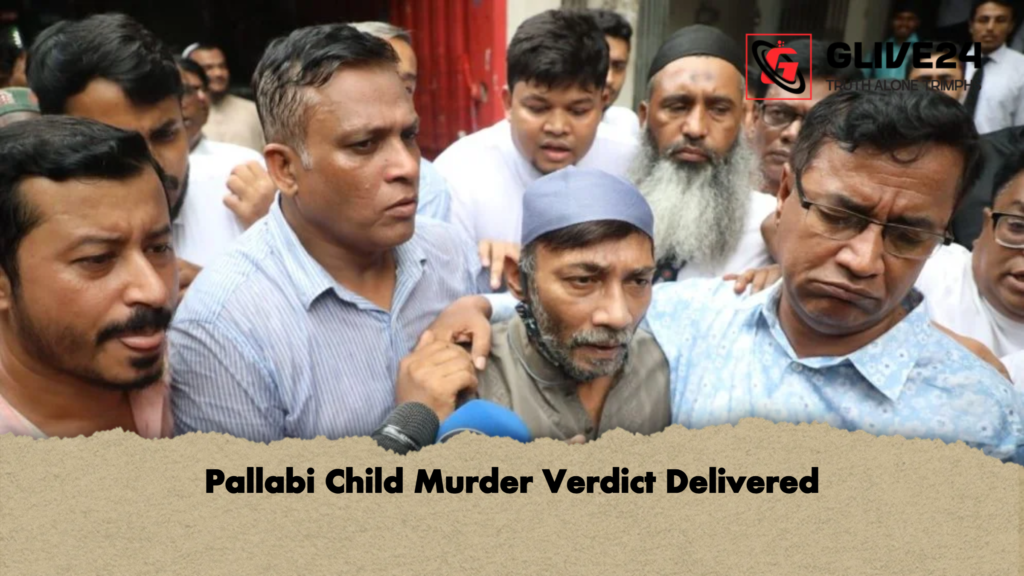
A court in Dhaka has sentenced the two principal accused in the widely discussed murder case of eight-year-old Ramisa Akter to death, concluding a fast-tracked trial that drew significant public attention across Bangladesh. The court also ordered financial compensation amounting to Tk 700,000 for the victim’s family, underscoring the importance of restitution alongside criminal punishment.
The verdict was delivered on Sunday by Judge Masrur Saleqin of the Dhaka Metropolitan Tribunal for the Prevention of Violence Against Children. The court sentenced Sohail Rana and his wife, Swapna Akter, to capital punishment and imposed separate fines of Tk 500,000 and Tk 200,000 respectively. According to the judgment, if the convicts fail to pay the fines, the compensation will be recovered through the sale of their movable and immovable assets and transferred to Ramisa’s family.
Following the verdict, Ramisa’s father, Abdul Hannan Molla, expressed satisfaction with the court’s decision. However, he stated that he would feel fully satisfied only after the sentence is carried out. He also thanked the law-enforcement agencies, the investigating officer, the prosecution team and the court for their roles in securing the conviction. At the same time, he called for swift and exemplary justice in crimes committed against children.
Case Overview
| Subject | Information |
|---|---|
| Victim | Ramisa Akter (8) |
| School Grade | Class Two |
| Educational Institution | Popular Model High School |
| Date of Incident | 19 May |
| Murder Case Filed | 20 May |
| Main Accused | Sohail Rana |
| Co-Accused | Swapna Akter |
| Charge Sheet Submitted | 24 May |
| Charges Framed | 1 June |
| Verdict Delivered | 7 June |
| Court | Dhaka Metropolitan Tribunal for the Prevention of Violence Against Children |
| Presiding Judge | Masrur Saleqin |
| Sentence | Death penalty for both accused |
| Compensation Ordered | Tk 700,000 |
According to court records, Ramisa was a second-grade student at Popular Model High School. Prosecutors stated that on the morning of 19 May, after leaving her home, she was allegedly lured into the accused couple’s room by Swapna Akter. Around an hour later, when Ramisa’s mother began preparing to send her daughter to school, she discovered that the child was missing.
Suspicion arose when family members noticed Ramisa’s shoes outside the accused couple’s room. Repeated attempts to contact the occupants reportedly went unanswered. Residents and relatives subsequently forced entry into the room, where they found the child’s dismembered body. The incident shocked the local community and generated widespread national outrage.
Police responded promptly after receiving information through the national emergency service 999. Swapna Akter was taken into custody at the scene, while Sohail Rana was later arrested near the Fatulla Police Station area in Narayanganj following a technology-assisted operation. The following day, Ramisa’s father formally filed a murder case at Pallabi Police Station. On the same day, Sohail Rana reportedly gave a confessional statement before a court. Swapna Akter was subsequently sent to jail by court order.
The investigation progressed rapidly. Sub-Inspector Ahiduzzaman of Pallabi Police Station, the investigating officer, submitted the charge sheet on 24 May, and the tribunal accepted it the same day. Formal charges against both accused were framed on 1 June.
The trial moved swiftly thereafter. Of the 18 witnesses listed in the charge sheet, 16 testified before the court. After examining witness testimony, confessional statements, forensic evidence and other materials presented during the proceedings, the tribunal found both defendants guilty and imposed the maximum punishment.
Legal observers have noted that the judgment highlights the importance of prompt investigation and expedited judicial proceedings in cases involving severe crimes against children. The court’s decision to ensure compensation for the victim’s family has also been viewed as a significant aspect of the ruling. The verdict is expected to be regarded as a strong judicial message against child abuse and child murder, reinforcing the principle that such offences warrant the severest legal consequences.