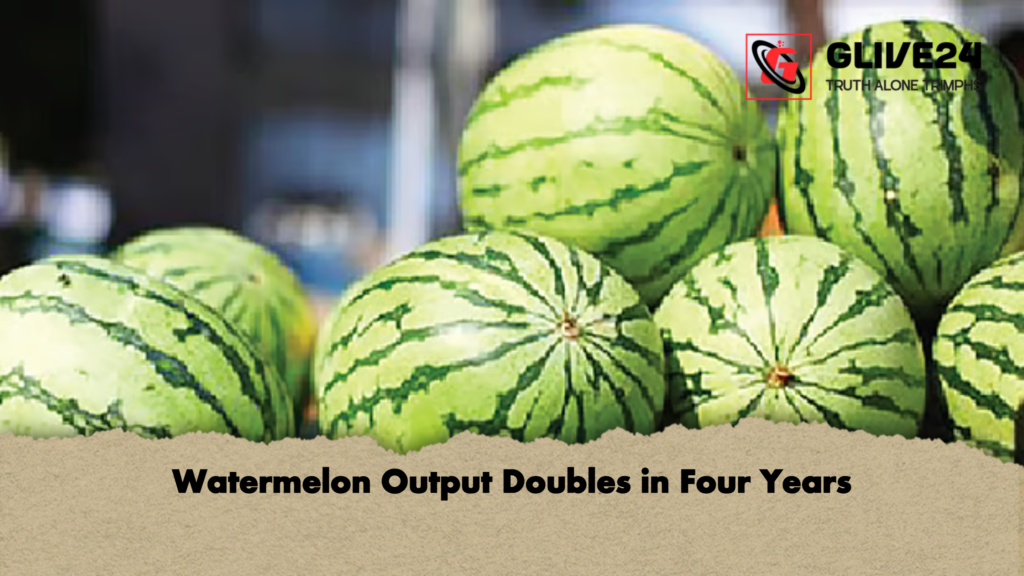
Watermelon, a prominent seasonal fruit in Bangladesh during the summer months, has experienced a substantial rise in production over recent years. Driven by strong consumer demand in hot weather, both cultivation and output have expanded steadily. Official data indicate that national production has nearly doubled within a four-year period.
According to the Department of Agricultural Extension (DAE), watermelon production stood at 1.789 million tonnes in the 2020–21 fiscal year. This figure rose significantly to 3.552 million tonnes in the 2024–25 fiscal year. Intermediate years also recorded notable growth, with 2.547 million tonnes in 2021–22 and 3.636 million tonnes in 2022–23.
The following table summarises the production trend:
| Fiscal Year | Production (million tonnes) |
|---|---|
| 2020–21 | 1.789 |
| 2021–22 | 2.547 |
| 2022–23 | 3.636 |
| 2024–25 | 3.552 |
Officials from the DAE and market participants expect production to increase further in the 2025–26 fiscal year. A higher supply has contributed to comparatively lower prices this season. March and April represent the peak marketing period, during which watermelons are widely available across neighbourhood markets.
Price data indicate a decline compared to the previous year. In early April last year, watermelons were sold at Tk 50 to Tk 60 per kilogram. In contrast, during the same period this year, prices ranged from Tk 30 to Tk 35 per kilogram in various markets in the capital, with some sales at Tk 25 to Tk 30 per kilogram in Karwan Bazar. Towards the end of the season, prices have increased slightly to Tk 45–50 per kilogram.
A DAE horticulture official stated that demand typically rises due to high temperatures; however, the increased production has ensured widespread availability, thereby moderating prices.
Despite the availability and lower prices, some consumers have reported concerns regarding taste and quality. Buyers have noted that although the internal colour appears red, the sweetness is often lacking and the fruit may spoil quickly. Market observations suggest inconsistency in quality across batches.
Agricultural experts attribute these issues to cultivation practices. The use of excessive fertilisers, pesticides, and growth hormones may accelerate fruit development, leading to premature harvesting. In such cases, the fruit may not reach full maturity, affecting flavour. Additionally, over-enlargement can increase water content, reducing sweetness.
A senior scientific officer at the Bangladesh Institute of Research and Training on Applied Nutrition explained that rapid growth techniques can result in immature fruit entering the market. He added that while such practices may affect taste, moderate consumption does not pose significant health concerns.
Watermelon production is concentrated בעיקר in coastal char areas. Districts such as Patuakhali, Bhola, Khulna, Bagerhat, and Barishal account for the majority of output. Early in the season, watermelons from Barishal and Bhola dominate the market, followed later by produce from Khulna.
DAE data show that Patuakhali leads national production, followed by Bhola and Barguna. In Bhola alone, approximately 0.8 million tonnes were produced in the 2024–25 fiscal year. Cultivation area has also expanded, with an additional 4,000 hectares brought under watermelon farming this year.
Farm-level profitability remains a key driver of expansion. Farmers report production costs of Tk 30,000 to Tk 35,000 per bigha, while revenues can reach Tk 80,000 to Tk 100,000 per bigha under favourable conditions. Individual fruits typically weigh between 4 and 5 kilograms. Strong returns have encouraged continued growth in cultivation year after year.