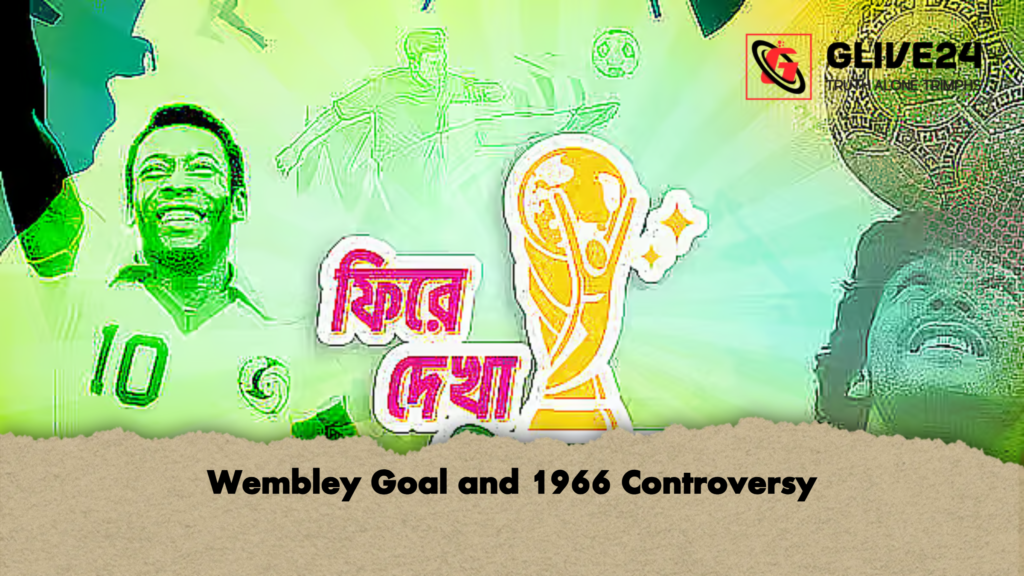
The 1966 FIFA World Cup remains one of the most discussed editions in football history, not only for England’s first and only title but also for the controversies surrounding key decisions, refereeing, and match organisation. The tournament, held in England, marked a significant chapter in the history of the 1966 FIFA World Cup.
England, long regarded as the originators of modern football, had struggled to achieve major success on the world stage, failing to progress significantly in earlier tournaments between 1950 and 1962. Their breakthrough came in 1966 under manager Sir Alf Ramsey, with a tactical system often referred to as the “Wingless Wonders.” Despite winning the title, the campaign has remained surrounded by debate.
The final was played against West Germany at Wembley Stadium. After 90 minutes, the score stood at 2–2. In extra time, in the 101st minute, England’s Geoff Hurst struck a powerful shot that hit the crossbar and bounced near the goal line before being cleared by German defenders. Swiss referee Gottfried Dienst awarded the goal after consulting linesman Tofiq Bahramov. West Germany strongly protested, but the decision stood. Hurst later completed a hat-trick, and England won 4–2.
The match remains controversial due to the disputed goal decision, which has never been conclusively resolved even with later analysis. It is one of the most debated moments in World Cup history.
Controversy was not limited to the final. England played all their matches at Wembley Stadium in London, making them the only World Cup winners to do so. In addition, a semi-final originally scheduled for Liverpool between England and Portugal was moved to Wembley at short notice, reportedly to accommodate larger crowds. This decision remains a notable organisational change in the tournament.
Refereeing decisions also drew criticism. In the match between England and Argentina, German referee Rudolf Kreitlein sent off Argentine captain Antonio Rattín, despite communication barriers. South American teams expressed concerns over European referees officiating key matches, citing perceived inconsistencies in disciplinary actions.
Key incidents of the 1966 World Cup
| Incident | Description | Outcome |
|---|---|---|
| Controversial final goal | Hurst’s shot awarded as goal in extra time | England won 4–2 amid dispute |
| Wembley advantage | England played all matches at Wembley | Raised concerns over home advantage |
| Semi-final relocation | Match moved from Liverpool to Wembley | Debate over fairness |
| Refereeing disputes | Multiple European referees in key matches | Allegations of bias |
| England vs Argentina red card | Rattín sent off by Rudolf Kreitlein | Increased controversy |
The tournament also featured notable incidents involving players and teams. Brazil’s Pelé suffered repeated fouls in matches against Portugal, leading to injury, and Brazil exited in the group stage.
Logistical and cultural aspects of the tournament were also distinctive. England’s opening match was delayed when several players forgot their identity cards at the hotel, requiring police assistance to retrieve them before kickoff. Additionally, dietary arrangements varied widely among teams, reflecting different national approaches to preparation.
Attendance and hospitality at Wembley were substantial, with large quantities of food and beverages prepared for spectators, reflecting the scale of the event.
The 1966 World Cup therefore stands as a landmark tournament defined by England’s historic victory, tactical evolution, and enduring controversies that continue to shape discussions in football history.