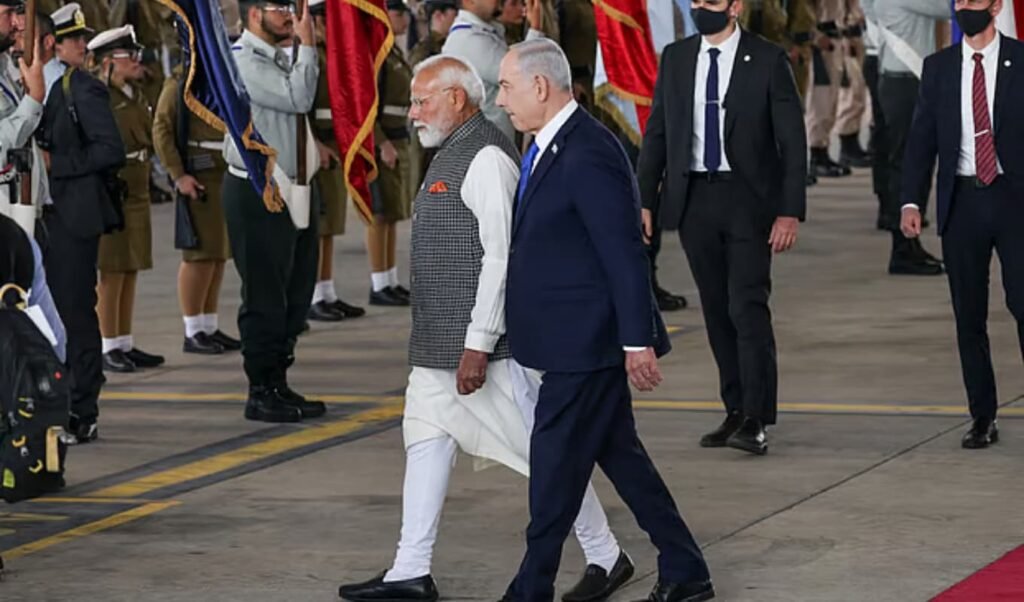
Indian Prime Minister Narendra Modi arrived in Tel Aviv on Wednesday for his second official visit to Israel, having first visited in 2017. His arrival marks a continuation of India’s deepening strategic relationship with Israel. Prime Minister Benjamin Netanyahu welcomed Modi with full ceremonial honours, underscoring the importance Israel places on its partnership with India, despite international controversy surrounding Netanyahu. The Israeli leader faces an arrest warrant from the International Criminal Court, and his military operations in Gaza have been widely condemned as potential acts of ethnic targeting. Nevertheless, these controversies have not impeded Modi’s visit.
Just days prior to Modi’s arrival, Netanyahu unveiled the Hexagon Alliance, also referred to as the “Hexagon Bloc,” positioning India as a central player in a new regional architecture. The alliance reportedly includes Greece, Cyprus, and select Arab, African, and Asian nations. According to Netanyahu, the alliance is designed to counter what he terms the “radical axis,” particularly addressing the resurgence of Sunni extremist networks following the weakening of the Shia axis.
The current geopolitical backdrop is complicated. Recep Tayyip Erdoğan remains a staunch critic of Israel, while Pakistan and Saudi Arabia formalised a strategic defence agreement in September 2025. Analysts suggest that Israel’s concern over emerging Sunni coalitions implicitly includes these nations. Consequently, India-Israel proximity may directly influence Pakistan’s security calculus.
Expansion in Defence and Technology Cooperation
Since Modi’s first visit in 2017, India-Israel ties have strengthened considerably, with India emerging as one of Israel’s largest arms purchasers. During this visit, discussions covered defence, artificial intelligence, quantum computing, and cybersecurity, with potential transfers of Israel’s high-performance Iron Beam laser systems and Iron Dome missile defence technology to India.
| Sector | Key Developments | Strategic Implications for Pakistan |
|---|---|---|
| Defence | Arms purchases, technology transfers | Heightened security concerns |
| Artificial Intelligence | Joint R&D initiatives | Enhanced cyber and defence capabilities |
| Quantum Computing | Technology exchange | Intelligence and information advantage |
| Cybersecurity | Collaborative threat mitigation | Strengthened national security architecture |
Experts note that India-Israel intelligence and military collaboration adds complexity to Pakistan’s strategic environment. Former Pakistani ambassadors Masood Khalid and Masood Khan have emphasised that the longstanding bilateral military and intelligence ties are a significant concern for Islamabad.
While the Hexagon Alliance’s full scope remains unclear, its focus appears directed at politically Islamic nations, particularly Turkey and Pakistan. Although Pakistan is not considered a direct adversary, analysts warn that it may face indirect strategic disadvantages. The delicate balance in the Gulf region presents Islamabad with a challenging scenario, given its longstanding dependence on regional economic and strategic partnerships. Specialists recommend Pakistan strengthen ties with Central Asia, Turkey, Iran, and Russia to mitigate emerging pressures.
Modi’s visit, coupled with Netanyahu’s strategic initiatives, introduces a new set of challenges for Pakistan. International analysts argue that the deepening India-Israel partnership will directly influence Pakistan’s military, intelligence, and strategic planning in the years ahead.