
Khabor Wala Desk
Published: 29th May 2026, 7:02 PM
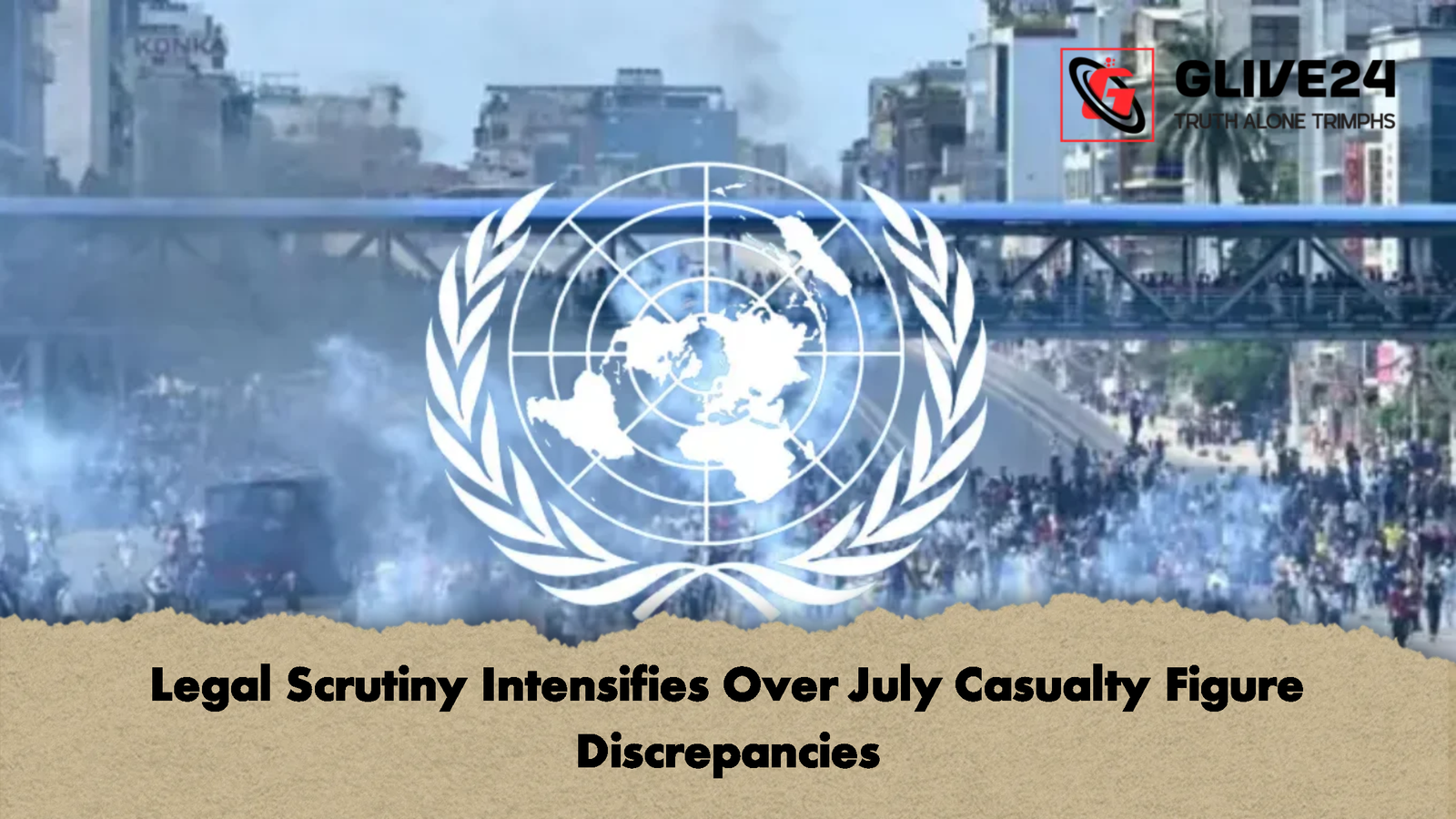
The intense public and legal debate surrounding the exact death toll from the July–August 2024 mass protests in Bangladesh shows no signs of subsiding. Instead, the controversy has deepened significantly following the publication of a formal fact-finding report by the Office of the United Nations High Commissioner for Human Rights (OHCHR). The document has become the subject of rigorous institutional scrutiny, raising profound questions regarding the recorded number of casualties, the underlying investigation methodology, the standard of data verification applied, and the potential legal deployment of these findings in subsequent judicial processes.
In a significant legal development, Mr Steven Powles KC, acting as legal counsel to Sheikh Hasina and practicing as a barrister at Doughty Street Chambers in London, has submitted a formal letter to the United Nations High Commissioner for Human Rights, Mr Volker Türk. Sent on 28 May 2026, the comprehensive correspondence systematically challenges the information, methodologies, and conclusions set out within the OHCHR report, which is officially entitled “Human Rights Violations and Abuses related to the Protests of July and August 2024 in Bangladesh”.
Alongside this primary letter, a highly detailed, separate complaint has been formally lodged. This secondary document alleges significant instances of procedural divergence, evidentiary inconsistency, and a potential abuse of mandate within the United Nations Fact-Finding Report (UNFFR) framework. Consequently, it demands that the United Nations initiate an immediate internal oversight investigation and an independent ethics review.
Table of Contents
A major point of contention within the submitted complaint focuses on the stark numerical disparities across official government registers, independent tracking bodies, and the figures published by the United Nations:
The UN OHCHR Report: Asserts that approximately 1,400 fatalities occurred during the period of mass civil unrest.
The Interim Government of Bangladesh: Lists the official death toll as approximately 834 individuals within its published official gazette.
The Anti-Discrimination Student Movement: Records a lower total of approximately 650 deaths on its dedicated digital monitoring website, shohid.info.
Legal experts and critics have questioned the specific verification methodology used by the United Nations to establish a figure that exceeds local and governmental tallies by hundreds of individuals.
Under established standards for international human rights investigations, confirming casualty attribution requires stringent adherence to clear verification protocols. These protocols universally include multi-source corroboration, rigorous forensic verification, a documented chain of custody for all physical evidence, strict source authentication, and comprehensive evidentiary transparency. The formal complaint maintains that the OHCHR report has failed to outline or explain its deployment of these core methodologies in an open or auditable manner.
A substantial portion of the legal challenge centres on the explicit disclaimers embedded within the introductory sections of the OHCHR document itself. The formal complaint highlights that the report explicitly contains three critical caveats:
The text has not undergone the full editorial standardisation typically required of formal United Nations publications.
The information presented inside the document does not constitute a formal judicial determination.
The report is not designed, nor should it be utilized, as a final document for determining legal liability.
Despite these clear institutional disclaimers, the complainants argue that the document has been repeatedly cited and utilised in public and administrative spheres as if it represents a conclusive, judicially proven factual adjudication.
This raises a fundamental question of international jurisprudence: If an investigatory report explicitly acknowledges its own structural and evidentiary limitations, can it legitimately serve as the primary legal or moral foundation for domestic criminal prosecutions or capital punishment?
Within international law and established criminal justice frameworks, a preliminary fact-finding report remains entirely distinct from court-admissible criminal evidence. The primary mandate of a human rights report is documentation and preliminary situational assessment. Conversely, securing a criminal conviction within a court of law requires satisfying a significantly higher evidentiary threshold, where every piece of data must withstand rigorous cross-examination and strict judicial rules of admission.
The complaint further asserts that the UN fact-finding mission failed to follow the mandatory procedural frameworks established in the official United Nations publication, “Commissions of Inquiry and Fact-Finding Missions on International Human Rights and Humanitarian Law: Guidance and Practice”.
Specifically, the legal challenge demands formal clarity regarding several key administrative areas:
The full public disclosure of the identities, backgrounds, and qualifications of the individual commission members.
The internal organizational structure and management of the secretariat.
The exact voting and election processes utilized to select the chairperson.
The transparent appointment and deployment of independent forensic consultants.
The critics argue that when an international fact-finding mission fails to fully implement its own internal procedural safeguards, its institutional legitimacy and evidentiary reliability are severely compromised.
Furthermore, the complaint alleges that the OHCHR report completely overlooked or failed to properly assess the systemic involvement of minors and children within the protest movement.
Invoking multiple binding international legal instruments—specifically the United Nations Convention on the Rights of the Child (CRC), the Optional Protocol on the Involvement of Children in Armed Conflict (OPAC), the Rome Statute, and the International Labour Organization (ILO) Convention 182—the complainants contend that the active engagement of children in political violence, their deployment in highly hazardous street environments, and their direct exposure to armed conflict scenarios raise profound issues under international child protection norms. They argue these critical dimensions were entirely neglected by the UN investigators.
The legal challenge additionally notes that the OHCHR report failed to provide a balanced evaluation of the violent components of the protests or the international legal frameworks governing the use of force by police officers.
While international law dictates that lethal force may only be deployed under circumstances of strict necessity and proportionality, the complaint maintains that the situation on the ground in July was not entirely peaceful. It asserts that the UN report failed to properly evaluate documented evidence concerning instances of civilian violence, widespread allegations of weapon usage by demonstrators, coordinated attacks on state property, and the active presence of armed civilian participants.
The case of Abu Sayed’s death is specifically detailed within the complaint to illustrate these methodological concerns. The document contends that definitive conclusions regarding his demise were reached without the benefit of an independent, verified forensic review of rubber bullet injuries, blunt force trauma, CCTV footage, and digital video evidence. Furthermore, it is alleged that certain individuals were assigned specific political identities within the report without the support of a rigorous, verified identification process.
It remains explicitly noted that these claims have not yet been proven in a court of law or confirmed by an independent judicial inquiry, and they must currently be treated as contested allegations rather than established historical facts.
The ongoing dispute points toward a broader legal question regarding institutional accountability if a United Nations document is found to contain material flaws. Legal experts note that if future independent reviews establish that a report contained intentional misrepresentation, selective evidence handling, procedural manipulation, or materially misleading data, several institutional outcomes generally follow:
| Potential Outcome | Impact on the Institution and Report |
| Credibility Damage | The overall authority, institutional integrity, and reliability of the report are severely undermined globally. |
| Official Retractions | The issuing body faces direct legal and political pressure to publish formal corrections, clarifications, or total retractions. |
| Internal Reviews | The compulsory initiation of internal audits, ethical reviews, or the appointment of an independent inquiry board. |
| Disciplinary Action | Administrative or disciplinary measures are taken against the specific United Nations officers or consultants involved. |
| Evidentiary Devaluation | A significant reduction in the evidentiary weight assigned to the document in future international or domestic judicial proceedings. |
While United Nations officials typically benefit from functional immunity, Western legal experts have observed that instances of proven procedural misconduct or knowingly misleading representations invariably force questions of institutional accountability.
At the absolute core of this legal dispute lies a fundamental question: Has the international human rights report maintained the necessary, rigorous separation between unverified allegations, witness testimonies, and judicially adjudicated facts?
The systemic strength of the international human rights framework relies heavily on its global credibility, which is explicitly dependent upon methodological transparency, evidentiary consistency, procedural neutrality, and fair process. The international legal community now awaits the formal response of the Office of the United Nations High Commissioner for Human Rights regarding whether it will offer a comprehensive reassessment or formal clarification concerning the disputed statistics and procedural methodologies.


Comments