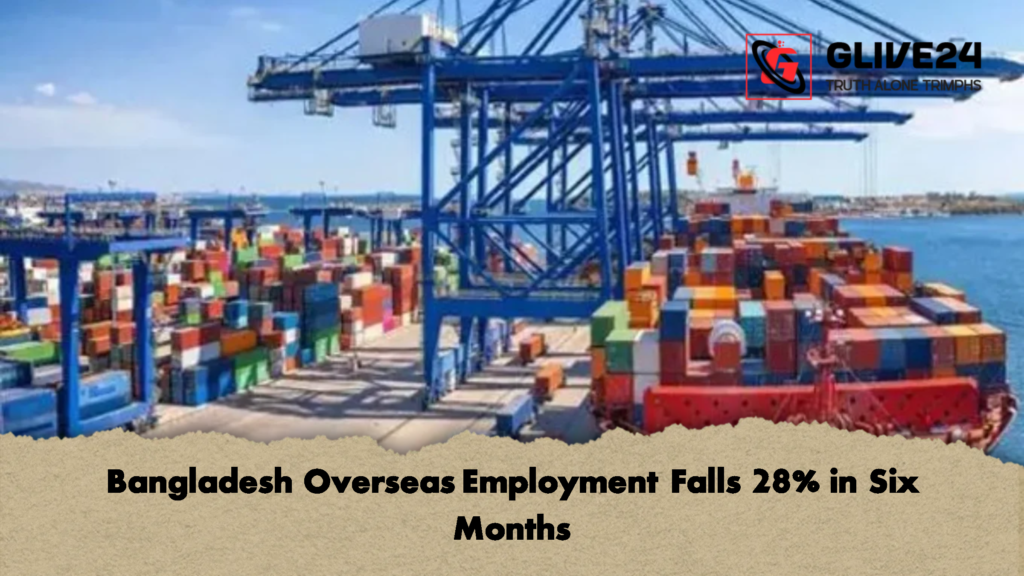
Bangladesh’s overseas employment sector has suffered a sharp setback during the first half of 2026, with the number of workers leaving the country for jobs abroad declining by nearly 28% compared with the same period last year. Industry leaders have attributed the downturn primarily to regional conflict in the Middle East, which disrupted air travel, slowed visa issuance and affected recruitment across the country’s largest overseas labour markets.
According to data from the Ministry of Expatriates’ Welfare and Overseas Employment, a total of 365,667 Bangladeshi workers travelled abroad for employment between January and June 2026. During the corresponding six-month period in 2025, the figure stood at 513,037, meaning overseas migration for work fell by 147,370 workers, a year-on-year decline of almost 28%.
The most significant reduction occurred in Saudi Arabia, Bangladesh’s largest destination for migrant workers. During the six-month period, the number of Bangladeshis travelling to Saudi Arabia declined by 150,519, highlighting the extent to which developments in the Gulf have affected the country’s overseas employment sector.
Industry stakeholders say Bangladesh’s labour migration remains heavily dependent on Middle Eastern markets. As a result, any political instability, military conflict or disruption to transport links in the region has an immediate impact on overseas recruitment and worker deployment.
The latest decline coincided with heightened military tensions centred on Iran towards the end of February, which affected aviation services across parts of the Middle East. During that period, flights to several destinations, including Saudi Arabia, experienced disruptions, leaving many Bangladeshi workers unable to travel despite having completed visa formalities and purchased airline tickets.
Although air travel has gradually returned to normal, recruitment activities have yet to regain their previous pace.
Analysis of the ministry’s data suggests that the deterioration was concentrated in the months following the outbreak of regional tensions.
Between March and June 2026, only 204,941 Bangladeshi workers departed for overseas employment. During the same four-month period in 2025, the number was 352,747. That represents a decline of 147,806 workers, accounting for virtually the entire reduction recorded during the first half of the year.
Recruitment agencies say the effects of the conflict extend beyond temporary travel disruptions. They argue that uncertainty has also reduced employers’ willingness to recruit foreign workers, delayed recruitment programmes and slowed the processing of new employment visas.
Security concerns during the conflict also affected Bangladeshi expatriates already living in the region. Reports indicate that six Bangladeshi migrant workers lost their lives during the period of heightened tensions, adding to concerns about the safety of overseas workers.
Mohammad Abu Jafar, Vice-President of the Bangladesh Association of International Recruiting Agencies (BAIRA), said the regional conflict had directly affected worker deployment to Saudi Arabia.
He said the issuance of new work visas for Saudi Arabia had fallen significantly following the outbreak of hostilities. In many cases, visas that had already been approved were later cancelled, preventing workers from travelling despite having completed the necessary preparations.
According to Abu Jafar, the conflict is the principal reason behind the decline in manpower exports during the first half of the year. He also noted that Bangladesh’s labour markets in Dubai and Oman have yet to fully reopen, further limiting overseas employment opportunities.
He added that warning signs had already emerged before the recent slowdown, particularly regarding recruitment in Saudi Arabia, where visa approvals had begun to decline.
Industry representatives believe the labour market will recover once stability returns to the Middle East, but they caution that the improvement is unlikely to be immediate. Although a ceasefire has eased some tensions, they note that no comprehensive peace agreement has yet been reached, leaving uncertainty over the region’s security environment.
Abu Jafar said the wider geopolitical tensions surrounding Iran had affected security conditions across several Gulf countries, including Saudi Arabia, Qatar, Bahrain and the United Arab Emirates, where the presence of foreign military facilities and heightened security measures disrupted normal economic activity. Those developments, he said, inevitably affected labour recruitment and worker mobility.
He warned that the consequences could continue for several more months unless the regional situation stabilises fully.
The decline in overseas employment is significant for Bangladesh’s economy, as labour migration remains one of the country’s largest sources of foreign remittance earnings. A prolonged slowdown in worker exports could affect both household incomes and future remittance inflows if overseas recruitment does not recover in the coming months.
| Key Indicator | January–June 2025 | January–June 2026 |
|---|---|---|
| Total workers sent abroad | 513,037 | 365,667 |
| Year-on-year change | — | -147,370 |
| Percentage decline | — | 28% |
| Reduction in workers sent to Saudi Arabia | — | 150,519 fewer |
| Workers sent abroad (March–June) | 352,747 | 204,941 |
| Decline during March–June | — | 147,806 fewer |
| Main destination affected | Saudi Arabia | Saudi Arabia |
| Labour markets yet to fully recover | Dubai, Oman | Dubai, Oman |
| Bangladeshi expatriates reported killed during conflict | 6 | 6 |
| Main factor behind slowdown | Stable regional conditions | Middle East conflict and visa disruptions |