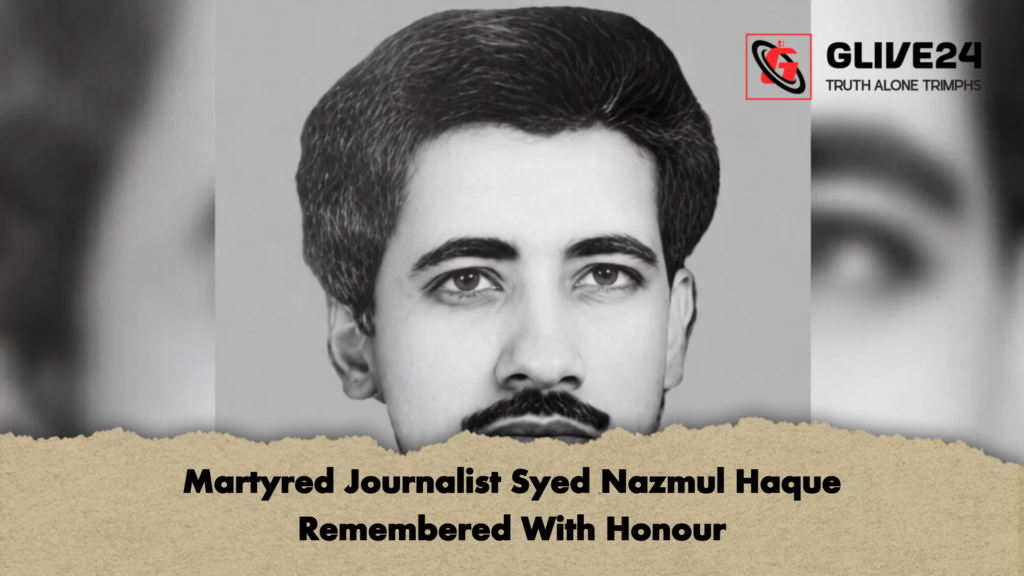
On the anniversary of his birth, Bangladesh remembers martyred journalist Syed Nazmul Haque, one of the country’s most courageous media professionals whose unwavering commitment to truth made him a powerful voice during the 1971 Liberation War. More than a reporter, he was a progressive intellectual, writer, cultural activist and a steadfast supporter of Bangladesh’s struggle for independence.
Syed Nazmul Haque was born on 5 July 1941 in Kandapara village of Khulna. His father, Emadul Haque, was a respected educationist and writer, while his mother was Shamsun Nahar. He began his education in Mathbaria, Barishal, before completing his Intermediate studies at Dhaka Government College in 1960. He later earned a Bachelor of Arts (Honours) in Political Science from the University of Dhaka in 1963, followed by a Master’s degree in the same discipline in 1964.
During his student years, he became actively involved in progressive student politics and cultural movements, reflecting his deep interest in social justice and democratic values. In 1964, he joined the inaugural batch of the Department of Journalism at the University of Dhaka and obtained a diploma in journalism. His pursuit of knowledge did not end there. In 1970, he completed a further Master’s degree in journalism, strengthening the academic foundation that would support his distinguished career.
Professionally, Syed Nazmul Haque established himself as one of the leading journalists of his generation. He served as Chief Reporter of Pakistan Press International (PPI), one of the region’s most influential news agencies at the time. Alongside this role, he worked as the Dhaka correspondent for Columbia Broadcasting System (CBS) and the Hong Kong-based Asian News Agency. He also served as City Editor of Dhaka Times, contributing significantly to the country’s developing newspaper industry.
His influence extended well beyond daily news reporting. As a respected columnist, he wrote thoughtful analyses on economics, politics, society and culture. His articles appeared in prominent newspapers and periodicals of the era, including Dawn, Pakistan Observer, Dhaka Times, Wave and Unity, earning recognition for their insight and balanced judgement.
Syed Nazmul Haque was equally devoted to cultural activities. He regularly participated in radio dramas, talks and one-act plays broadcast by Dhaka Radio and Bangladesh Television. His ability to combine journalism, literature and cultural engagement made him a distinctive public intellectual whose contributions reached audiences through multiple platforms.
One of the defining moments of his public life came in 1969. After Sheikh Mujibur Rahman was released from the Agartala Conspiracy Case, Syed Nazmul Haque accompanied the future leader of Bangladesh as his personal secretary during visits to Europe and London. The responsibility reflected the confidence placed in his integrity, discretion and organisational ability.
When the Liberation War began in 1971, Syed Nazmul Haque transformed his journalism into a vital instrument of resistance. At a time when accurate information was both dangerous and essential, he documented the atrocities committed by the Pakistani occupation forces, including mass killings, widespread repression and grave violations of human rights. Through his reports and analyses, the realities of the conflict reached international news organisations, helping the world understand the scale of the humanitarian crisis and the legitimacy of Bangladesh’s struggle for independence.
His fearless reporting inevitably drew the attention of the Pakistani military authorities and their local collaborators, particularly the Al-Badr militia, which systematically targeted intellectuals, academics and journalists during the closing days of the war.
On 10 December 1971, just six days before Bangladesh achieved victory, members of the Al-Badr force abducted Syed Nazmul Haque from his home. He never returned, and his whereabouts have never been established. Like many of Bangladesh’s finest intellectuals who were murdered or disappeared in the final days of the Liberation War, he did not live to witness the birth of the independent nation for which he had risked everything.
Today, Syed Nazmul Haque is remembered as one of Bangladesh’s martyred intellectuals, whose courage and professional integrity continue to inspire journalists and citizens alike. His life stands as a powerful reminder that truthful reporting can challenge oppression and shape history, even at the greatest personal cost.
On his birth anniversary, the nation pays profound tribute to this fearless journalist, progressive thinker and devoted patriot. His sacrifice remains a lasting symbol of the values of truth, justice and freedom, inspiring future generations to uphold these principles with courage and conviction.