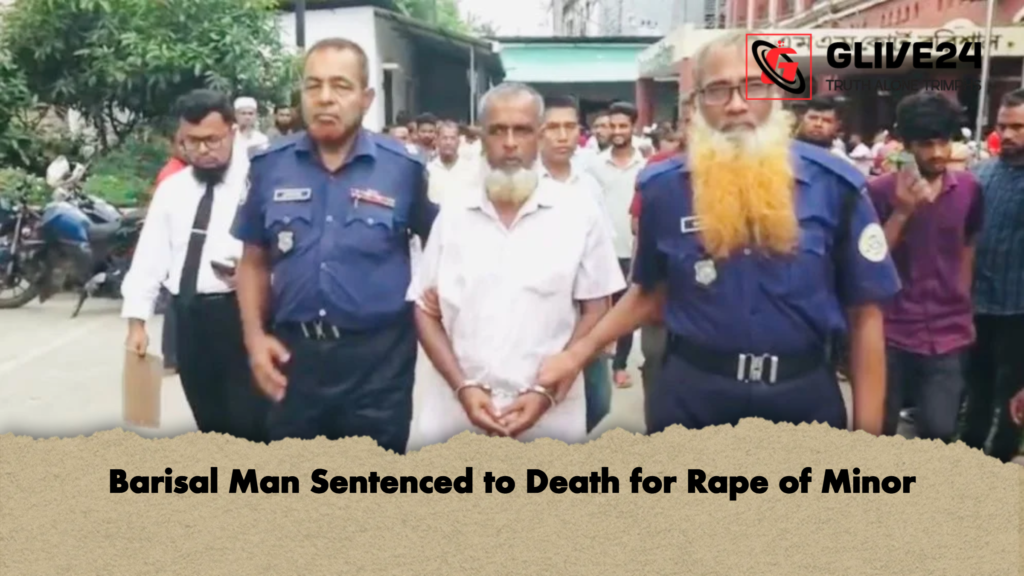
A special court in Barisal has sentenced a 52-year-old man to death for the rape of a ninth-grade madrasa student, concluding a case that has drawn significant attention to the protection of minors.
The verdict was delivered on Thursday by Judge Ashraf Uddin of the Child Violence Suppression Tribunal in the presence of the convict, Alamgir Sikdar. Alongside the capital punishment, the court imposed a fine of 100,000 Taka on the perpetrator. In a landmark directive, the tribunal also ordered the local district administration to fully bear the maintenance and living expenses of both the young victim and the child born as a result of the assault.
Background and the Trial
The convict, Alamgir Sikdar, is the son of the late Abdur Rashid Sikdar, residing in the Purba Keshabkati village under Uzirpur Upazila in Barisal. According to state prosecutor Advocate AKM Shamsul Haq, the survivor was a neighbour of the accused, which led to regular social interactions between the families.
The incident occurred on 3 March 2023, when the teenager visited Sikdar’s residence. Taking advantage of an empty house, Sikdar subjected the minor to sexual assault. The survivor subsequently became pregnant and later gave birth to a child, who is now three years old.
Following the incident, the survivor’s father initiated legal proceedings by filing a formal complaint at the Uzirpur Police Station on 21 May 2023. After a thorough investigation, the investigating officer submitted a formal charge sheet against Sikdar on 31 May 2024. The prosecution built a robust case, presenting testimonies from six witnesses whose evidence ultimately convinced the tribunal of the guilt of the accused beyond reasonable doubt.
State Welfare and Child Rights
Beyond the penal sentence, the court’s decision to assign the financial and social responsibility of the mother and child to the Barisal District Administration highlights a growing judicial emphasis on rehabilitation. Under this directive, local authorities will ensure access to education, healthcare, and daily sustenance for the young family, aiming to shield them from the social stigma and financial vulnerability often associated with such cases.
This ruling aligns with legal frameworks in Bangladesh designed to offer institutional support to victims of gender-based violence, establishing a precedent for state-sponsored welfare in the aftermath of heinous crimes. Legal experts note that while the death penalty serves as a severe deterrent, the court’s focus on the long-term well-being of the child represents a vital step towards holistic justice.