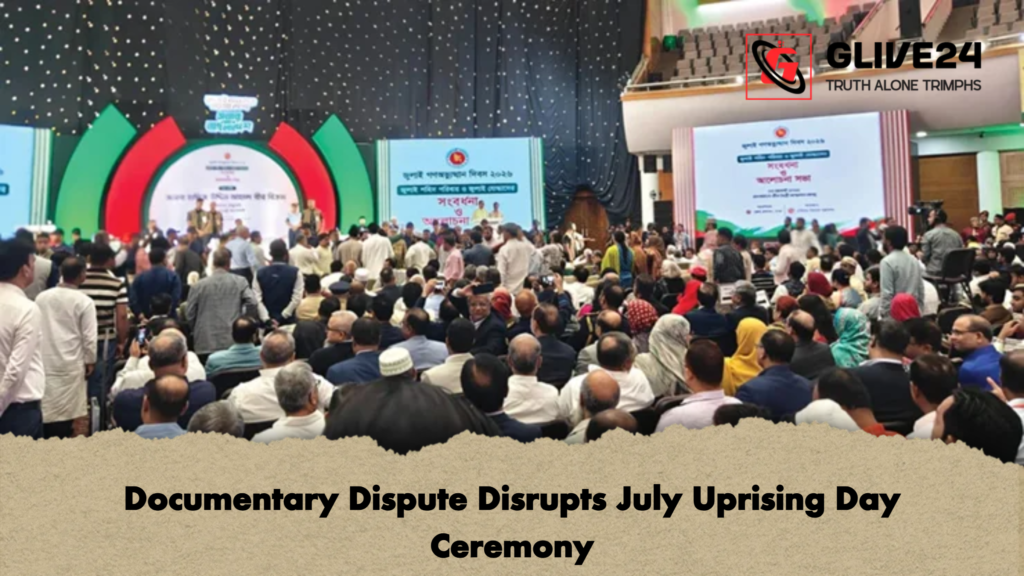
A state ceremony marking July Uprising Day 2026 was briefly disrupted after objections were raised over the content of a documentary screened during the event. Leaders and activists of the National Citizen Party (NCP), several individuals injured during the July movement, and some family members of those নিহত during the protests staged a protest inside the venue, alleging that the documentary failed to present key events and prominent figures associated with the movement accurately. The situation eventually returned to normal after government representatives assured attendees that the concerns would be reviewed and, if necessary, the documentary would be amended.
The official programme began at 12:00 noon on Wednesday at the China Friendship International Conference Centre in Sher-e-Bangla Nagar, Dhaka, with the recitation of the Holy Quran. Organised by the Ministry of Liberation War Affairs to commemorate July Uprising Day, the ceremony was attended by Acting President Hafiz Uddin Ahmed, Bir Bikram, as the chief guest. Senior government officials, political leaders, individuals injured during the July movement and members of families of those who lost their lives during the uprising were also present.
During the event, organisers screened a documentary depicting the background, key phases and major developments of the July movement. Soon after the screening concluded, several attendees voiced strong objections, arguing that important moments in the movement and the contributions of certain individuals had either been omitted or inadequately represented.
The protest quickly escalated as demonstrators chanted slogans of “Fake, fake” inside the auditorium, temporarily disrupting the programme. The interruption highlighted the sensitivity surrounding the documentation of recent political events and differing interpretations of the movement’s historical record.
Attempting to restore order, Liberation War Affairs Minister Ahmed Azam Khan appealed to those present to remain calm. He stressed that maintaining discipline during a state function was the responsibility of everyone attending the event.
The atmosphere became more tense after State Minister for Liberation War Affairs Ishraq Hossain reportedly told the audience, “You have come here to promote yourselves.” The remark drew an immediate and angry response from sections of the audience, further intensifying the confrontation inside the hall.
As tensions mounted, Home Minister Salah Uddin Ahmed addressed the gathering and urged all sides to exercise restraint. He invited those who objected to the documentary to come onto the stage and present their concerns directly, assuring them that the government would carefully consider their observations.
Responding to the invitation, NCP Member Secretary Akhtar Hossain addressed the audience and outlined what he described as significant shortcomings in the documentary. He argued that the portrayal of events, particularly those surrounding 3 August, and several other crucial stages of the July movement was incomplete or inaccurate. According to him, the matter would be raised with the highest levels of government, and discussions would be held with the relevant authorities to seek appropriate corrections. He also urged protesters and members of the bereaved families to remain peaceful while pursuing their concerns.
Later, Minister Ahmed Azam Khan acknowledged that if factual inaccuracies or omissions were found in the documentary, they would be examined in consultation with the concerned stakeholders. He said revisions would be made if necessary and expressed regret if any part of the film had caused distress to those present.
NCP Joint Member Secretary Mahin Sarkar also criticised the documentary, claiming that it had incorrectly presented the declaration of the movement’s “One-Point Demand”. According to his allegation, the film identified Prime Minister Tarique Rahman as the individual who announced the demand, whereas the party maintains that the declaration was made by Nahid Islam. He described the issue as an attempt to distort history and announced that his party would boycott the remainder of the ceremony in protest.
Mahin Sarkar further alleged that he had been assaulted by activists of the Bangladesh Nationalist Party (BNP) at the venue. He later repeated the allegation in a social media post, stating that he had been attacked after protesting against the documentary in the presence of the Acting President. He also claimed that the documentary failed to adequately acknowledge the roles of Nahid Islam and Asif Mahmud, arguing that their contributions were not presented in a manner consistent with the movement’s historical record.
The incident has renewed debate over the challenges of documenting recent political movements through official state narratives. Questions surrounding historical accuracy, the inclusion of different perspectives and consultation with stakeholders have become central to the discussion following the ceremony.
While the government has pledged to review the documentary and examine the complaints raised during the event, any decision regarding revisions is expected to attract close attention from political parties, participants in the July movement and the wider public. The episode has underlined how differing interpretations of recent history continue to shape public discourse and the presentation of national events.