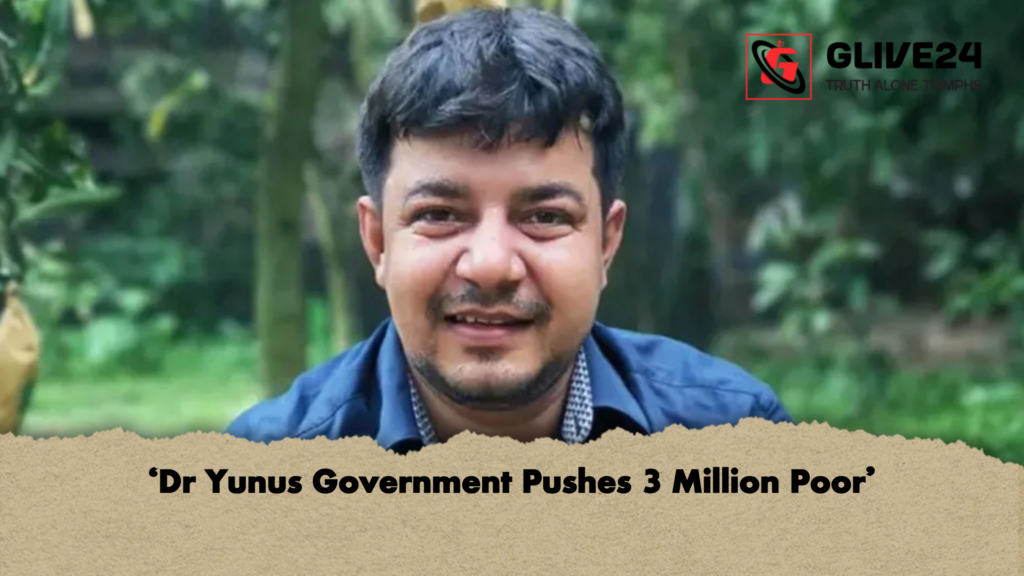
Mohammad Tarek Rahman, Secretary-General of the Amjonota Party, has claimed that the administration of Dr Yunus has plunged an estimated three million people into poverty since taking office. Speaking in a recent interview with a national media outlet, he raised serious concerns over the socioeconomic impact of the new government’s policies.
According to Rahman, the figure of three million newly impoverished citizens represents a significant setback in national poverty alleviation efforts. He warned that while reports of the current government’s initiatives are being widely circulated, the media and public should first examine the legacy of previous administrations to understand the full context.
“The moment Dr Yunus assumed office, economic measures and social programmes appear to have disadvantaged a large segment of the population,” Rahman asserted. “We must ask: who has benefited at the expense of these three million vulnerable citizens, and where has their money gone?” he added, questioning the transparency and allocation of public resources under the new regime.
Rahman emphasised that this surge in poverty is not solely a reflection of individual misfortune but stems from systemic issues, including flawed economic policies, insufficient social safety nets, and rising living costs. He highlighted that rural communities and urban low-income groups are disproportionately affected, with families struggling to meet basic needs such as food, education, and healthcare.
To provide a clearer picture of the situation, the following table summarises Rahman’s claims regarding poverty trends under the Dr Yunus government:
| Indicator | Data / Estimate |
|---|---|
| Newly impoverished population | 3,000,000 people |
| Timeframe | Since Dr Yunus assumed office |
| Most affected regions | Rural areas, low-income urban districts |
| Primary causes (claimed) | Economic policy shifts, weak social safety nets, inflation |
| Key concerns | Transparency of public funds, declining living standards |
Rahman also expressed concern for vulnerable groups, particularly children and the elderly, noting that the rise in poverty could have long-term social consequences if left unaddressed. He urged the government to implement immediate corrective measures to protect at-risk populations and to ensure that public funds are deployed transparently and effectively.
“The current trend, if not reversed, threatens to expand poverty further, potentially affecting millions more in the coming months,” he warned. Rahman concluded by calling for a comprehensive review of policy decisions and their social impact, emphasising that public accountability must remain a top priority.
The claims by the Amjonota Party have sparked a wider debate over the economic and social performance of the Dr Yunus administration, prompting policymakers, analysts, and civil society to scrutinise the government’s strategies in poverty reduction and resource allocation.