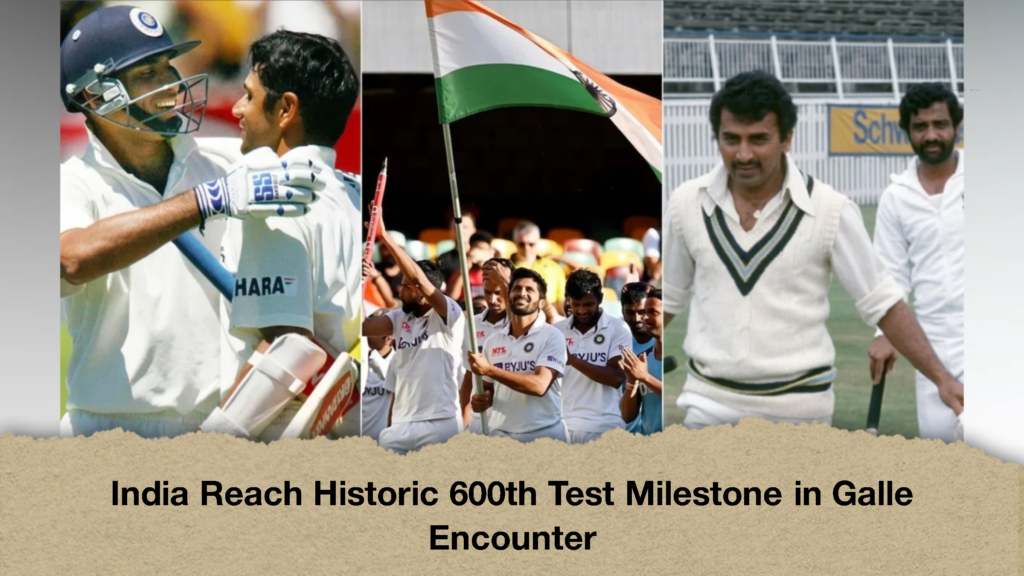
A momentous chapter in world cricket began at the Galle International Stadium as India took to the field against Sri Lanka, marking their 600th match in Test cricket history. India have now joined an elite club, becoming only the third nation after England and Australia to cross this monumental threshold in red-ball cricket. The achievement highlights a dramatic evolution across nine decades, tracing a path from modest early struggles to world-class dominance.
India made their international Test debut in June 1932 against England at Lord’s Cricket Ground in London. Under the captaincy of CK Nayudu, the team fought valiantly but ultimately succumbed to a 158-run defeat. That debut set off a long and demanding journey to secure a foothold on the international stage. It took two full decades and 25 matches before the national team achieved their first victory. That decisive breakthrough arrived on 10 February 1952 in Madras, where a side led by Vijay Hazare bowled out England to win by an inning and six runs, ending a long spell marked by 12 defeats and 12 draws against England, Australia, and the West Indies.
For much of the 20th century, India remained a respected yet statistically average force in five-day cricket. By the close of the century, they ranked sixth globally in total Test victories. Rival nations such as Pakistan and South Africa had managed to tally more match wins despite having played fewer total fixtures. However, the dawn of the 21st century sparked a comprehensive overhaul in Indian cricket. Enhanced athleticism, the emergence of world-class fast bowlers, and aggressive batting strategies transformed the team into a formidable force both at home and abroad.
Over the last quarter of a century, India have contested 263 Tests and collected 123 victories. This impressive record places them third globally in modern win counts, trailing only Australia and England. The nation’s step-by-step progression through each century of Test matches illustrates this remarkable shift in momentum:
-
1st to 100th Test: 10 wins
-
101st to 200th Test: 35 cumulative wins
-
201st to 300th Test: 56 cumulative wins
-
301st to 400th Test: 88 cumulative wins
-
401st to 500th Test: 130 cumulative wins
-
501st to 599th Test: 186 cumulative wins
Prior to stepping out for their 600th match, India’s complete record stood at 186 wins, 188 losses, 224 draws, and a single tied test—the famous 1986 encounter against Australia in Madras.
A pivotal factor in accelerating India’s modern ascendancy was the leadership era of Virat Kohli, who assumed the captaincy from Mahendra Singh Dhoni. Between 2014 and 2020, Kohli oversaw 68 Test matches, achieving 40 wins and establishing a win rate of 58.82 per cent. His tenure instilled a relentless winning mindset, particularly on overseas tours in Australia, England, and South Africa.
Skipper Shubman Gill leads the national squad in this commemorative fixture in Sri Lanka. Speaking to journalists ahead of the opening toss in Galle, Gill reflected on the profound significance of the occasion, noting that while leading India in any Test match represents an extraordinary honour, doing so for the nation’s 600th appearance adds a deeply memorable layer to his career.
As play continues in Galle, India reflect on a storied past while continuing to shape the future of five-day cricket. Currently, England lead the all-time appearance list with 1,097 matches, followed by Australia with 883.