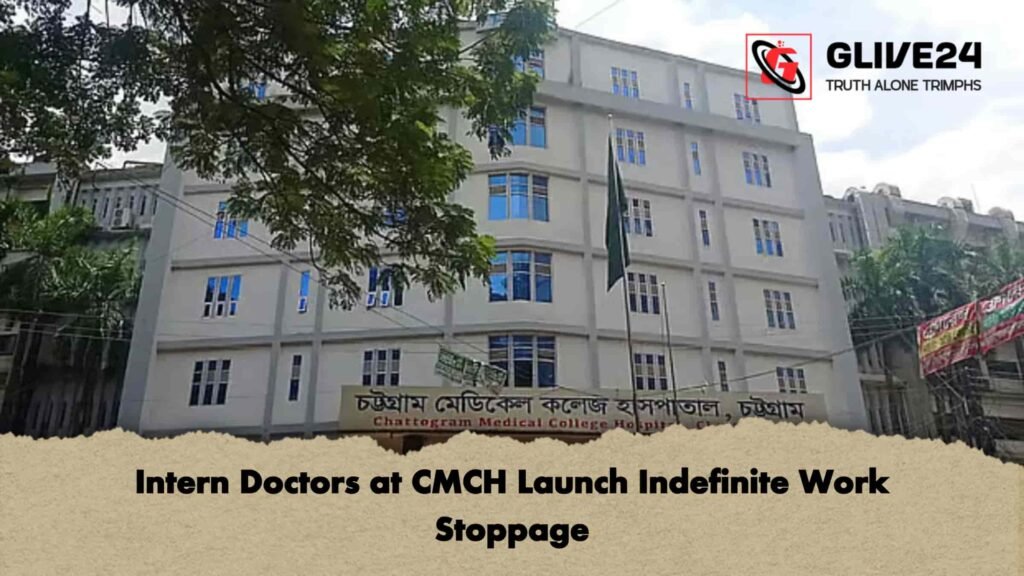
Intern clinicians at the Chittagong Medical College Hospital (CMCH) have entered into an indefinite work stoppage to enforce a six-point list of demands relating to structural, financial, and legal reforms. The full strike commenced at 08:00 on Sunday, succeeding a two-day series of human-chain protests. Concurrently, students enrolled at Chittagong Medical College expressed solidarity with the medical interns by staging a complete boycott of academic classes from 11:00 onwards.
The strike action was formally publicised via a media statement distributed at approximately 01:30 on Sunday, signed by Md Irfanur Rahman, the Office Secretary of the CMCH Intern Doctors’ Association. To further demonstrate their grievances, the striking medical personnel staged a mass protest rally outside the principal gates of the hospital infrastructure at 11:00.
Origin of the Disputes
The underlying industrial friction stems from an administrative policy document circulated on 19 May by the Health Education and Family Welfare Division of the Ministry of Health and Family Welfare. This directive amended the current framework governing Fellowship of the College of Physicians and Surgeons (FCPS) training, introducing highly contested measures, which include:
-
The suspension of fresh deployments across specific specialities at both Dhaka Medical College Hospital and Shaheed Suhrawardy Medical College Hospital.
-
The implementation of a mandatory two-year public service placement at rural sub-district (upazila) medical facilities.
-
The restriction of training allowances under a merit-demarcated quota system.
Association representatives observed that whilst minor concessions were offered regarding their primary concern, no verifiable legislative or administrative steps have been enacted by state representatives to address the remainder of their petition. This lack of institutional progress prompted the decision to cease all professional hospital duties permanently until full resolution is achieved.
The Seven Elements of Reform
The following framework presents the precise administrative modifications demanded by the CMCH Intern Doctors’ Association to resolve the deadlock:
| Core Target Category | Precise Legislative & Administrative Demand |
| FCPS Training Directives | Retraction of the 19 May Health Division policy within 48 hours, followed by a new regulatory framework. |
| Workplace Safeguards | Promulgation of a comprehensive Healthcare Worker Protection Act, to be enforced through speedy trial tribunals. |
| Remuneration Framework | Standardization of the monthly intern stipend to 30,000 BDT and the creation of an independent pay scale for state doctors. |
| Civil Service Admission | Extension of the maximum eligibility age limit for entering the BCS Health Cadre to 34 years. |
| Regulatory Authority | Transformation of the BMDC Act 2025 into a full act of parliament rather than an ordinance, and legal crackdowns on bogus practitioners. |
| Assessment Tariffs | Enforcement of a strict 1,000 BDT fee ceiling for all entry evaluations under the BMDC and Bangladesh Medical University. |
Institutional Negotiations
Amidst the escalating disruption, the Bangladesh College of Physicians and Surgeons (BCPS) issued a clarifying circular. The body declared that urgent consultations had occurred between the Ministry of Health and Family Welfare and the leadership of the BCPS to address the public healthcare friction.
As an initial consequence of these talks, the state agreed to completely invalidate the requirement for mandatory rural upazila training deployments. Additionally, the BCPS adjusted its allowance policy, confirming that private medical candidates who pass their FCPS Part-I examinations will receive standard training stipends, provided their residencies are completed at BCPS-accredited government medical college hospitals and central institutes.
Sajib Hossain, the President of the CMCH Intern Doctors’ Association, clarified that the executive committee had purposefully delayed the strike timeline out of ethical concern for critical patient treatment. He emphasized that the group had extended the original 48-hour deadline by an additional 24 hours to allow for a state response. “Our backs are now firmly against the wall,” Hossain remarked. “We have been left with no viable choice but to proceed with this indefinite work stoppage.”