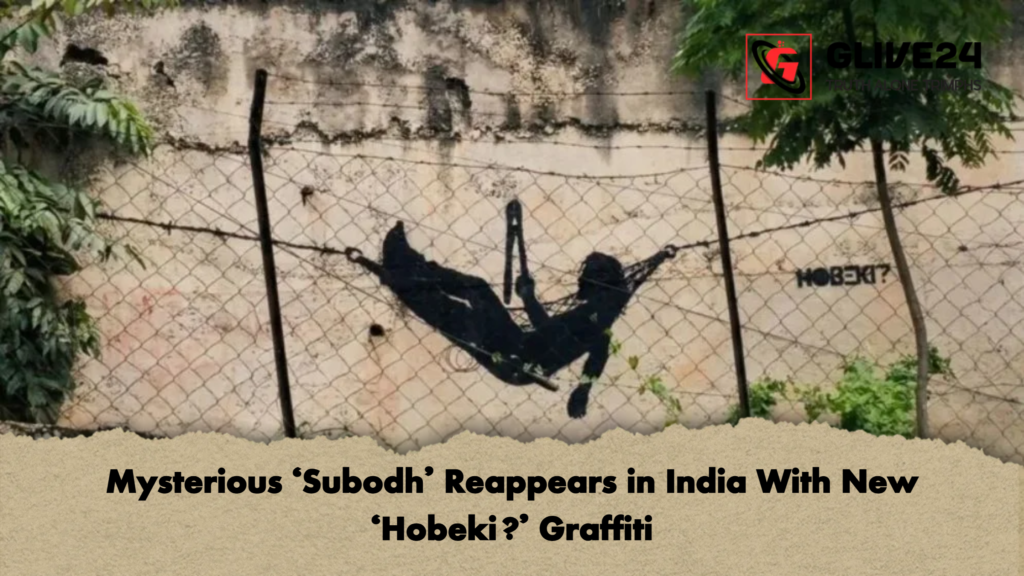
The mysterious ‘Hobeki?’ graffiti series, which has appeared on walls across Bangladesh for nearly a decade, has now surfaced beyond the country’s borders. The latest artwork featuring the iconic character Subodh has been discovered in the Indian state of Sikkim, adding a fresh chapter to one of South Asia’s most enigmatic street art movements.
The graffiti was painted on the wall of the Majhitar Nala Bridge along the Gangtok–Rangpo Road on the final day of June. Created using spray paint and stencil techniques on a concrete surface, the mural stretches for approximately 20 feet. At its far end, the artist’s familiar signature tag, ‘Hobeki?’, is prominently displayed.
The artwork depicts Subodh lying in a hammock while wearing shoes, his long, untidy hair flowing freely. The hammock is suspended between two sections of barbed wire, creating a striking visual metaphor. In his right hand, Subodh holds a wire cutter, while his left arm hangs loosely outside the hammock. A bucket has been placed directly beneath him, adding another symbolic element to the composition, though its intended meaning has not been explained publicly.
Residents living near the Majhitar Nala Bridge told local media that the graffiti had been visible on the wall for several days before attracting wider attention.
Its appearance comes at a particularly sensitive moment in regional politics. Tensions have recently emerged along the Bangladesh–India border following allegations surrounding the forced return of individuals described by Indian authorities as Bangladeshi nationals after accusations of illegal entry. Just two days before the mural appeared, India also announced the resumption of tourist visas for Bangladeshi citizens after a suspension of nearly two years, making the timing of the artwork especially noteworthy.
The anonymous artist behind ‘Hobeki?’ has never publicly identified themselves, and no individual has ever claimed ownership of the murals. Documentation of the artist’s work is carried out by an organisation called Artcon, which has closely followed the evolution of the series over the years.
According to Artcon founder ARK Ripon, the choice of Sikkim as the location for the latest mural is closely linked to themes surrounding Bangladesh–India relations. He said the symbolism of barbed wire, the wire-cutting tool held by Subodh, and the issue of the Teesta River’s water all informed both the concept and the selection of the site.
Ripon explained that Rangpo is widely recognised as the principal gateway to Sikkim. Travellers entering the state from West Bengal pass through the town, where permits, identity verification and official documentation form part of everyday movement. Against that backdrop, he argued, the mural becomes more than a piece of public art. Instead, it transforms into what he described as a “border event”, inviting viewers to reflect on the political and geographical realities surrounding the location.
Throughout Bangladesh, the Subodh series has consistently been associated with subtle political commentary, social criticism and visual satire. Although the artist has never provided explanations for individual works, each mural has typically carried symbolic imagery that encourages public interpretation rather than offering explicit messages.
A defining feature of the series is its use of stencil art, allowing the artist to produce bold, instantly recognisable images while maintaining anonymity. The recurring figure of Subodh has become one of Bangladesh’s most recognisable examples of contemporary street art, frequently sparking discussion on social media and among artists, academics and the general public.
The precise origin of the Subodh series remains unknown. Neither the date of its creation nor the identity of its creator has ever been confirmed. The murals first gained widespread public attention around 2017, when they began appearing across Dhaka and other parts of Bangladesh. Reports at the time suggested that law enforcement agencies also attempted to identify the anonymous artist, but no verified information has ever emerged.
The latest appearance of Subodh in Sikkim extends the reach of the long-running series beyond Bangladesh and reinforces its reputation as a form of street art that blends mystery, symbolism and commentary on contemporary social and political issues without revealing the identity of its creator.