
Khabor Wala Desk
Published: 28th May 2026, 9:01 AM
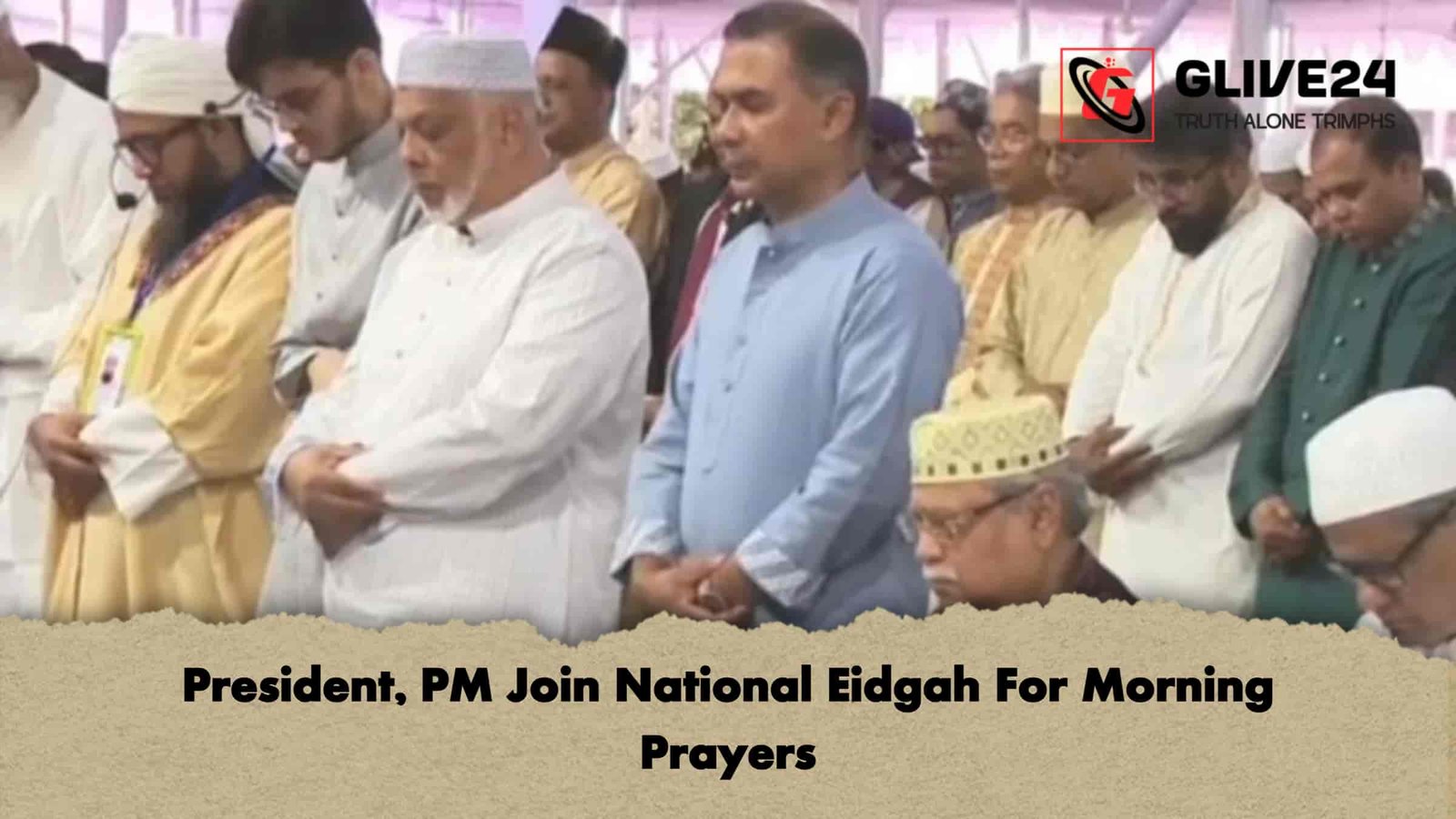
The principal congregation of the holy festival of Eid-ul-Adha was observed at the National Eidgah in Dhaka at 07:30 BST on Thursday, 28 May 2026. The major religious assembly brought together thousands of devout Muslims alongside the highest echelons of the state administration, establishing a structured environment for the national holiday’s formal prayers.
President Mohammed Shahabuddin and Prime Minister Tarique Rahman led the state delegation at the venue, accompanied by senior members of the cabinet. High-profile politicians, civil bureaucrats, members of the diplomatic corps, and citizens from various socio-economic backgrounds stood together in rows, reflecting the unified nature of the annual festival.
The formal prayer proceedings were led by Mufti Maulana Mohammad Malek, the Khatib of the Baitul Mukarram National Mosque, who served as the chief imam for the congregation. Following the conclusion of the two-unit Eid prayer, the Khatib delivered the traditional Arabic and Bengali sermon (Khutbah), emphasizing the values of sacrifice, self-restraint, and civic empathy.
The primary administrative and political figures who joined the frontline rows at the National Eidgah are structured in the table below:
| Public Dignitary | Official State Roster / Portfolio | Institutional Authority |
| Mohammed Shahabuddin | President of the People’s Republic of Bangladesh | Head of State |
| Tarique Rahman | Prime Minister of the People’s Republic of Bangladesh | Head of Government |
| Salahuddin Ahmed | Minister of Home Affairs | Ministry of Home Affairs |
| Mir Shah Alam | Minister of State for Local Government | Ministry of Local Government |
Following the completion of the sermon, the congregation took part in a collective supplication (Munajat) that commenced precisely at 07:51 BST. The prayer focused on the continued welfare, economic stability, and progress of the nation and its citizens.
The Khatib also extended the supplication to global affairs, offering prayers for the safety, protection, and relief of Muslim populations facing persecution and oppression in various parts of the world. The service concluded with a call for worshippers to integrate the foundational lessons of Eid-ul-Adha—specifically its values of humanitarian service and sacrifice—into their daily social interactions.
The atmosphere surrounding the High Court area remained lively from the early hours of dawn, with large groups of families, colleagues, and friends walking toward the venue.
To maintain absolute public safety, law enforcement personnel deployed strict access-control protocols around the perimeter. Worshippers were permitted entry into the main grounds only after passing through designated security arches and undergoing manual physical screening.
The physical layout of the venue handled the large crowds efficiently. The main pavilion enclosure was engineered to safely hold approximately 35,000 worshippers simultaneously. Dhaka South City Corporation (DSCC) authorities established separate entry gates and designated seating enclosures for state guests, general worshippers, and women.
Furthermore, the venue infrastructure included specialized ablution areas, chilled drinking water points, modern sanitation blocks, and temporary medical camps staffed with emergency healthcare personnel. At the close of the service, the President, the Prime Minister, and general citizens exchanged traditional Eid greetings before the state dignitaries departed under official protocols.


Comments