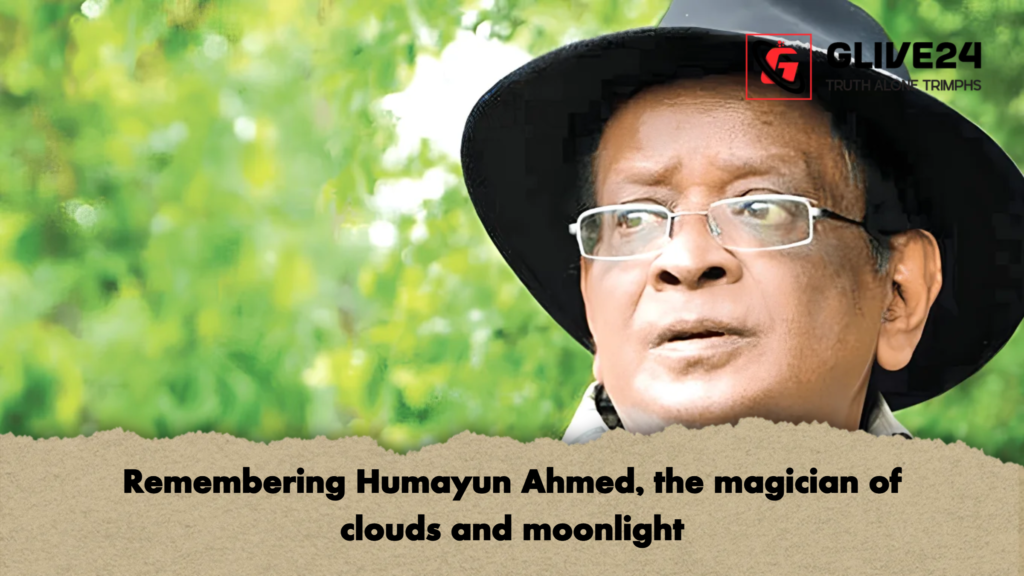
Certain literary luminaries cast a light so brilliant it never truly fades. Humayun Ahmed remains an irreplaceable titan in the realm of Bengali literature. He was far more than an exceptionally popular author; he defined an era, captured the raw emotions of successive generations, and served as an intimate companion to millions of lonely souls navigating the complexities of life.
Today, 19 July, marks a somber anniversary for Bengali language and literature. On this day in 2012, the legendary wordsmith passed away at Bellevue Hospital in New York after a prolonged, valiant battle with colon cancer. Whilst he may have departed from the physical world, death has failed to diminish his presence. He endures vibrantly through hundreds of stories, novels, television dramas, and cinematic masterpieces, as well as the timeless characters he breathed life into.
His beloved creations continue to wander through the cultural psyche of Bangladesh. Himu, the eccentric, barefoot bohemian, still roams the alleyways of Dhaka in his signature yellow panjabi. Misir Ali, the quintessential investigator, continues to pierce the darkness of human psychology with the unwavering light of pure logic. Rupa’s silent, unrequited devotion still draws sighs from readers, while iconic figures like Shuvro and Baker Bhai evoke deep nostalgia. Whether through seminal works like Nondito Noroke (In Blissful Hell) and Shonkhonil Karagar (The Shonkhonil Prison), or unforgettable television productions like Kothao Keu Nei, Ahmed’s creative spirit remains deeply woven into the daily lives of Bengalis.
During his final days in the United States, where he was undergoing intensive cancer therapy, the author found himself isolated in a snow-covered New York landscape. Gazing out of a hospital window at the pristine, white scenery, he reportedly turned to a companion and expressed a profound yearning for his homeland. He confessed that the snow brought him no joy, longing instead for the torrential monsoon rains at Nuhash Pallid, his beloved rustic estate. He dreamed of the rhythmic sound of water dripping from the leaves and the distant croaking of frogs, wondering if he would ever experience that natural symphony again. These few poignant words encapsulated his entire artistic soul—an unbreakable bond with the soil, rain, and rural beauty of Bangladesh.
The maestro did eventually return to his native land, though not with his characteristic vitality. He returned in a coffin, silenced forever. He was laid to rest beneath the shade of a lychee orchard at Nuhash Palli, the green sanctuary he painstakingly built. To this day, his gravesite feels uniquely connected to the elements he romanticised. Every monsoon shower seems to weep softly over his resting place, and the silver glow of every full moon appears to linger by his headstone, whilst the rustling leaves converse with the ghosts of his untold stories.
Ahmed’s spectacular literary ascent began in 1972 with his debut novel, Nondito Noroke. Over the subsequent four decades, he penned more than four hundred books and directed a string of critically acclaimed films and television series, cementing his status as the most influential Bangladeshi writer of the modern era. His unparalleled contributions earned him the country’s highest accolades, including the Bangla Academy Literary Award, the Ekushey Padak, and the Independence Award. His storytelling did not merely entertain; it democratised reading, exploring joy, grief, romance, the liberation war, and scientific rationalism in a beautifully lucid language that resonated with ordinary citizens and academics alike.
Perhaps his greatest gift was teaching his audience that solitude possesses its own exquisite beauty. Through his words, he became a companion during rainy afternoons, moonlit nights, and quiet midnight reading sessions. On his death anniversary, the nation offers deep respect and eternal gratitude to this literary magician. Bodies perish, but a true creator remains immortal. As long as the Bengali language is spoken, Himu will walk the streets, Misir Ali will unravel mysteries, and the monsoon rain will fall beautifully over Nuhash Palli.