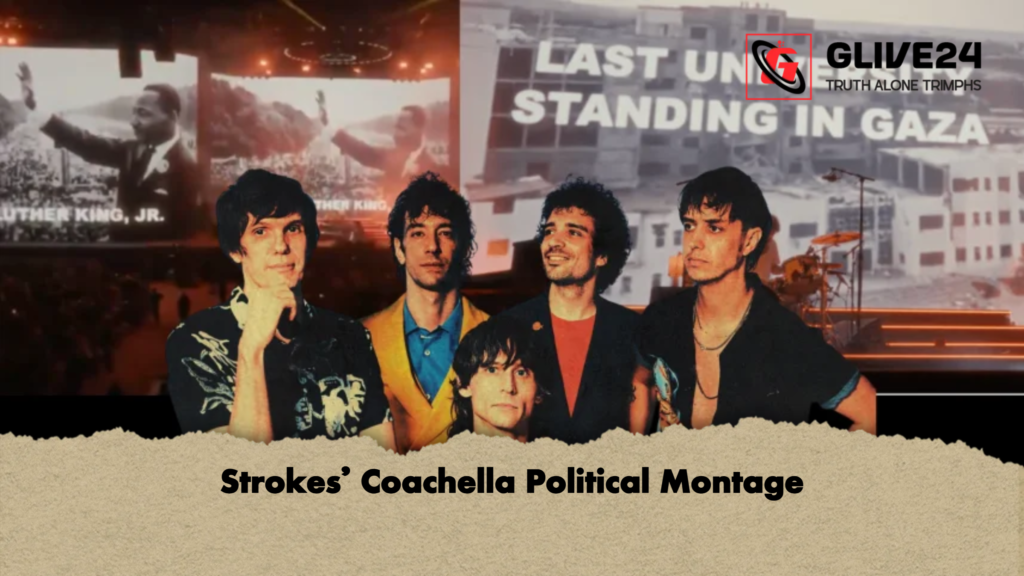
At the second weekend of California’s Coachella Valley Music and Arts Festival, American rock band The Strokes drew significant attention after incorporating a politically charged visual sequence into their headline performance. The segment, screened during the closing portion of their set, combined archival and contemporary imagery alongside pointed references to United States foreign policy and historical interventions.
During the performance, the band revisited their track “Oblivious,” which had not been performed live for an extended period. Frontman Julian Casablancas repeatedly delivered the line “which side are you on,” synchronised with the visuals displayed on the large stage screens, intensifying the interpretative weight of the sequence.
The accompanying video montage reportedly included footage of recent bombardments in Gaza and Iran, alongside references to multiple historical events in which United States agencies have been accused of involvement in foreign political transitions. The presentation also highlighted a series of contentious episodes in twentieth-century history that remain subject to differing interpretations among historians and policymakers.
The montage concluded with imagery depicting military aircraft following scenes of conflict, before abruptly ending the performance segment. The sequence has since been widely discussed as one of the most explicitly political statements delivered during this year’s festival.
Earlier in the festival’s opening weekend, Irish group Kneecap had also attracted controversy after making critical remarks concerning Israeli military operations. However, in contrast to that episode, The Strokes’ visual presentation was broadcast without interruption during the live stream, according to reports from attendees and coverage of the event.
The historical references included in the montage are summarised below:
| Event | Year | Location/Context | Issue Highlighted |
|---|---|---|---|
| Overthrow of Mohammad Mossadegh | 1953 | Iran | Allegations of foreign involvement |
| Removal of Salvador Allende | 1973 | Chile | Military coup and external influence claims |
| Death of Omar Torrijos | 1981 | Panama | Disputed cause: accident or conspiracy |
| Death of Jaime Roldós | 1981 | Ecuador | Ongoing questions over circumstances |
| Legal case linked to Martin Luther King Jr. assassination | 1999 | United States | Court ruling and subsequent debate |
| Bombardments in Gaza and Iran | Recent | Middle East | Representation of ongoing military conflict |
The Strokes’ performance blended music with a sequence of politically and historically loaded imagery, prompting renewed discussion about the role of large-scale music festivals as platforms for socio-political commentary. While some observers view such presentations as an exercise of artistic freedom and expression, others consider them contentious interventions in politically sensitive issues.
The set has contributed to broader debate surrounding the boundaries between performance art, historical interpretation and political messaging within contemporary live music culture.