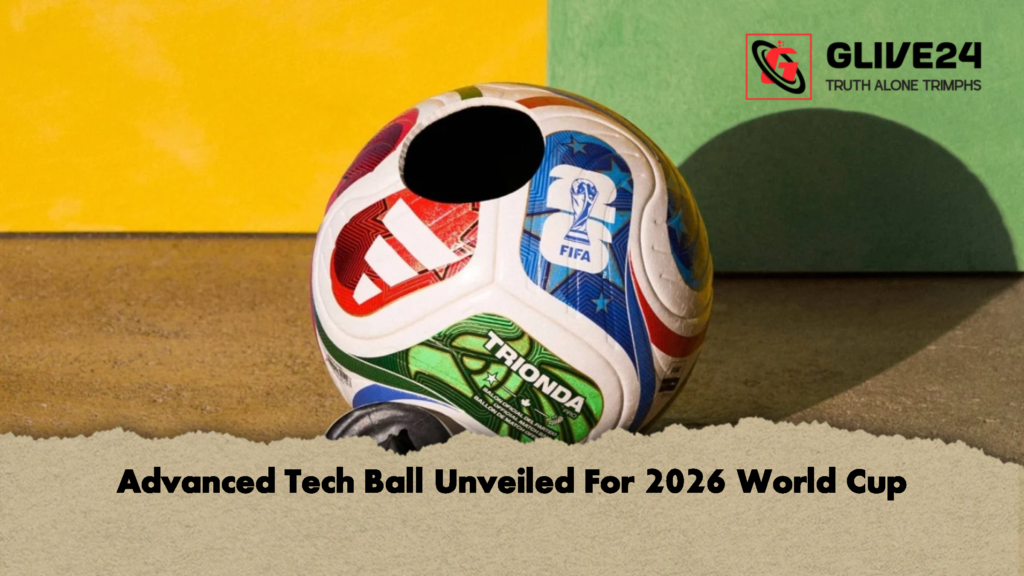
Football fans across the globe are highly anticipating the 2026 FIFA World Cup. This landmark tournament is set to break records as the first iteration to feature an expanded roster of 48 teams. Scheduled to commence on the pitch on 11 June, the tournament has already generated significant discussion regarding its technical innovations. At the heart of this discussion is “Trionda”, the official tech-driven match ball engineered specifically for the competition by Adidas.
The tournament will be staged across 16 host cities distributed throughout the United States, Canada, and Mexico. To honour the three co-hosting nations, Adidas designed the match ball with a direct visual tribute. The name “Trionda” itself is derived from a combination of the English prefix “tri-” (meaning three) and the Spanish word “onda” (meaning wave). Its exterior design incorporates the primary colours of the host nations’ flags: blue for the United States, red for Canada, and green for Mexico.
Beyond its symbolic appearance, the ball represents a major shift in sports engineering, featuring integrated deep-seam technology and a high-performance internal motion sensor. The primary objective of these advancements is to provide maximum aerodynamic stability and to enhance the accuracy of Video Assistant Referee (VAR) decisions.
The internal architecture of Trionda introduces the most significant technological transformation. Nestled inside the ball is a sophisticated 500 Hz motion sensor chip. This inertial measurement unit operates as an advanced tracking device, collecting and transmitting spatial data approximately 500 times per second. By continuously broadcasting this data, the system registers the exact millisecond the ball is touched, its exact coordinates on the pitch, its current velocity, and its trajectory. Consequently, match officials receive instantaneous data regarding whenever a player makes contact with the ball.
Despite the inclusion of this hardware, the sensor chip is remarkably lightweight, weighing a mere 14 grams. While connected-ball technology has been deployed in previous tournaments, the system inside Trionda has been highly refined. Unlike earlier models where the technology required complex internal suspension lines anchored to the center of the bladder, this chip is seamlessly integrated directly into one of the outer panels. This positioning ensures that the ball retains its natural weight distribution, flight path, bounce consistency, and general tactile responsiveness, meaning players will experience no structural distortion during active play.
Another distinct feature of this high-tech sporting equipment is its integrated power system. To keep the internal electronic tracking system operational throughout a fixture, the ball must be fully charged prior to kick-off. Referees and match coordinators are tasked with checking the power levels alongside other electronic refereeing apparatus. A complete charging cycle provides up to six hours of continuous battery life, which easily spans the entire duration of a standard match including the pre-match warm-ups and half-time intervals.
Externally, there are no visible indicators to suggest that the ball houses such complex electronic components. The tracking mechanism operates in tandem with specialized high-speed optical cameras installed throughout the stadium infrastructure. By combining the 500 Hz data stream from the ball with the multi-angle footage captured by the stadium cameras, officiating systems can construct a live three-dimensional model of the match. This unified platform provides instantaneous analyses of complex incidents, allowing VAR officials to rapidly resolve tight offside calls, handball claims, goal-line disputes, and contested touches. Ultimately, Trionda functions as a highly precise, data-driven instrument engineered to secure officiating accuracy at every moment of the game.