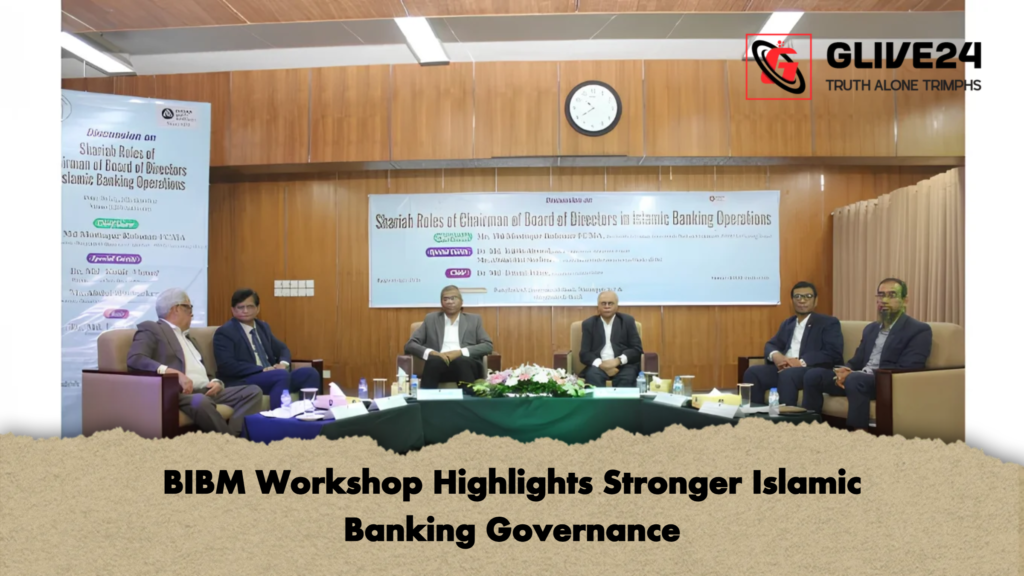
Governance, institutional accountability and stronger Shariah compliance emerged as the key themes of a joint workshop organised by the Bangladesh Institute of Bank Management (BIBM) and the Islamic Banks Regulation and Policy Department of Bangladesh Bank in Dhaka on Saturday.
The workshop, titled Discussion on Shariah Roles of Chairman of Board of Directors in Islamic Banking Operations, brought together regulators, banking executives, academics and industry professionals to discuss ways of strengthening governance standards and reinforcing public confidence in Bangladesh’s rapidly expanding Islamic banking sector.
Md Mostaqur Rahman, FCMA, Governor of Bangladesh Bank and Chairman of the BIBM Governing Board, attended the programme as the chief guest. Dr Kabir Ahmed, Deputy Governor of Bangladesh Bank, and Abdul Hai Sarker, Chairman of the Bangladesh Association of Banks, joined the event as special guests.
The programme began with a welcome address by Professor Dr Mohammad Tazul Islam, Director of Training at BIBM, while Md Ashraful Alam, Executive Director of the Islamic Banks Regulation and Policy Department of Bangladesh Bank, delivered the inaugural remarks. The session was chaired by Dr Ezazul Islam, Director General of BIBM.
Addressing the gathering, Md Mostaqur Rahman said a significant proportion of depositors in Bangladesh prefer Islamic banking services, making strong Shariah governance essential for maintaining public trust. He stressed that Shariah Councils should play a more proactive and effective role in ensuring that Islamic banking operations remain fully compliant with Islamic principles.
He also said Bangladesh Bank continues to place the highest priority on improving governance standards across the banking industry to rebuild public confidence and ensure that financial institutions operate independently of political influence. The Governor expressed optimism that Bangla QR would achieve wider nationwide adoption over the coming year, encouraging further growth in digital financial transactions.
Speaking at the event, Abdul Hai Sarker observed that Bangladesh has comparatively more banks than many neighbouring countries. He suggested that a more rational number of financial institutions would improve management quality, regulatory supervision and operational efficiency throughout the banking sector.
Deputy Governor Dr Kabir Ahmed said the country’s new regulatory framework significantly broadens the responsibilities assigned to Shariah compliance functions while strengthening institutional mechanisms designed to ensure effective oversight. He added that the growing popularity of Islamic banking makes robust Shariah governance increasingly important for the sector’s long-term sustainability.
Chairing the workshop, Dr Ezazul Islam said the continued expansion of Islamic banking requires stronger governance structures and more effective compliance mechanisms. He noted that strict adherence to Shariah principles enhances customer confidence while promoting stability, transparency and sustainable growth across the industry.
He also emphasised the importance of close coordination among boards of directors, senior management and Shariah supervisory bodies to develop an internationally competitive Islamic banking system. Reaffirming BIBM’s commitment to the sector, he said the institute would continue supporting the banking industry through research, professional training and knowledge-sharing initiatives.
During his remarks, Md Ashraful Alam revealed that the drafting of the proposed Islamic Banking Act has entered its final stage. He expressed confidence that the new legislation would strengthen the regulatory framework while improving transparency, efficiency and accountability in Islamic banking operations.
The workshop also featured three technical presentations delivered by members of the Bangladesh Bank Shariah Advisory Board. The presentations examined the application of Islamic legal maxims in banking and finance, the Shariah Governance Framework and its implications for Islamic banking operations in Bangladesh, and the responsibilities of chairmen of boards of directors in ensuring effective Shariah compliance.
The programme concluded with an open discussion session, where participants exchanged views and offered recommendations aimed at strengthening governance, enhancing Shariah oversight and supporting the continued development of Islamic banking in Bangladesh.
Directors of Islamic banks, senior officials from Bangladesh Bank, representatives of scheduled banks and financial institutions, academics, researchers and banking professionals attended the workshop.