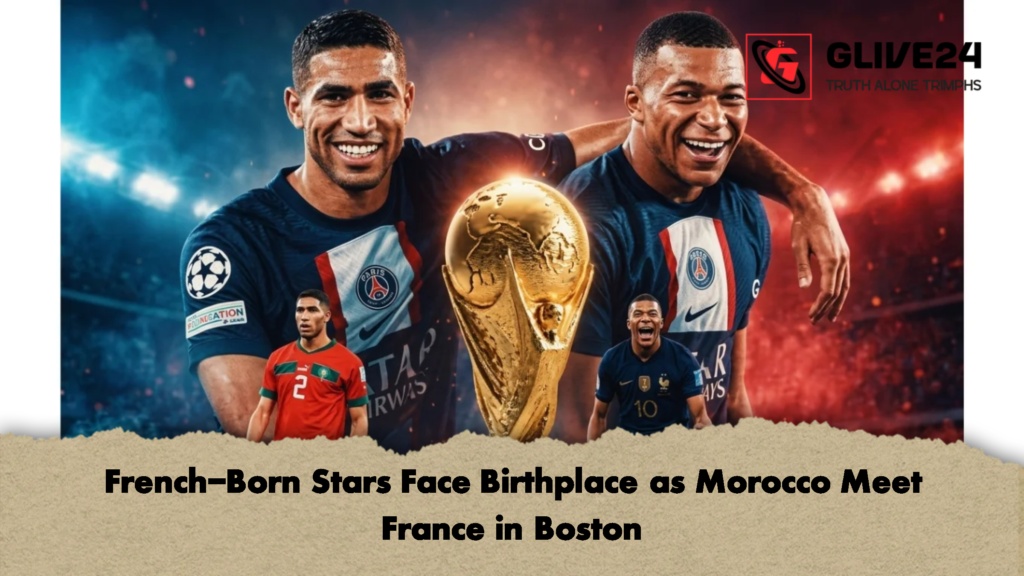
The expanded 48-team FIFA World Cup has reached its ultimate crucible, leaving just eight elite nations standing in the quarter-finals. Whilst every remaining fixture promises immense drama, the high-voltage encounter between Morocco and France at the Boston Stadium carries a distinct, deeply personal narrative. For six members of the Moroccan squad, this match transcends standard international competition. They are preparing to take the pitch against France—the very country where they were born, raised, and educated in football.
This fascinating sub-plot stems from Morocco’s highly sophisticated, multi-year blueprint targeting dual-national talent. By actively engaging with its vast global diaspora, the Royal Moroccan Football Federation has systematically bolstered its squad depth. Within the current 26-man roster navigating this tournament, six specific individuals—Redouane Halhal, Gessim Yassin, Samir El Mourabet, Neil El Aynaoui, Issa Diop, and Ayoub Bouaddi—possess French birth certificates. As the children and grandchildren of North African immigrants, these athletes inherited a dual footballing identity, holding legitimate eligibility for both the European powerhouse and the Atlas Lions.
Among these six, none has attracted more media scrutiny than 18-year-old midfield prodigy Ayoub Bouaddi. The youngster’s international allegiance shift caused considerable friction earlier this year; he had been serving as the captain of the French Under-21 national side. His sudden decision to defect to Morocco just before the World Cup cycle sent shockwaves through the French football establishment at Clairefontaine, underscoring the fierce, modern tug-of-war for elite academy prospects.
Yet, this pipeline from the French academy system to the Moroccan senior squad is a well-trodden path rather than an anomaly. For over a decade, Moroccan scouts have scoured Europe to convince dual-nationality players to represent their ancestral homeland. This long-term recruitment strategy previously yielded fundamental national team pillars who chose the red and green over the French Bleu, including the likes of Sofiane Boufal, Romain Saïss, Marouane Chamakh, Medhi Benatia, and the iconic Mustapha Hadji.
When the match gets underway in Boston, the narrative will inevitably shift from administrative allegiance to tactical execution. For these six French-born players, the encounter demands total emotional compartmentalisation. They must now attempt to orchestrate the downfall of their nation of birth, carrying the aspirations of a diaspora and aiming to guide their ancestral homeland into the semi-finals of world football.