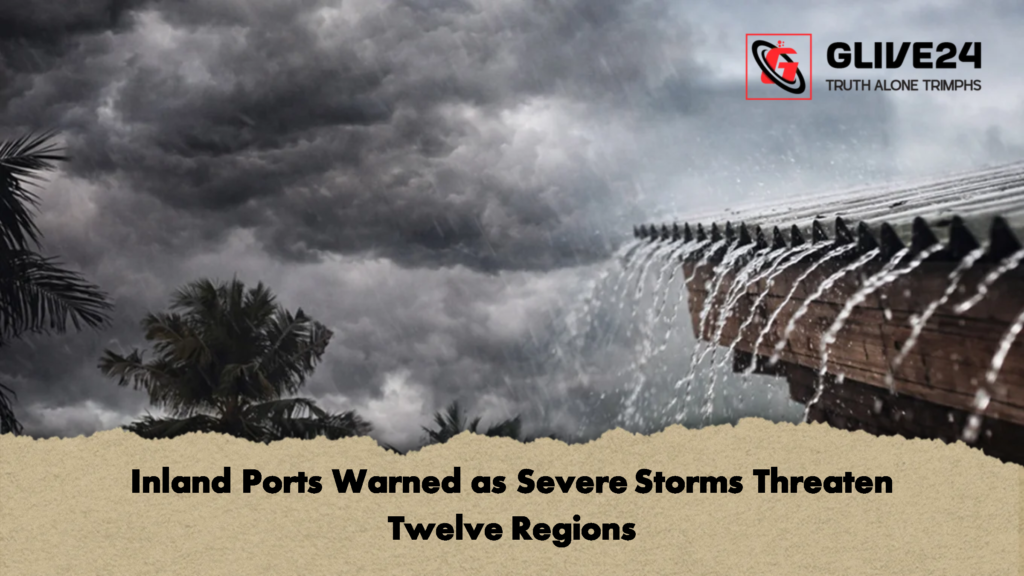
The Bangladesh Meteorological Department has issued an urgent weather warning for twelve regions across the country, advising internal river ports to hoist cautionary signal number one. Meteorologists announced on Thursday evening that unstable atmospheric conditions are likely to trigger sudden, violent squalls capable of reaching speeds of up to 60 kilometres per hour.
The official forecast, released at 9:00 pm on Thursday, 9 July, indicates that these turbulent conditions will persist until at least 9:00 am on Friday. Experts have warned that intense atmospheric instability during this twelve-hour window will result in heavy downpours accompanied by frequent thunder and lightning strikes.
The administrative zones identified as most vulnerable to these sudden weather shifts span the central, south-western, southern, and north-eastern belts of the delta. The advisory explicitly covers Dhaka, Faridpur, Kushtia, Jessore, Khulna, Barisal, Patuakhali, Noakhali, Comilla, Chittagong, Cox’s Bazar, and Sylhet. In these areas, temporary gusty winds are predicted to blow from the south or south-east, fluctuating between 45 and 60 kilometres per hour.
This latest warning arrives amidst an active monsoon season, a period when low-pressure systems over the Bay of Bengal regularly sweep across the country. Bangladesh’s vast inland river networks are highly susceptible to these sudden disruptions. Small motor launches, fishing trawlers, and commuter ferries operate continuously across these waters, making early warnings vital for public safety. The hoisting of cautionary signal number one serves as an explicit directive for all vessel operators to navigate with extreme care and closely monitor changing cloud formations.
Local authorities, particularly in low-lying southern districts and exposed coastal belts, have been urged to maintain open communication channels. Sudden monsoon squalls are notorious for causing localized flash flooding, uprooting trees, and disrupting regional electricity grids. Commuters and transport operators across the twelve designated zones are advised to minimize unnecessary travel until the weather system passes and the cautionary signals are officially lowered.