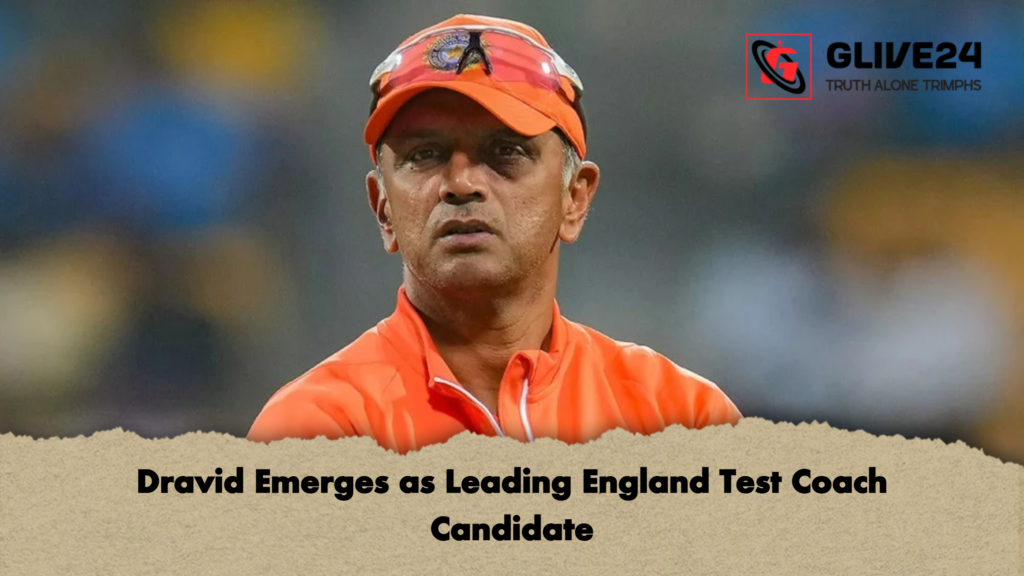
The England and Wales Cricket Board (ECB) has begun its search for a new head coach for the men’s Test team following the end of Brendon McCullum’s tenure in the role. Among the leading candidates under consideration is former India captain and highly respected coach Rahul Dravid, whose reputation for developing players and his deep understanding of Test cricket have made him one of the strongest contenders for the position.
The coaching vacancy arose after England suffered a 2-1 home Test series defeat to New Zealand, a result that prompted the ECB to remove McCullum from his responsibilities with the red-ball side. Despite losing the Test role, McCullum continues to retain the board’s confidence in white-ball cricket and will remain in charge of England’s One-Day International and Twenty20 International teams.
Reports suggest that the ECB has already compiled a shortlist featuring several experienced international coaches, with Dravid attracting significant attention. Widely known as “The Wall” during his illustrious playing career, the former Indian batting great earned global admiration for his patience, technical excellence and remarkable consistency at the crease. Those same qualities have carried over into his coaching career, where he has established himself as one of the most respected figures in world cricket.
Dravid’s coaching credentials are particularly impressive. During his tenure as India’s head coach, the team won the 2024 ICC Men’s T20 World Cup, ending a lengthy wait for a global title. Under his leadership, India also reached the final of the 2023 ICC World Test Championship, reinforcing his reputation as a coach capable of preparing teams for the highest level of competition across different formats.
Following his departure from India’s national team, Dravid indicated that he was no longer interested in taking on a year-round, full-time coaching commitment. He explained that spending more time with his family and maintaining a healthier work-life balance had become a priority after several demanding years in international cricket.
According to reports, the ECB is aware of Dravid’s preferences and is exploring whether the Test coaching role could be structured with greater flexibility. Unlike the white-ball calendar, the Test schedule often allows for longer breaks between series, potentially enabling Dravid to spend substantial periods in India while still fulfilling his coaching responsibilities. Such an arrangement could satisfy both the ECB’s desire to appoint an elite coach and Dravid’s wish to avoid an all-year-round commitment.
Should the appointment materialise, Dravid would become the first Indian to serve as England’s men’s national Test head coach. Given the rich and often fiercely contested cricketing rivalry between England and India, such a move would be historically significant. It would also reflect the increasingly global nature of modern cricket coaching, where experience, tactical expertise and leadership qualities frequently outweigh nationality in recruitment decisions.
Dravid, however, is far from the only name under consideration. Former England coach Andy Flower, who previously enjoyed considerable success during his spell in charge of the national side, is reportedly among the candidates. Other names linked with the vacancy include former England spinner Richard Dawson, ex-England all-rounder Andrew Flintoff, Sri Lankan great Kumar Sangakkara, former New Zealand head coach Mike Hesson and former Australia coach Justin Langer. Each brings extensive international experience and a distinct coaching philosophy.
The ECB now faces one of its most important appointments in recent years. England’s recent Test performances have raised concerns over batting consistency, tactical planning and the effectiveness of the bowling attack. The board is seeking a coach capable of rebuilding confidence, improving long-term performance and guiding the team back towards sustained success in the longest format of the game.
Attention will now turn to the ECB’s final decision and, perhaps more importantly, whether Dravid is prepared to consider what would be one of the most intriguing coaching opportunities in contemporary international cricket.