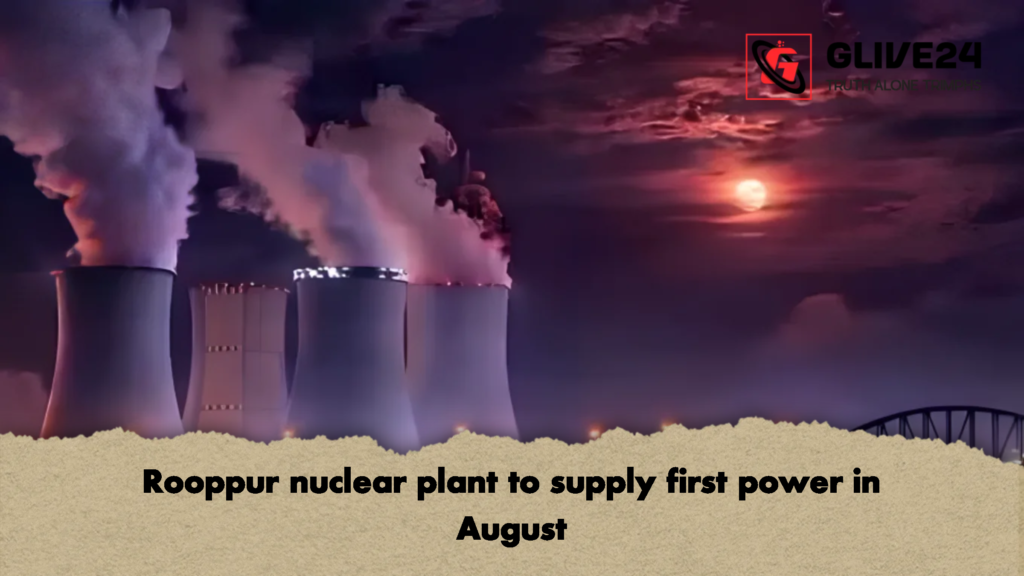
Bangladesh’s ambitious march towards atomic energy is on the verge of a historic breakthrough, with the Rooppur Nuclear Power Plant scheduled to deliver its first 300 megawatts of electricity to the national grid on a trial basis by late August. Fakir Mahbub Anam, the Minister for Science and Technology, announced the milestone, indicating that the output from the first unit is expected to climb steadily to cross the 1,000-megawatt mark by December this year.
This initial power injection represents a critical stepping stone towards full commercial operation. Dr Md Zahedul Hassan, Managing Director of the Nuclear Power Plant Company Bangladesh Limited (NPCBL)—the state-run entity tasked with operating the site—clarified that the first unit is projected to commence full commercial generation at the start of 2027. The second unit is anticipated to follow in early 2028, systematically bringing the country’s largest infrastructure project to its peak potential.
Strict global oversight ensures robust safety
The run-up to the plant’s trial phase has drawn intense scrutiny regarding its operational safety, emergency preparedness, and the handling of hazardous radioactive materials. Addressing these public and media concerns directly, Dr Hassan pointed out that the facility operates within a highly regulated ecosystem and is not governed by any singular entity.
Crucially, the commissioning process is being monitored by several international and domestic watchdogs. Operations comply with the strict guidelines laid down by the International Atomic Energy Agency (IAEA) and are supervised jointly by Rostechnadzor, Russia’s independent federal environmental regulator, and the Bangladesh Atomic Energy Regulatory Authority (BAERA). In addition, VO Safety, a highly regarded German technical audit group, is conducting independent safety checks at every phase of the project’s commissioning to guarantee that nothing is left to chance.
Local expertise and spent fuel resolution
-
Human Capital Development: Over the past decade, Bangladesh has invested heavily in creating a specialised workforce to manage the facility. Hundreds of local engineers and technicians have completed rigorous, long-term training programmes in Russia to ensure they meet strict international operating standards. Working hand-in-hand with Russian specialists, the NPCBL team is fully prepared to take over the day-to-day operations of the plant.
-
The Spent Fuel Agreement: Public anxiety over the disposal of highly radioactive waste has been resolved through a formal treaty signed with the Russian Federation. Under this bilateral agreement, Russia will take back all spent fuel generated by the plant.
-
The Cooling Process: According to international safety protocols, used fuel rods cannot be transported immediately upon extraction. They will first be cooled down in Rooppur’s heavily shielded, on-site storage pools until their thermal and radiation levels drop sufficiently. Once safe, they will be transported back to Russia, ensuring no long-term environmental hazards remain in Bangladesh.
The Rooppur facility, situated on the banks of the Padma River in Pabna, houses two advanced Russian VVER-1200 reactors. These Generation III+ units are equipped with passive safety mechanisms designed to automatically secure the plant in the event of extreme natural disasters. Once both units are fully operational, they will feed a combined 2,400 megawatts of stable, low-carbon power into the national grid, significantly reducing the country’s carbon footprint and dependence on imported fossil fuels.