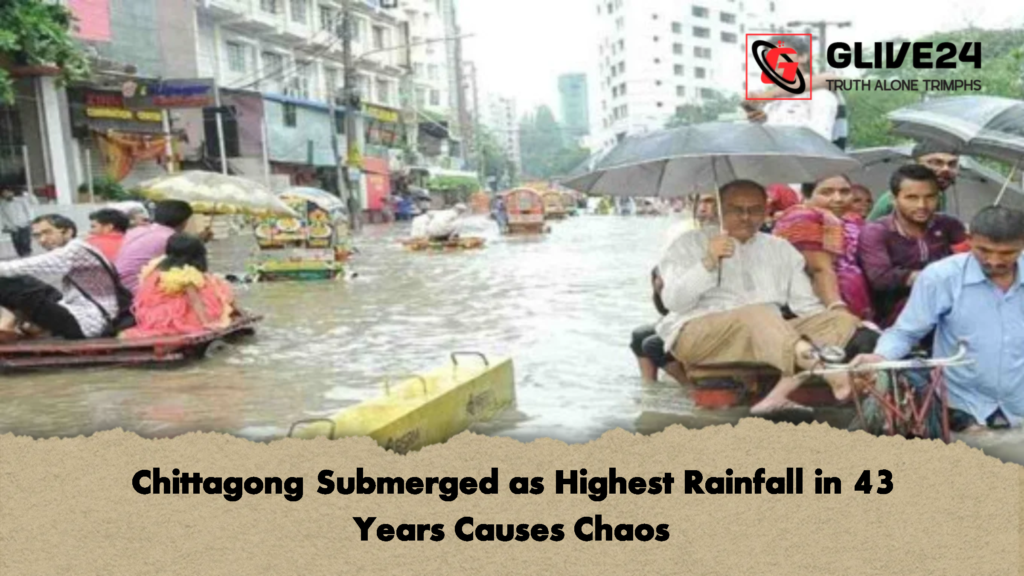
A catastrophic monsoon system has brought the strategic port city of Chittagong to a virtual standstill, shattering a 43-year-old rainfall record and triggering widespread infrastructure failures. The extreme weather has claimed at least one life, suspended vital regional rail services, severely disrupted maritime commerce, and forced the diversion of international flights. Emergency services are operating under immense duress as local administrators face intense public scrutiny over failing flood-mitigation infrastructure.
According to the Patenga Meteorological Office, Chittagong recorded a monumental 412 millimetres of rainfall in the 24 hours leading up to 3:00 pm on Tuesday, 7 July. Assistant Meteorologist Suman Saha confirmed that this figure eclipses the previous historical benchmark of 411 millimetres, registered on 4 August 1983. In a subsequent update, the Bangladesh Meteorological Department stated that the 24-hour total ending at 6:00 pm stood at 394.3 millimetres, validating it as the heaviest spell of the current season. Driven by an active monsoon system and an associated low-pressure zone, authorities have hoisted local cautionary signal number three at the sea ports and warned of impending tidal surges and river flooding.
Severe Disruption to Transport and Maritime Commerce
The sheer volume of water has paralysed the region’s transport network. Sections of the newly developed Chittagong-Cox’s Bazar railway line were completely submerged, forcing railway authorities to suspend all train operations along the route. The suspension left nearly a thousand passengers stranded at various stations aboard the high-profile ‘Tourist Express’ and ‘Probal Express’ services.
Air travel suffered a similar fate. Due to poor visibility and hazardous landing conditions at Shah Amanat International Airport, aviation authorities were forced to divert three flights—two international and one domestic—to Dhaka.
Beyond public transit, the economic engine of the nation has taken a direct hit. Out in the turbulent waters of the Bay of Bengal, cargo operations have broken down entirely. Port officials confirmed that offloading and loading activities for 43 commercial vessels anchored at the outer anchorage of the Chittagong Port have been completely suspended. The closure of these maritime operations threatens to disrupt supply chains across the country if the adverse weather persists.
Human Toll and Infrastructure Under Fire
The human cost of the deluge manifested tragically in the city’s East Nasirabad neighbourhood. A retaining wall collapsed under the weight of the waterlogged earth, killing a local fish trader named Shafikul Rahman. Three other members of his immediate family sustained injuries in the same incident and were rushed to hospital.
In response to the escalating danger, the district administration has deployed teams across 26 highly vulnerable hillsides. Officials are using megaphones to warn residents of imminent landslide risks, conducting forced evictions to move families into emergency shelters. Concurrently, the Chittagong City Corporation has mobilised its 101-member ‘Rapid Response Team’ to handle urban rescues and clear blocked water channels.
The sheer scale of the inundation, which has left low-lying residential and commercial districts submerged under knee-to-waist-deep water, has sparked public outrage. Residents are openly questioning the efficacy of the city’s mega-projects aimed at mitigating waterlogging. These initiatives, which collectively swallowed a massive 104.08 billion taka in public funds, have seemingly failed to prevent the port city from drowning under this historic downpour.