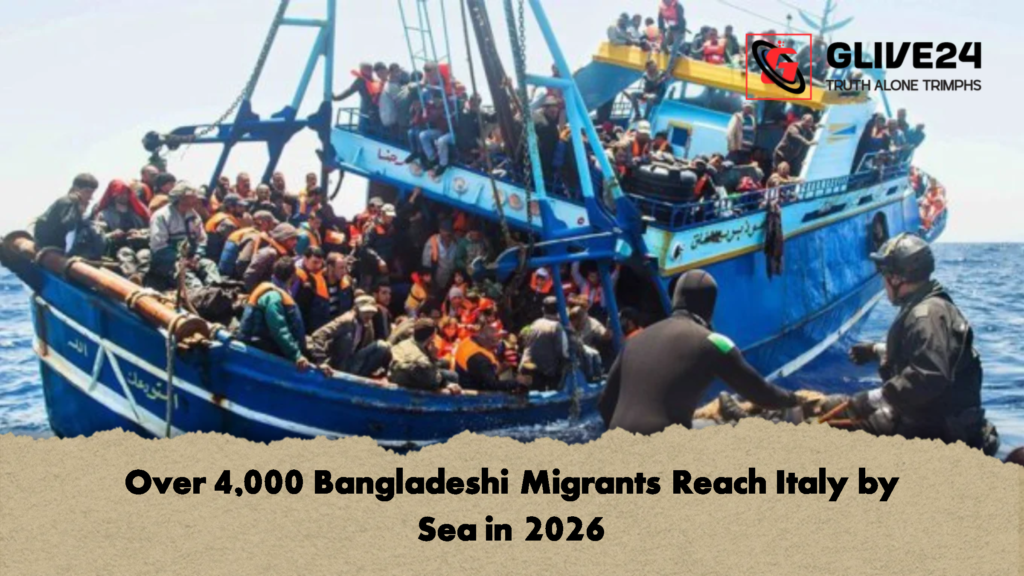
The total number of migrants arriving in Italy by sea has dropped drastically compared to the last two years, yet Bangladeshi nationals remain the single largest group risking the treacherous Mediterranean crossing. Official data underlines a shifting landscape in irregular migration routes to Europe, characterised by tighter enforcement and evolving transit dynamics, even as economic and social pressures continue to drive departures from South Asia.
According to data released by the Italian Ministry of Interior, captured up to 8:00 am on 7 July 2026, a total of 14,623 migrants reached Italian shores via the Mediterranean Sea since 1 January. This marks a substantial decline in maritime arrivals compared to the same period in previous years. In 2025, Italy recorded 31,430 arrivals by the first week of July, while the figure stood at 26,664 in 2024. The 2026 influx represents a 53 per cent reduction from 2025 and a 45 per cent decrease compared to 2024. Monthly breakdowns for 2026 show steady but lower volumes: 1,457 in January; 2,510 in February; 2,150 in March; 2,459 in April; 3,054 in May; and 2,758 in June.
Nationality Breakdown Positions Bangladesh at the Apex
Despite the overall reduction in arrivals, Bangladeshis constitute nearly one-third of all migrants arriving in Italy by sea this year. Between 1 January and 7 July, some 4,314 Bangladeshi nationals successfully made the crossing, outnumbering arrivals from any other single country.
The data illustrates a diverse diaspora of nationalities utilising the central Mediterranean route, primarily departing from the North African coastline. While South Asian nationals from Bangladesh and Pakistan form a significant portion of the irregular influx, the majority of the remaining cohorts originate from sub-Saharan and East African nations. The Italian Ministry of Interior noted that these statistics are subject to minor adjustments as formal identification procedures continue for recently arrived individuals.
Comprehensive Data of Migrant Arrivals by Country of Origin
The following table provides a detailed breakdown of the 14,623 migrants who arrived on Italian shores during the first half of 2026, categorised by their registered country of origin.
| Position | Country of Origin | Number of Migrants |
| 1 | Bangladesh | 4,314 |
| 2 | Somalia | 1,702 |
| 3 | Sudan | 1,371 |
| 4 | Pakistan | 1,185 |
| 5 | Algeria | 1,106 |
| 6 | Egypt | 936 |
| 7 | Eritrea | 662 |
| 8 | Tunisia | 626 |
| 9 | Mali | 310 |
| 10 | Nigeria | 291 |
| 11 | Ivory Coast | 216 |
| 12 | Ethiopia | 199 |
| 13 | Iran | 183 |
| 14 | South Sudan | 180 |
| 15 | Guinea | 179 |
| — | Other Nationalities (including unidentified) | 1,163 |
The prominent position of Bangladesh in these statistics highlights the complex networks of human smuggling that connect South Asia to North African transit hubs like Libya and Tunisia. Migrants often endure lengthy, dangerous overland journeys before attempting the final maritime crossing to cross the European Union’s southern border. While international partnerships and stricter coastal patrolling have successfully suppressed the overall volume of crossings this year, the lure of economic opportunities in Europe continues to sustain the flow of irregular migrants from the global south.