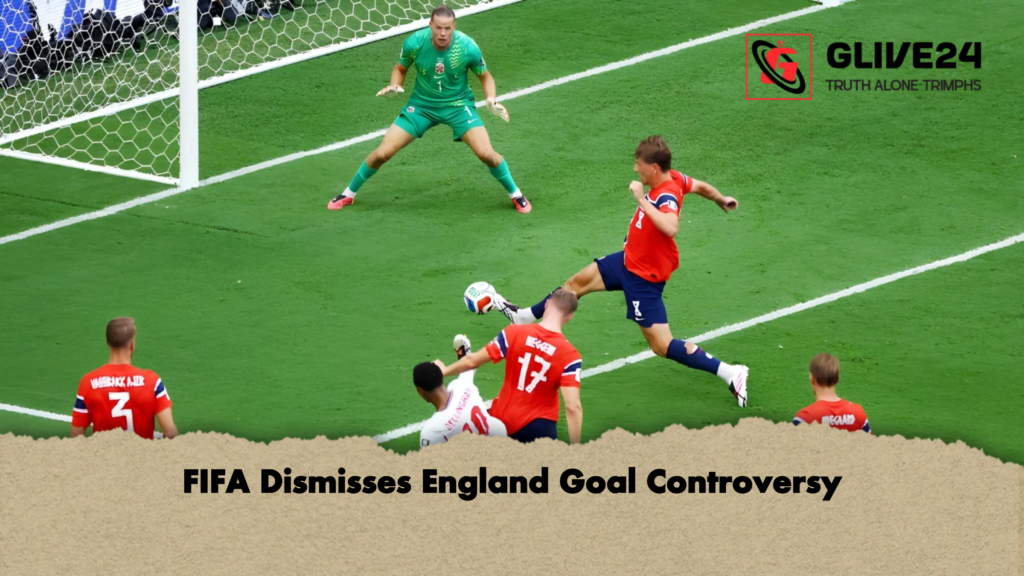
FIFA has rejected claims that England’s controversial equaliser against Norway in the World Cup quarter-final should have been disallowed, stating that there is no evidence the ball struck an overhead camera cable before the goal was scored.
The incident occurred during England’s 2-1 victory at Hard Rock Stadium, where Jude Bellingham found the net in first-half stoppage time to level the score at 1-1. The goal immediately sparked protests from Norway’s players, who argued that the attacking move should have been halted because the ball had allegedly made contact with one of the stadium’s suspended camera wires.
The disputed sequence began with a goal-kick from Norwegian goalkeeper Ørjan Nyland. Television footage appeared to show the ball unexpectedly changing direction while travelling through the air before falling to England midfielder Elliot Anderson. The move continued without interruption and eventually ended with Bellingham’s equaliser.
Under the Laws of the Game, play is stopped and restarted with a dropped ball if the ball touches an outside agent, including certain fixed objects above the pitch, and that contact affects play. The apparent change in the ball’s flight therefore prompted immediate questions from players, supporters and television commentators, with many calling for the incident to be reviewed.
In a statement issued on Saturday, FIFA said its technological review found no evidence to support those claims. According to the governing body, the connected match ball, fitted with an internal motion sensor, detected no indication that the ball had struck the overhead camera cable at any stage of the move.
FIFA explained that the sensor continuously monitors the ball’s movement and records subtle changes whenever it comes into contact with a player or another object. The data from the incident showed no unusual variation in the ball’s movement signature, often referred to by the system as its “heartbeat”, while the ball was in flight before England’s goal.
The organisation added that the same connected-ball technology had previously been used earlier in the tournament when reviewing an incident involving a disallowed goal in Croatia’s knockout match against Portugal. That earlier case demonstrated the system’s ability to identify significant ball contacts with a high degree of precision.
Addressing the specific incident against Norway, FIFA said the sensor data recorded at the 45+2-minute mark showed no abnormal readings that would indicate contact with an overhead cable. As a result, the governing body concluded there was no technical or scientific evidence that the ball’s trajectory had been altered before reaching Anderson.
FIFA’s clarification is intended to settle the debate surrounding one of the most discussed moments of the quarter-final. Although the decision has continued to generate discussion among supporters and analysts, the governing body maintains that the available technological evidence fully supports the validity of England’s equalising goal.