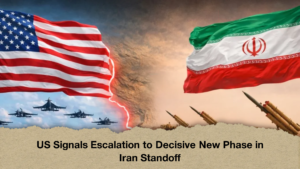
Global oil markets have reacted with renewed concern following fresh US military strikes on Iran, with crude oil prices moving higher amid fears that escalating tensions could prolong the conflict and delay the normalisation of shipping operations through the strategic Strait of Hormuz.
Market sentiment weakened as expectations of a swift resolution to the crisis faded. The Strait of Hormuz, a vital maritime route connecting the Persian Gulf with global markets, remains a key focus for energy traders because a significant share of the world’s oil shipments passes through the waterway. Any disruption to shipping activities in the region could create further uncertainty over global energy supplies.
According to data reported by British news agency Reuters, Brent crude, the international benchmark for oil prices, rose by 78 cents, or around 1 per cent, reaching 78.80 US dollars per barrel by 00:54 GMT.
Meanwhile, US West Texas Intermediate (WTI) crude also recorded gains. The benchmark increased by 74 cents, or 1.01 per cent, to reach 74.26 US dollars per barrel.
The rise in oil prices came after the latest military developments between Washington and Tehran intensified concerns over regional stability. Investors have been closely monitoring the situation, particularly because prolonged tensions in the Middle East could affect transportation routes, production facilities and wider energy markets.
The latest US strikes also resulted in casualties in Iran. Iran’s state-run news agency IRNA reported that eight Iranian military personnel were killed in attacks carried out by US forces in the country’s south on Wednesday (8 July).
According to the report, those killed were members of Iran’s air and naval forces. The strikes reportedly targeted areas around Bandar Abbas and Bushehr, two strategically significant locations in southern Iran. Bandar Abbas, located near the Strait of Hormuz, hosts important naval facilities and plays a major role in Iran’s maritime operations.
In response to the US attacks, Iran claimed it had carried out retaliatory strikes against key US military facilities in Kuwait and Bahrain. The Islamic Revolutionary Guard Corps (IRGC) announced the operation.
In a statement broadcast by Iran’s state media outlet IRIB, the IRGC said its naval and aerospace forces had jointly launched missile and drone attacks as the first stage of what it described as a “punitive response” to the US military action.
The IRGC claimed that the targets included Camp Arifjan and Ali Al Salem air base in Kuwait, along with the Juffair and Sheikh Isa military facilities in Bahrain. However, details regarding the extent of damage or casualties from these reported attacks were not immediately confirmed by the governments of Kuwait or Bahrain.
The latest exchange of attacks has increased uncertainty over diplomatic efforts aimed at reducing tensions between Iran and the United States. Analysts warn that continued military escalation could have consequences beyond the region, particularly for global oil markets and international trade.
Energy markets are expected to remain sensitive to further developments, with traders closely watching the security situation around the Strait of Hormuz and any potential impact on global crude supplies.