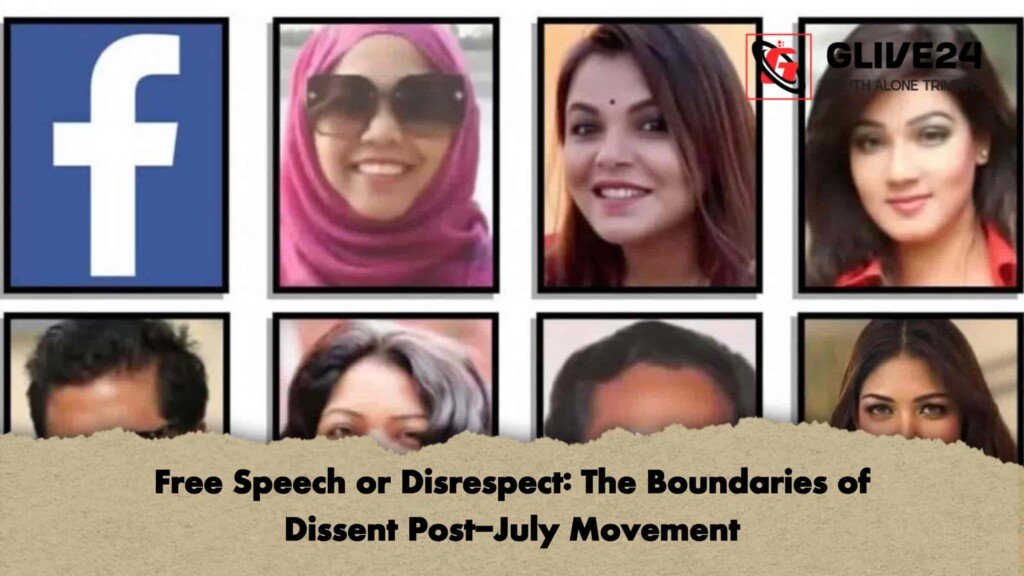
A formal written complaint has been lodged at the Shahbagh Police Station in Dhaka against several high-profile individuals—including prominent journalists, television presenters, actresses, models, and lawyers—over social media commentary regarding the July popular uprising. The complainants allege that the accused have questioned the legitimacy of the July movement, demeaned the martyrs and the injured, spread misinformation, and attempted to rehabilitate a banned political outfit.
The police have confirmed that the allegations have not yet been registered as a formal criminal case. Authorities stated that legal action would only be initiated following a thorough verification of the social media posts, video clips, and hyperlinks cited in the complaint. Journalists and human rights defenders have expressed strong reservations, cautioning that criminal litigation should never be deployed as a tool to suppress purely political expression, which remains a cornerstone of a democratic society.
Table of Contents
Cyber Investigation Instigated
According to police sources, the contentious digital material has been forwarded to the Cyber Unit of the Dhaka Metropolitan Police (DMP) for forensic evaluation. Investigators noted that before initiating formal charges, it is imperative to verify whether the accounts genuinely belong to the accused, determine if the audio-visual material has been edited or manipulated, and evaluate the holistic context of the remarks.
Md Moniruzzaman, the Officer-in-Charge (OC) of Shahbagh Police Station, confirmed the development:
“Since the allegations pertain strictly to cyber activity, the matter has been referred to the DMP’s Cyber Unit. Further legal measures will be determined entirely by the findings of their investigation.”
The written complaint was submitted on Sunday, 5 July, by Millat Hossain on behalf of a platform styled as the ‘State Dialogue Forum’. The complaint names:
-
Anis Alamgir (Journalist and Columnist)
-
Soma Islam (Television Presenter)
-
Jannatul Ferdous Peya, popularly known as Peya Jannatul (Lawyer and Model)
-
Momin Mehedi (Columnist)
-
Maria Kispotta (Model)
-
Tusti (Actress and Model)
This follows a prior general diary lodged against prominent actress Meher Afroz Shaon, film actress Mahiya Mahi, and Shanta Farjana, who were similarly accused of mocking the July mass uprising, disrespecting monuments, and disseminating misleading statements.
Specific Allegations Levied Against the Accused
The complainants have detailed specific grievances against each individual, asserting that their public pronouncements, television talk-show appearances, and social media activity sought to trivialise the historic movement:
-
Soma Islam: Accused of demeaning the July movement during televised talk-shows and actively seeking to rehabilitate the banned Awami League.
-
Peya Jannatul: Alleged to have used derogatory language regarding those injured in the uprising, mockingly categorising the demonstrators as a “mob”.
-
Momin Mehedi: Faced accusations of hurling shoes at a July memorial monument and making offensive remarks about the iconic martyr, Abu Sayed.
-
Anis Alamgir: Accused of collaborating with banned affiliates of the Awami League post-release from prison to undermine the movement, whilst allegedly insulting those who suffered amputations or lost their sight.
-
Maria Kispotta: Alleged to have framed the July uprising as a terrorist campaign and issued threatening, misleading statements regarding the injured.
-
Tusti: Accused of branding July as a “month of deception” and claiming that no individuals were martyred during the mass upheaval.
-
Meher Afroz Shaon, Mahiya Mahi, & Shanta Farjana: Shaon is accused of characterizing the uprising as a “staged drama”, Mahi is alleged to have satirised the participating organisations, and Farjana is accused of desecrating a July monument.
Tariqul Islam, Deputy Commissioner (South) of the DMP’s Cyber and Special Crime Division, stated that whilst the paperwork had not yet reached his desk, his department would execute a meticulous verification of all digital footprints once received.
Contextual Background: The Fractured Narrative
The controversy emerges from the deeply polarised political landscape of Bangladesh following the tumultuous events of mid-2024, colloquially referred to as the July Revolution or the July Mass Uprising. The movement, which began as a student-led protest against a controversial quota system in public service recruitment, rapidly evolved into a nationwide anti-authoritarian struggle, ultimately leading to the dissolution of the Awami League-led administration.
In the aftermath, an interim administration headed by Nobel Laureate Professor Muhammad Yunus assumed governance, tasked with restoring democratic institutions and state stability. However, the transitional period has seen acute tension between the zeal to protect the sanctity of the revolution and the democratic imperative to preserve absolute freedom of speech. Critics argue that accusing dissenters of “disrespecting July” is increasingly being weaponised to stifle legitimate political critiques of the interim administration’s performance.
Perspectives on Free Speech and Incitement
The accused journalist, Anis Alamgir, robustly defended his position, dismissing the complaints as politically motivated fabrications designed for cheap publicity.
“I have never demeaned the July movement or its martyrs; on the contrary, I have consistently spoken out against those who disrespect their sacrifice. My critiques are directed solely at the misgovernance under Dr Yunus, and the vigilantism, extortion, and undemocratic behaviour of certain individuals using the ‘July’ banner as a shield. If criticizing these elements is branded as disrespecting the revolution, it is nothing short of a cynical attempt to suppress the truth.”
Senior journalist Masud Kamal offered an analytical distinction between illegal incitement and protected political speech. He observed that whilst calls to physical violence or vigilantism constitute unambiguous criminal offenses that warrant state intervention, subjective political opinions must remain unpunished.
“If an individual expresses an opinion that the expectations of the July movement have not been realised, that is a legitimate political viewpoint. Conversely, if someone calls for an individual’s house to be burnt down under the pretext of them being ‘anti-July’, that passes into criminal incitement. The state must decouple political critique from violence.”
Human rights advocate Abu Ahmed Faijul Kabir emphasised that in a resilient democracy, controversial or offensive opinions should be countered with superior logic, facts, and intellectual debate, rather than immediate legal retaliation. He warned that using the state’s punitive apparatus against professionals risked fostering a culture of self-censorship, which would ultimately imperil the democratic transition.
Echoing these concerns, Ejajul Islam, Executive Director of the Human Rights Support Society (HRSS), urged mutual restraint. While acknowledging that public sensitivities surrounding the dead and injured are understandably acute, he reiterated that freedom of expression is a constitutionally guaranteed fundamental right. He concluded that resorting to police complaints and intimidation to counter unpalatable opinions would invariably contract the civic space necessary for a free society.