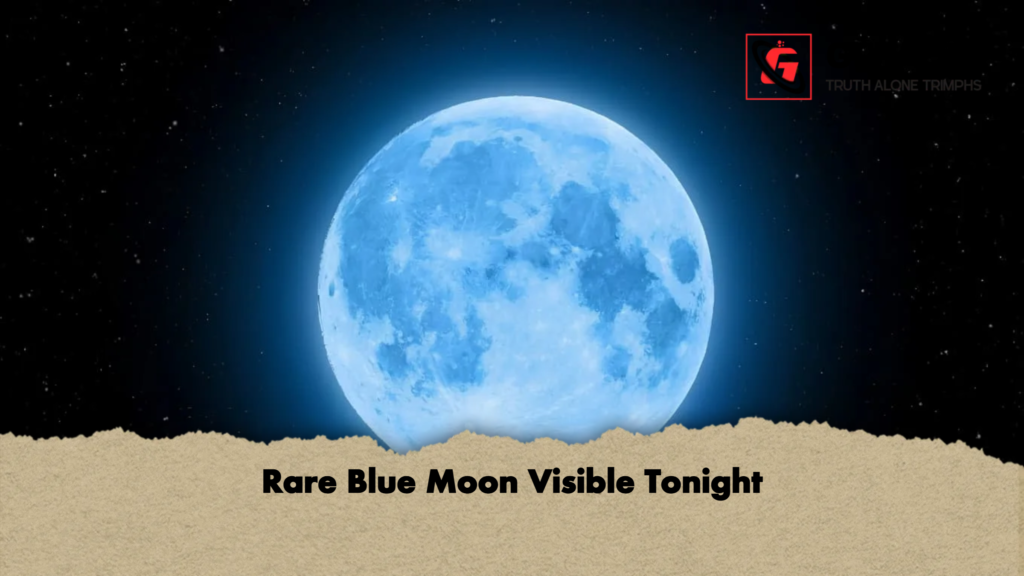
For skywatchers across Bangladesh and much of the world, Sunday night (31 May) is set to feature the rare astronomical phenomenon known as a “Blue Moon”. According to the United States space agency NASA, weather permitting, millions of people across Asia, Australia, Europe and the Americas will be able to observe the event directly in the night sky.
Astronomers describe a Blue Moon as a relatively uncommon occurrence. The most recent example took place in August 2023, when two full moons appeared within the same calendar month. After a gap of nearly three years, the phenomenon is returning, offering another opportunity for observers to witness this distinctive lunar event.
Despite its name, a Blue Moon does not appear blue in colour. Instead, the Moon will retain its usual silvery-white appearance and may take on golden hues when viewed near the horizon. In astronomical terminology, a Blue Moon refers to the second full moon occurring within a single month of the Gregorian calendar.
The event arises because the Moon’s synodic cycle—the period between successive full moons—is approximately 29.5 days long. As a result, calendar alignment occasionally allows two full moons to occur in the same month. Such events generally recur every two to three years and can occur up to seven times within a 19-year cycle.
The expression “once in a blue moon” has historical roots in Western culture, where it was used to describe something rare or unusual. The term later became associated with this specific lunar event. There have, however, been rare instances in history when the Moon appeared genuinely blue. One notable example followed the catastrophic 1883 eruption of Indonesia’s Krakatoa volcano, when large quantities of dust and sulphur particles entered the atmosphere, temporarily altering the Moon’s appearance for observers in various parts of the world.
A particularly notable feature of the 31 May event is that it also qualifies as a “Micro Moon”. A Micro Moon occurs when a full moon coincides with the Moon being near apogee—the point in its elliptical orbit where it is farthest from Earth.
On this occasion, the Moon is positioned approximately 406,093 kilometres (252,334 miles) from Earth. This is considerably farther than the Moon’s average distance of around 384,400 kilometres.
Key Facts About the Event
| Feature | Details |
|---|---|
| Event | Blue Moon |
| Date | 31 May |
| Additional Classification | Micro Moon |
| Distance from Earth | Approximately 406,093 km |
| Average Lunar Distance | Approximately 384,400 km |
| Apparent Size | About 10% smaller than a typical full moon |
| Viewing Equipment Required | None |
| Previous Blue Moon | August 2023 |
| Next Blue Moon Expected | 31 December 2028 |
Scientists state that this will be the most distant and smallest full moon of 2026. Because of its greater distance from Earth, the Moon is expected to appear around 10 per cent smaller than an average full moon. However, the difference is subtle and may not be readily noticeable to casual observers viewing it with the naked eye.
While observers in parts of Europe and North America saw the Moon reach its fullest phase on the night of 30 May, viewers in Bangladesh and elsewhere across Asia are expected to see it at its brightest and fullest on Sunday night, 31 May.
Meteorologists and astronomers note that no special telescope, protective eyewear or expensive equipment is required to observe the event safely. The Moon can be viewed comfortably with the naked eye.
Particularly during the early evening, when the Moon is close to the horizon, atmospheric conditions may cause it to appear orange or golden in colour. This effect is often most noticeable between approximately 5:30 pm and 6:30 pm and can provide favourable conditions for photography.
Astronomers have also noted that, following this event, another Blue Moon is not expected to occur until 31 December 2028, making this a comparatively rare opportunity to observe the combination of a Blue Moon and a Micro Moon in the same full-moon event.