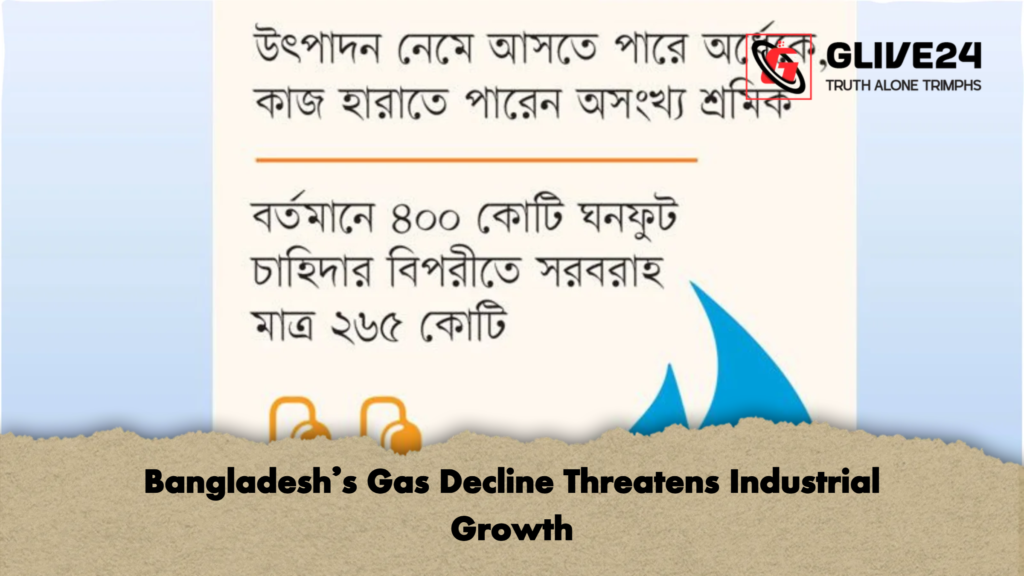
Bangladesh’s industrial sector is facing mounting uncertainty as production from the country’s domestic gas fields continues to decline, raising fears of a prolonged energy shortage that could significantly disrupt manufacturing over the coming years. Energy experts, industry representatives and officials warn that unless effective measures are implemented swiftly, hundreds of factories may be forced to reduce production or suspend operations altogether between next year and 2028.
The consequences could extend well beyond individual businesses. A sustained gas shortage is expected to affect employment, export earnings, manufacturing costs and the wider economy at a time when Bangladesh continues to pursue industrial expansion and export-led growth.
Industrial zones across the country are already experiencing a noticeable deterioration in gas supply. Major manufacturing hubs, including Gazipur, Ashulia, Tangail, Chandra, Rajendrapur, Dhanua and Konabari, have reported persistently low gas pressure, leaving many factories unable to secure the fuel required for uninterrupted operations. Some manufacturers have been compelled to slow production lines, while others are operating for fewer hours than planned. Residential consumers in several parts of the capital are also experiencing extremely low gas pressure, causing disruptions to everyday household activities such as cooking.
Shahnewaz Parvez, Managing Director of Titas Gas Transmission and Distribution Company, said gas pressure has been declining on a daily basis. He warned that if the trend continues, industrial users, commercial establishments and residential consumers will all face increasingly severe difficulties. According to him, the matter has already been raised with senior levels of government through various official forums.
Industry sources say the situation became even more acute after approximately 70 million cubic feet of additional gas per day was recently allocated to electricity generation. While the move aimed to strengthen power supply, it further reduced gas availability for industries, forcing many manufacturers either to curtail production or consider switching to more expensive alternative fuels.
Bangladesh’s current daily demand for natural gas stands at around 4 billion cubic feet. However, the country is supplying only about 2.656 billion cubic feet per day, leaving a substantial supply gap. Of this available supply, nearly 1.032 billion cubic feet comes from imported liquefied natural gas (LNG), highlighting the country’s growing dependence on overseas energy sources. This increasing reliance also exposes Bangladesh to fluctuations in global LNG prices and international market conditions.
Within the service area of Titas Gas alone, more than 4,500 industrial facilities and captive power plants are connected to the gas network. Industry stakeholders estimate that several hundred of these factories are already facing production constraints because they cannot obtain adequate gas supplies.
The shortage is also affecting future industrial investment. Government reports indicate that around 550 industrial enterprises remain on waiting lists for gas connections despite having already paid the required demand note fees. At the same time, applications from approximately 1,300 additional prospective industrial projects have yet to be processed. Providing gas connections to these nearly 1,800 industries would require more than 400 million cubic feet of additional gas per day.
According to Petrobangla, domestic gas production has been declining year after year, while demand continues to rise steadily due to expanding industrialisation, electricity generation and urban development. If the current trend persists, total gas supply is projected to fall to approximately 2.607 billion cubic feet per day by June next year and decline further to around 2.57 billion cubic feet by 2028. During the same period, national demand is expected to exceed 5 billion cubic feet per day, widening the gap between supply and consumption.
Government projections also paint a worrying picture for domestic production. Although Bangladesh currently produces around 1.65 billion cubic feet of gas daily from local fields, output could fall to roughly 850 million cubic feet per day by the end of 2028, effectively reducing domestic production by nearly half within just a few years.
To address the growing deficit, the government plans to establish another floating LNG terminal by 2029, with the objective of adding approximately 600 million cubic feet of gas per day to the national grid. However, responsibility for implementing the project has yet to be finalised. Authorities are also planning to add around 210 million cubic feet of gas per day from Bhola and several other gas fields. A feasibility study is underway to assess the construction of a pipeline that would transport Bhola’s gas to other regions of the country, although no implementation timetable has been announced.
Petrobangla has also outlined plans to increase production by drilling additional wells across several gas fields. Yet previous efforts have produced limited results. Despite drilling more than 20 wells over the past four years, the organisation has been unable to secure an additional 50 million cubic feet of daily gas production.
Efforts to explore new offshore oil and gas reserves are progressing through international bidding processes, but officials acknowledge that meaningful production from those projects remains several years away. The stages of tendering, investor selection, contract negotiations, exploration, field development and eventual production make offshore exploration a long-term solution rather than an immediate answer to the current shortage.
The country’s major gas fields continue to record sharp production declines. Bibiyana, Bangladesh’s largest gas field, once produced around 1.2 billion cubic feet per day but now delivers only about 746 million cubic feet. Production at the Titas field has fallen from approximately 542 million to 327 million cubic feet per day. Habiganj has declined from 225 million to 102 million cubic feet, while Bakhrabad has dropped from 43 million to just under 20 million cubic feet. Moulvibazar’s production has fallen from 42 million to about 16 million cubic feet, and Bangura has declined from roughly 103 million to around 31 million cubic feet per day. Output from the Sylhet gas field has also decreased by nearly half.
Industry observers believe Bangladesh must accelerate investment in domestic gas exploration, expand drilling programmes, modernise transmission infrastructure and strike a more sustainable balance between imported LNG and indigenous production. Without timely policy decisions and substantial investment, the country’s industrial sector may face deeper operational challenges, with long-term implications for exports, employment, private investment and overall economic growth.